Burglars commit spate of plate thefts
At the last meeting of Chudleigh Writers’ Group we each selected a headline from a newspaper and wrote a short story bases on the headline. I worked on the above and produced this.
‘Where shall we go next,’ said Ada, as she poured a cup of tea from a white Doulton tea pot.It was one of her favourite’s, it was such an elegant shape enhanced by a thin line of decoration in green and gold.
‘I’m not sure,’ replied Elsie, crumbling a piece of fruit cake onto a plate bearing the crest of the Imperial Hotel Torquay. ‘We’ve done Burgh Island, Tresanton, that place in Penzance and the Royal in Jersey.’
Neither of them spoke for a few seconds, until Ada said, ‘You know I’d quite like to go up to London. Have a bit of adventure. There’s the Ritz, the Savoy…’ She paused while she thought of other hotels. ‘Brown’s. Isn’t that the place the Middletons’ stayed before the wedding? Lovely wasn’t it?’
‘What Brown’s? Have you been there?’
‘No, the wedding. I do like a good cry. And now there’s George. Sweet.’
‘Really Ada, pull yourself together. We’re trying to plan a serious raid on some of the top hotels in London; not going on a tourist trip. We need to do more than three. What about the Dorchester, Rubens and then there’s Park Lane.’
‘I don’t think I can eat that much cake.’
‘Surely you can two in an afternoon. If we go up by train one Tuesday, better to do mid-week I think. We could do two that afternoon. A bit of retail therapy … hang on what about plates from Harrods.’
‘Elsie, that’s brilliant. There’s Selfridges and Fortnum and Mason. Oh Fortnum’s, one of my favourites. It’s where I met Harold.
‘I didn’t know that. One of those ‘Brief Encounter’ moments in the tearoom?’
‘No, no, he was the lift attendant. We got stuck in the lift. Then he said he’d better make an honest women of me.
Elsie raised her eyebrows at the thought of hanky panky in the lift at Fortnum’s. ‘Back to our trip to the big city. Harrods first morning, two hotels in the afternoon. Then Selfridges for coffee, two more hotels after lunch. Fortnum’s just before we catch the train back. Quite a trip, two nights in London; train fares…you do have a railcard Ada?’
‘Yes, yes. We’ll need to dress up a bit. Perhaps we could do a musical as well. Make a real expedition of it.’
Elsie wasn’t paying attention. ‘We’ll need quite capacious handbags; three plates as well as purses, make-up and what ever other rubbish you normally carry.’
‘Not just me. You have all sorts of things in your handbag. Have you still got that fur, Elsie? You could wear that.’
‘I’m not sure. I have a nice coat I bought in Jaeger. In the sale mind you and it was ten years ago. Well retro’s in fashion isn’t it?’
She wasn’t expecting an answer.
‘It’s the bags I’m worried about. We’ve used shoppers and beach bags before. Can’t go to the Ritz in flip flops and carrying a beach bag. I don’t think I’ve got a leather bag big enough, Elsie.’
‘We’ll have to try the charity shops if we haven’t got anything in our wardrobes. This raid is taking some planning. We’ll have to book a table at the Ritz, I wonder how far ahead that will be. Still a few months will give us time for meticulous planning, getting our disguises in place. I’ll telephone now, shall I.’
‘Yes do,’ said Ada, sipping from her cup of tea.
‘
Winter Writing Retreat

Just returned from Abbey Dore Court in Herefordshire after attending a great weekend with a group of women writers on a retreat led by Lucy English and Rachel Bentham. Operating as Wordsmiths they had organised workshops, tutorials and discussions on writing and in particular on women’s attitudes to writing. The group comprised writers at all levels, but what a talented lot they were. Novels with great characters and covering many genres, including historical, crime, modern feminine. We acted out dialogue we’d written – we were really good at arguing in fiction.
We ate meals round the huge mahogany table in the dining room, had breakfast, mid morning coffee and afternoon tea snuggled round a light blue Aga, and finished the evenings round the wood burner in a former ballroom. We talked, played Actuality and read out our work.
Abbey Dore Court is a large quirky house close to the remains of Dore Abbey. A great place to hold a writers retreat. See http://www.thewordsmiths.org
Cover Spread
I have now reached the last stage in the preparation of my novel for publication. This week I have finally approved the cover spread; that’s the front and back cover and the spine. I say finally because initially not only was the word crucial 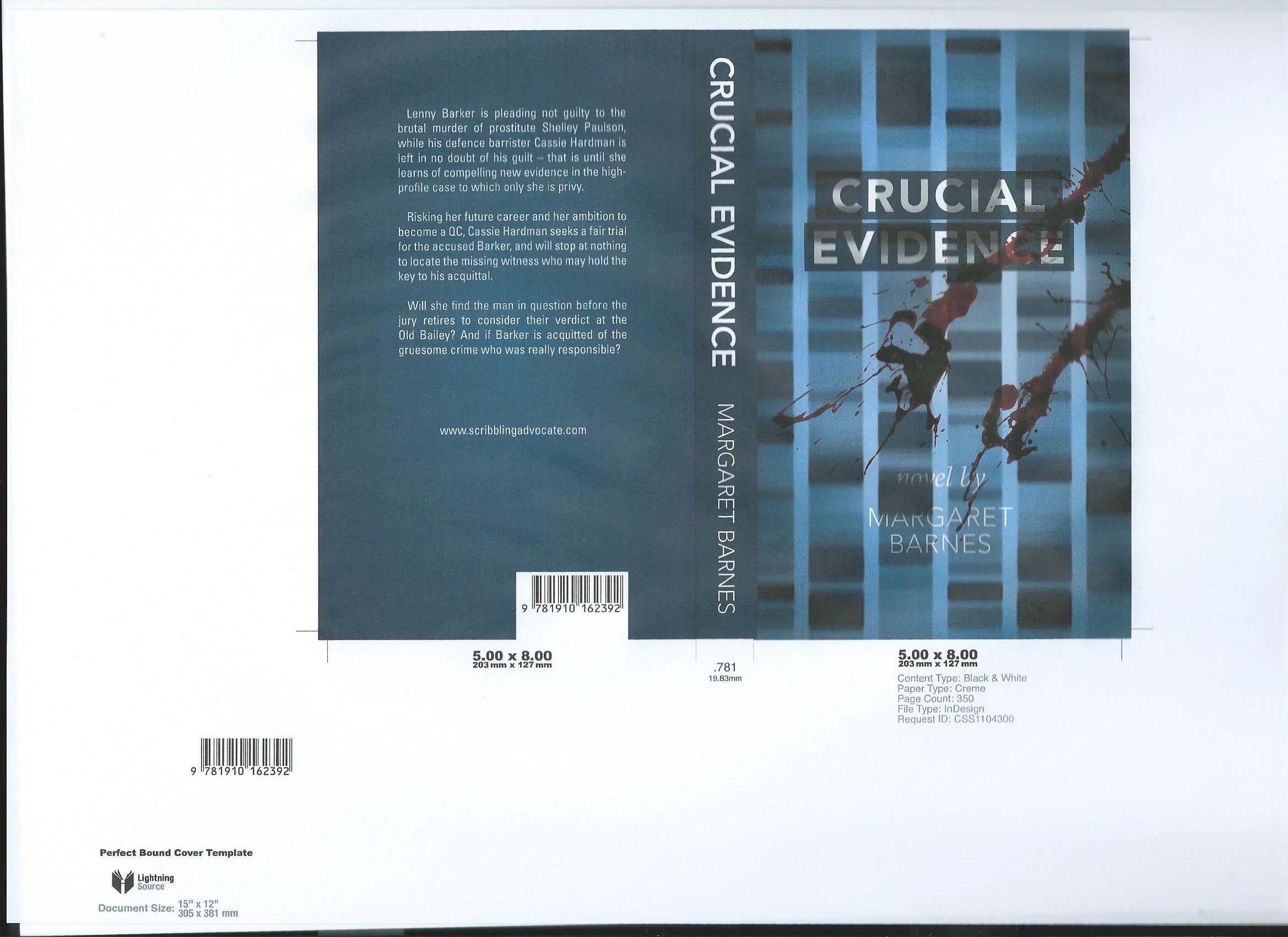 misspelt on the spine, but the designer was working on the basis that the novel was 250 pages whilst my printer’s proof was 350. I was puzzled by that, as I had assumed the proof was what it said it was and the novel would look like the copy I had. I realised as well, that if the width of the spine had been calculated on 250 pages rather than 350, then it wasn’t big enough. After a flurry of emails the cover designer acknowledged he had got the page count wrong and the width of the spine enlarged.
The next stage will be a copy of the book for me to approve before it is officially published. I’m hoping to have a launch party in London sometime in February.
Proof Reading and Cover Design
I have now agreed a proof copy of my novel Crucial Evidence to go to the printers and for the ebook formats. It took four copies to hopefully eliminate all the irritating typo’s, minor grammatical mistakes etc, before I was satisfied. My husband read the proof as well just to make sure – I was sure I was missing mistakes because I had read it so often.
He raised with me the question of hyphens as there were times when he thought I should have a hyphen between words for example cross examination. I checked the original copy edit and found that Lucy, the copy editor had taken them out.
I am currently reading ‘For Who the Bell Tolls’ by David Marsh, who edits The Guardian’s style guide. I consulted the book and discovered that the hyphen is going out of fashion. One reason is that the computer breaks up hyphenated words at the end of sentences. So, he says, if they are not needed to ensure the clarity of a sentence don’t use them. Incidentally the book is a good read as well as really helpful about rules of grammar they’re not as many you think – is the message.
The next stage with the book is completing the cover design and the blurb for the back. The front cover looks like this

I really like it – I hope everyone else does as well.
Publication should happen at the beginning of February 2012.
Best Wishes to all for the Festive Season and a Happy New Year.
London: Art and Shopping
Three days in my favourite place; I still find it exciting after all these years. And such a variety of things to do. First a dinner to support a former pupil of mine who is the Labour Candidate for Erewash (it’ s on the borders of Derbyshire and Nottingham, if you need to ask) then a trip to Peter Jones in Sloane Square, my old stomping ground. The swinging sixties had ended by the time I moved to Old Chelsea, but there were still art galleries and individual boutiques selling new designers creations and family owned restaurants and cafes, Picasso’s for a good Italian meal, Asterix selling crepes and Charlies for coffee. The Chelsea Drug Store was still a pub and not a McDonalds. Now it’s mainly the chain fashion stores so just another high street. I was glad to see the book shop John Sandoe was still going.
Today was much more interesting, Chiswick House Gardens because the dog needed a walk. It’s a wonderful mixture of woodland, cricket ground,

Chiswick House (1725-29) by Lord Burlington (Photo credit: Wikipedia)
miniature canal with a variety of ducks and geese on it, a beautiful Palladian house. or rather a pleasure palace and an orangery not with citrus fruit but a collection of camellias. Good cafe in the grounds as well; lots of other dog walkers and couples airing their children. Definitely worth a visit.
Then to the Royal Academy and a visit to Paris at the time of the Revolution. An exhibition of the works of Daumier. He is better known for his political caricatures in the UK but he painted the people of Paris going about their ordinary lives. I particularly liked a painting of a laundress with her daughter on the Ile St Louis, hard to believe it was a very poor area of Paris at that time.
Then one of the best places for Christmas presents, Fortnum & Mason’s. I know the food stuffs they sell are very expensive but they are so beautifully

English: image of the front of fortnum and mason in Picadilly. photographed in 2005 by Andrew Meredith (Photo credit: Wikipedia)
packaged that it’s worth paying the price. Those receiving tea or biscuits in such gorgeous tins feel they are getting a luxury item, rather than simply teabags or gingernuts.
And of course at this time of year the windows of Fortnum’s are dressed in their Christmas finery. This year they hark back to the 1950’s with figures of a family decorating the tree or cooking lunch on an Aga. If you are in London at this time of year then the windows of all the big department stores are enchanting. Just stroll round Oxford Street, Regent Street and Picadilly for a free show. Enjoy.
Age of Consent
Should the age of consent for sexual intercourse be reduced from 16? It’s a good question and I would say no, it shouldn’t. However I would add a caveat to that which is to acknowledge that many young people under the age of 16 are physically mature and that it is societies’ decision that they are not emotionally mature enough to indulge in

English: This map displays the legal age of consent for heterosexual sex in various countries. – puberty – less than 12 – 12 – 13 – 14 – 15 – 16 – 17 – 18 – 19 – 20 – 21+ – varies by state/province/region/territory – must be married – no law – no data available (Photo credit: Wikipedia)
sexual behaviour.
Also those aged between 14 and 16 rarely see themselves as children even if parents and the community at large do, and a number of them want to have intercourse whatever the law says. There are other things to consider as well, such as boys under 16 are children as well even though they are capable of having sex. (When I first qualified a boy of 14 was considered incapable of SI and therefore could not commit rape) Zoe Williams makes the same point in her article in todays Guardian. And as many parents know, often boys mature emotionally more slowly than girls (Isn’t that why girls and young women tend to have relationships with men a few years older than themselves?)
As in the case I outlined in my blog Serious Stuff, these cases are often more complicated than the press and media generally allow for in their condemnation of underage sex. I can think of a number of examples of cases where the girl was a willing participant in the sexual activity and was not a victim in any real sense of the word.
Writing Retreat

A La Ronde near Lympstone, Exmouth, Devon (Photo credit: Wikipedia)
I have just spent a whole day at the National Trust Property A La Ronde. The group was small; only four of us with a tutor from the University of Falmouth, Meredith Miller. We were given a tour of this strange sixteen-sided house built by two sisters, the Parminters, in 1797. The rooms are strangely shaped and filled with objects collected by the sisters as they travelled around Europe. And of course the shells they collected and used to decorate their home.
Meredith put the construction of the house in the context of events in the world of literature and politics and described the period as turbulent after the French Revolution of 1789. A La Ronde was for the Parminter sisters, the stillness in the storm.
When we came to write, I wanted to build on that phrase and write about ‘being still.’ I had just finished reading The Last Runaway by Tracey Chevalier about a young Quaker. In the novel Chevalier describes the Quaker meetings and how still Honor Bright, her main character is during these services. I thought it would be a good exercise to write about stillness. I have called my character Sophia and I pictured her sitting in the drawingroom where I was sitting and I tried to imagine what it would have been like.
‘Sophia sat still, very still. On her lap was a collection of shells she had gathered that morning. The clock ticked the seconds away. She heard the click of her mother’s knitting needles, the rustle of paper as her sister turned the pages of a novel. Then the clock chimed, one, two, three … up to eight.
Sophia felt the chair pressing against her back, the arms holding her arms. Looking down at the shells, her eyes lingered over them; the round pink pincushion of a sea urchin, the brown and white whelk shell and shiny bluish tinge of the clam shell. She wondered where they had come from. What tides, what winds had brought them to the beach below the house? Did those same winds blow over Robert, wherever he now was?’
Proof Reading
The route to publication has moved on another step. I have checked through the printers proof again. This time instead of doing it on the computer screen I printed a hard copy of my novel. There are 350 pages so I printed four pages using both sides of an A4 sheet of paper. It is beginning to look like a book, with an acknowledgements page and the publication details as well as the publication rights. I found only six changes needed making. I’m sure there are others but I’m missing them. I will get it returned to me again to check there are no more changes necessary. I do hope there are none, as I’m sure the law of diminishing returns sets in and I will fail to spot any mistakes in it.
I think the next version will have the front and back cover in place. We have yet to finalise the draft blurb, so that’s another step

Sculpture/fountain by Naum Gabo at Guy’s and St Thomas’s Hospital, London, U.K. (Photo credit: Wikipedia)
to get through. Interestingly I met a writer friend on Tuesday, who complained that the blurb for her book was written by the publisher and she was not consulted. One of the differences between traditional publishing and independent is the lack of control, once a writer has sold the publication rights, over the presentation of the novel to the public.
The same author expressed how dissatisfied she was with the marketing of her book. I am paying for a marketing campaign, so I do expect some publicity to be generated. The other job I had this week was to answer a questionnaire about my book which included providing another summary of the story and biography which included any media interest in my personal story. During my Twenty-five years at the Bar I did do a number of cases which attracted a great deal of publicity at the time, but most of it was some years ago. I thought two might still attract some media interest today.
The first was the killing of the fashion designer Ossie Clark by his lover Diego Cogolato. Ossie Clark was very successful designer in the 1960’s along with his then wife Celia Birtwell. There is a wonderful painting of them both by David Hockney in the National Portrait Gallery. By 1996 Ossie was living in a one bedroomed council flat in West London and Cogolato under the influence of a mixture of drugs killed him. He was diagnosed as suffering from a drug-induced psychotic state. He pleaded guilty to manslaughter and after I mitigated on his behalf he received a sentence of six years.
The other case featured in the newspapers only five years ago, when a young woman called Alex Griffiths was successful in her A level examinations. The Times, no doubt looking for a different angle to report on the announcement of the results chose to write an article about her, because as the baby she was stolen from St Thomas’s Hospital within hours of her birth. A nation-wide search followed, and she was found alive and well three weeks later. I represented the woman who stole her, coincidently also called Griffiths, Janet Griffiths. She too was diagnosed with mental health issues, in this case she had Munchausen’s, not the by- proxy type that has been much in the news over the last few years, but the original illness. She received a hospital order and was released after about eight months. She was to die about four year later of cancer. It is not often a barrister gets to know what happens to the victims and defendants in cases in which they appear, but I am pleased that on this occasion I did.
Serious Stuff
Listening to Radio 4 this morning and hearing Keir Starmer, the current DPP, I thought how unrealistic when he said that the behaviour of those complaining of sexual abuse should not be taken into account when deciding to prosecute.
I was defending a sixteen year old on a charge of raping a fourteen year old. She said he had come to her home, uninvited when her mother was out, and had dragged her into her bedroom and raped her. His case was that she had invited him to visit her and had taken him to her bedroom where they had sexual intercourse to which she had consented.

English: Engraving of Gilbert and Sullivan’s Trial by Jury. Français : Gravure basée sur Trial by Jury de Gilbert et Sullivan. (Photo credit: Wikipedia)
Now obviously no witnesses to the event, so how is a jury to decide who is telling the truth about the incident?
Let’s call them Joe and Lindy. They had met at their local youth club. Joe was a good-looking boy, doing well at school and hoping to go onto college. Lindy instantly took a fancy to him and followed him around all the time. The youth worker at the club, confirmed that she always made a bee-line for him when she came to the club, and he thought Joe found her a bit of a nuisance, but was too polite to tell her to go away.
After a few weeks she invited him home to the flat she shared with her mother. When Joe got there, Lindy’s mother had cooked dinner and the table was set for two. Lindy and Joe were left alone to enjoy a candle-lit supper. None of this was in the statements either Lindy or her mother had made to the police, but they admitted it was true when I cross-examined them. Joe said she had given him a note at the youth club inviting him to visit her on the evening in question. Again the youth worker confirmed Lindy had given him an envelope at the club. Something she denied.
A few nights after the alleged rape, Joe refused to talk to Lindy when another young woman who he liked came to the youth club. It was then that Lindy told her mother that he had raped her and her mother went to the police.
If you were on the jury, wouldn’t you like to have known all that? Wouldn’t you have asked yourself why Lindy kept all the background secret? Was it because she consented to the sexual intercourse? In order to prove a case the prosecution have to make the jury sure of the defendant’s guilt. The jury didn’t take long to acquit Joe and I think rightly on the evidence.
Of course I had to call Lindy a liar as part of the defence case is to put the defendant’s account to the witness. There is no way of doing it without saying she was lying on the crucial issue of consent. As an aside, rape is not having sexual intercourse when you don’t want to – it’s without consent and there is a difference. We all do things we don’t want to but still consent to. When I said that to a jury I found most of the women nodding in agreement.
And what about taking responsibility for you own actions. Lindy really shouldn’t have invited Joe to her flat when her mother was not there. If a juvenile takes part in a criminal activity they are not excused because they are too young (unless they are under 10) they are meant to understand they were doing something wrong. Similarly drunkenness is no excuse for committing a criminal offence that you would not commit if you were sober. The law expects you to be responsible for your actions. If you left your handbag on a bus and it was stolen, you would say to yourself, I’ve been very silly, and most people would agree. Are we encouraging young women to be reckless, by telling them it’s not their fault?’ I don’t know, but my experience with these case leaves me feeling very uneasy that we are following some feminist agenda on the lines that ‘all men are rapist.’
It’s also worth saying that although the legal age of consent to sexual intercourse is sixteen, that is a decision made by Parliament and is often broken by young girls. Of course the law is there to protect them, but it can’t stop puberty happening much younger and both boys and girls becoming sexual aware.
The current debate appears to me to be very one-sided, and sometimes I feel very sorry for young men, whose own sexual experience and behaviour is often uncertain and where they risk seven or eight years imprisonment if they get the signals wrong.
Writing a Blurb
In between telling the various authorities, banks etc where I now live, I have finished the first set of amendments to the Printers Proof copy of Crucial Evidence. The next stage is to write a blurb for the back cover. Trying to condense a 90,000 word novel into 120 is really difficult. Which bit to include, which to leave out. Are the bits I think important the true turning points in the story? This is my first attempt;

English: The word “blurb” was coined by Burgess, in attributing the cover copy of his book, Are You a Bromide?, to a Miss Belinda Blurb. (Photo credit: Wikipedia)
Lenny Barker pleads not guilty to a charge of murdering prostitute Shelley Paulson. Cassie Hardman, junior barrister for the defence, believes he is just another defendant trying to avoid responsibility for his crime. Then, just before the trial begins, she discovers he has an alibi. Cassie is determined he will have a fair trial and risks her career to locate the crucial witness.
Will he be found before the jury retire to consider their verdict and will his evidence establish Barker’s innocence? If Barker is not the killer then who is? Can Cassie help Detective Constable Alexis Seymour in her efforts to solve the crime?
Is this enough? I don’t say where the novel is set or that the story follows Barker’s trial at the Old Bailey, which is an important part of the book. I could do to look at the blurb on other books, but all mine are in store at the moment until we get some bookshelves built.

 scribblingadvocate