Work in Progress
I was asked to do this by Catherine Lumb. I think it’s an interesting excercise to make you think about your writing.
What is the title of the book/WIP?
The book is called Crucial Evidence. Apart from WIP it’s had about five titles including ‘Defending the Innocent.’ and ‘Missing Alibi’
Where did the idea come from?
I know that defending an innocent man is the hardest thing a barrister can do. I expanded on that theme so that my main character goes to unusal lengths to ensure her client gets a fair trial.
What Genre is your WIP.
It’s a crime novel, legal drama.
Which actors would you chose to play your characters in a movie rendition.
I am tempted to say Maxine Peake as she plays a very similar character in Silk, but prehaps she should play my police officer, Alexis Seymour, and Anne Marie Duff could play Cassie Hardman, my barrister, but perhaps she’s too attractive for Cassie.
What is your one sentence synopsis of your WIP
Female barrister Cassie Hardman, sure her client is innocent of murder, searches for a crucial witness, and with Police woman, Alexis Seymour, finds the witness and then identifies the real killer.
Is your WIP published or represented?
I have sent the book to a number of Literary Agents without any sucess, but this year the consulting editor of a major publishing house asked to read the whole book. She didn’t want to take it any further after reading the novel, but she made some suggestions about the book and I am now redrafting it with those in mind with the intention of resubmitting it again.
How long did it take to write it?
About three years so far. I keep on rewriting it when I see flaws or I’ve had comments about it from Literary Agents, which make sense to me.
What other books within your genre would you compare it with.
‘Presumed Innocent’ by Scott Turow, the outstanding example of a legal thriller, and John Grisham’s ‘A Time to Kill.’
Which authors inspired you to write this WIP
Charles Dickens. ‘Bleak House’ is a great legal drama with strong identifiable characters. You can find the same types in the legal profession today.
Tell us anything else that might pique our interest in this project?
If you have ever asked yourself how can a barrister represent a person they believe is guilty, you will find the answer.
The Ball Gown
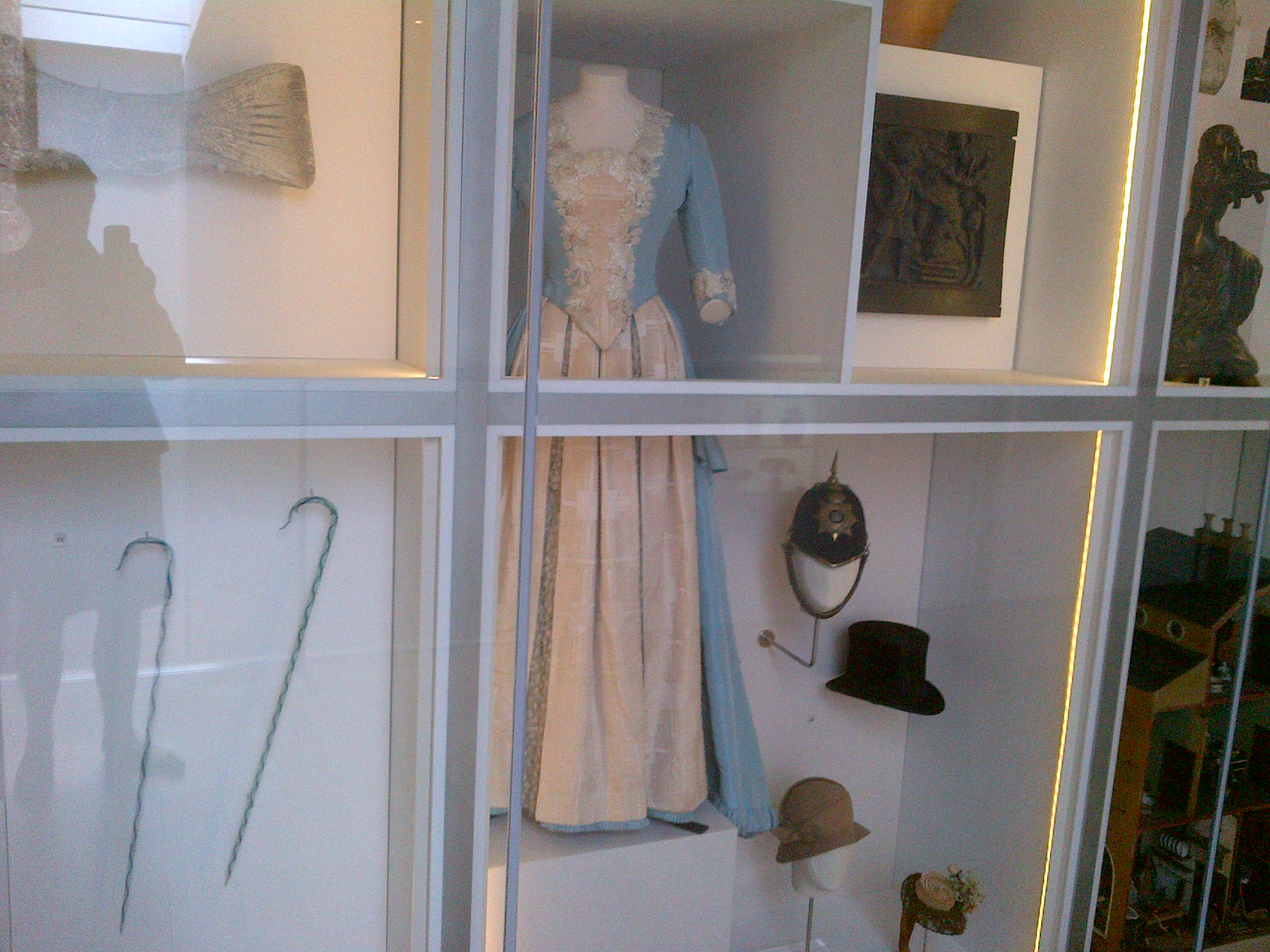 Our Writing Group spent a Day at the Royal Albert Memorial Museum in Exeter this week. We wandered round and looked at the exhibits and we each choose and item to write about. I selected this ball gown and wrote the beginning of an Historical Romance.
‘Will he notice me? He must,’ Sophia said. Her breath coming in short bursts as her maid, Anna, pulled tight the corset round her waist.
The invitation to the Big House had arrived six weeks ago. A large stiff card edged in gold with her name written on it in an educated hand.
‘Sir William and Lady Goldbrough would like the pleasure of your company at a Grand Ball on 23rd October 1883 at 9pm.’
Sophia’s immediate reaction was one of ennui. Country Balls were so, well, boring; young girls twittering and giggling, awkward young men who trod on your toes and talked of hunting and fishing. So tedious after the excitement of a season in London, but that had been four years ago.
Her father had grumbled at the expense of her time in the city, and when she came home without having received a single proposal of marriage, he begrudged the expenditure. She didn’t dare tell him she had refused an offer from the ugliest man doing the season.
Then Anna told her she had learnt that Robert Goldbrough, Sir William’s youngest son had returned from Canada.
‘He’s worth six thousand pounds a year.’ Anna exclaimed.
Robert and Sophia had been childhood playmates, running around the estate, playing in the streams and ponds and climbing trees, until he went first to Eton and then Oxford. They saw each other when he came home on vacation, but slowly drifted apart as he became more worldly, and she remained stuck in her rural backwater. Now he was back.
‘Is his wife with him?’ she asked.
‘No, Miss Sophia. He’s not married. Yet.’ Anna pulled the brush through Sophia’s hair, straightening the tangles, of her strawberry blonde hair.
When Anna had left her, Sophia went to her wardrobe and searched through her ball-dresses. She took out first one, then another, throwing them on her bed. She needed a new gown; something so beautiful that everyone in the room would admire her.
She said nothing for a couple of days, then, when she thought her father was in a good mood, she went down to breakfast early.
‘You’re early,’ her father said.
‘Yes, I wanted to ask you about something.’
He looked at her over his newspaper, waiting to hear her request.
‘I’ve been invited to the Goldbrough’s Ball, and I really need a new gown.’
‘What’s wrong with those you had for London. Won’t one of those do?’ He began to read the paper again.
‘Those old things. No. No. I need something more fashionable, now I’m older.’
‘You need a husband to pay your bills.’
She let him continue reading and nibbled on a slice of toast.
‘Robert’s back from Canada.’ She paused, ‘Unmarried.’
Her father folder the newspaper and placed it by the side of his plate, picked up one of his letters and slide the blade of a knife through the envelope to open it. He pulled out the sheet of paper, and then looked up at Sophia.
‘Go and see your dressmaker, but don’t spend too much money.’
‘Thank-you, Papa.’ She blew him a kiss as she hurried from the room.
The parlour of Mrs Haworth’s house was stuffed with fabrics, silk, satins and velvet as well as the more homely cottons, worsteds and linen. Hanging out of the drawers were ribbons of every conceivable colour, intricate lace and beads of every size and shape. Sophia touched the silks, her hand lingering against the soft fabric. She held up a piece to her face, to gauge the effect on the colour of her skin and her eyes.
‘Blue, I think blue. What do you think, Mrs Haworth,’ Sophia said to the little dumpling of a dressmaker.
Mrs Haworth held out a swatch of midnight blue.
‘Something lighter, nearer the colour of my eyes.’
The dressmaker searched through a pile of cloths, and then produced a fine corded silk the colour of a summer sky.
Sophia sighed deeply. ‘Yes, that’s it.’
‘And the bodice and underskirt of cream,’ said Mrs Haworth. ‘I have just the thing.’
She dived into a cupboard and pulled out a bolt of figured silk satin in two shades of cream.
‘There, hold that against your skin.’
Sophia took it, held it against her cheek. Her face took on the bloom of a fresh pink rose. The silk was soft and tactile, irresistible. Just what she was looking for.
‘We’ll cut the bodice just so,’ said Mrs Haworth running her finger so that it just crossed the top of Sophia’s breasts. ‘The over dress we’ll cut like a coat, with points just here.’ She pointed to hip-level.
‘And a train?’
‘Yes, of course. Just like the London fashions.’
‘Now for trimming the bodice, I’ve got these.’ Mrs Haworth bobbed down and opened the bottom drawer. She pulled out a roll of net embellished with glass beads, the shape of maple leaves.’
Sophia hugged herself. ‘He will notice me,’ she whispered to herself.
What other ways have writers used to fire the imagination.
Coincidence
 Coincidences happen all the time, but how easy is it to make them convincing in a novel. A senior editor told me it was easier in a play or film because the viewer has less time to think than the reader. Would you find this convincing?
I have owned a small cottage in the South of France for twenty five years, and when we first bought it we wanted to have a roof terrace. Somewhere to eat and sit in the sun. We were advised to speak to a builder in the next village, a Monsieur Martin. He was described as a ‘Homme Serious’ meaning he was well respected. We went to see him at his home to discuss our proposal for the new terrace. He was sturdy, dark haired and spoke French with a strong Provencal accent. His wife was an attractive brunette, who moved swiftly around the large sitting room, fetching coffee and water for us, as we had walked from our cottage to their house and it was very hot. From time to time she translated his heavily accented French into a more standard version.
While we were in England the following winter, M. Martin did the work on our terrace, but when we asked him to do some more work he declined, saying he was building a school in a nearby town and would be occupied there for some time to come. In spite of living very near to us and in a village we visited frequently, we never saw him again.
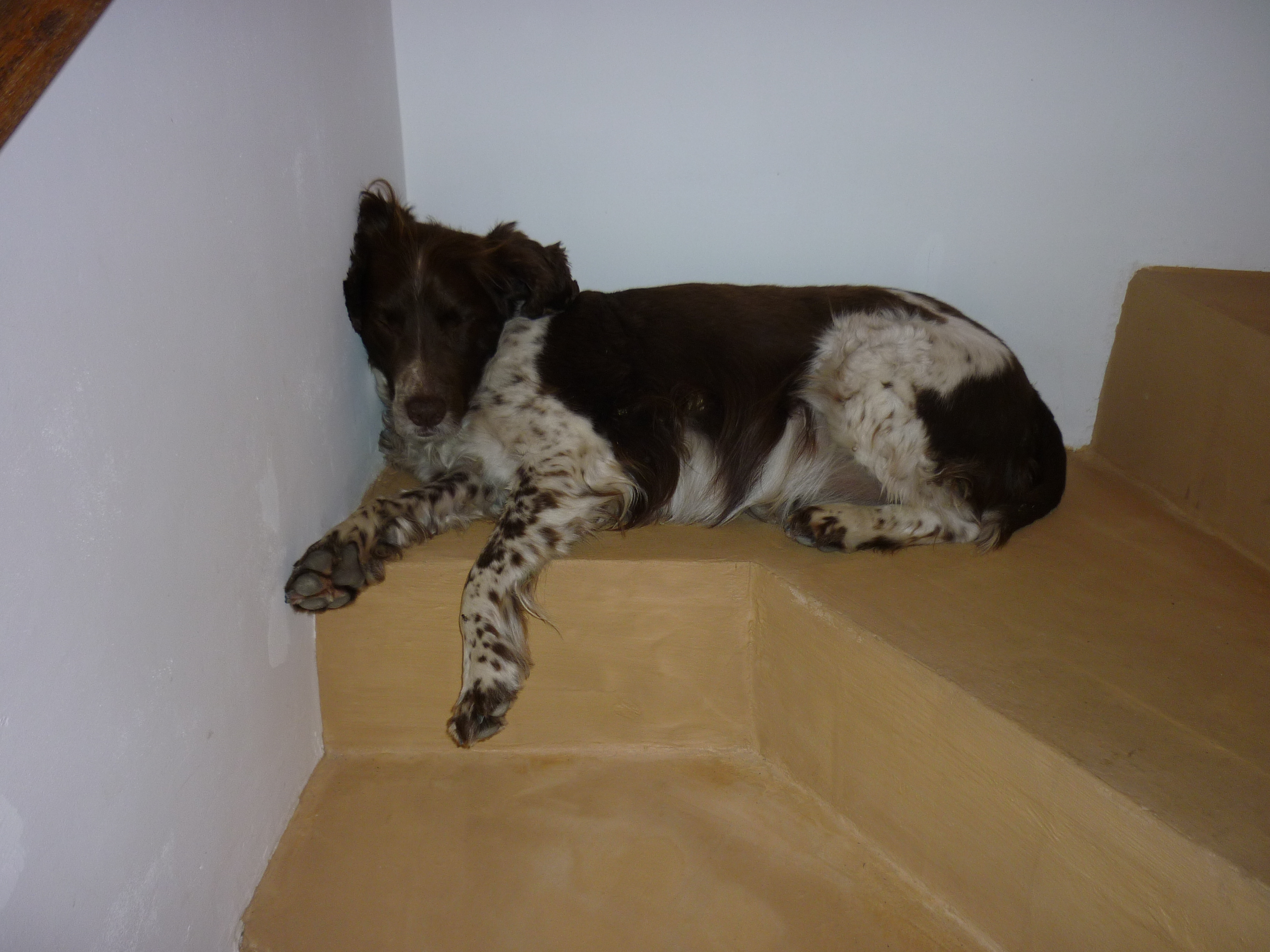
Now we have sold the cottage and this summer was the last visit we would make with our dog, Rudi. Three days before we left Uzes, we took Rudi to the vets to have his worm treatment and his passport updated, for the return to the UK. The surgery was very busy and the waiting room was full of other people with their dogs. The only cat owner decided to stand outside rather than risk causing mayhem. In addition to us, their was a sophisticated woman in a blue and orange shift dress with her six month old brown labrador, a large Alsation who appeared to have a cough with his two equally large owners. Sitting at the far end of the row of seats from us, was an elderly couple with very old poodle. The dog was emaciated and unable to stand on all four legs.
When the vet came to call them into the consulting room, she said, ‘Monsieur Martin.’
‘I thought I recognised him,’ Alan said to me.
‘Are you sure,’ I said.
At first the man refused to go in, but his wife insisted. She lead the way towards the consulting room, with the poodle gamely following. M. Martin trailed behind her, his steps heavy and slow.
Some ten minutes later, we saw them emerge from the door at the rear of the building. M. Martin was carrying a plain brown box. There was no sign of the poodle.
We were called by the vet for our consultation. We got up and walked towards her office. Alan asked her if that was M. Martin from our village and she said it was. The dog had been so ill, there was no option but to end it’s life.
Is it a true story or not?
Christening Characters

Русский: Зефир и Гиацинт, Аттический сосуд из Тарквинии, ок. 480 до н. э., Бостонский Музей Искусства (Photo credit: Wikipedia)
I had no difficulty naming my main protagonist. She has always been Cassandra Hardman. I like the abbreviated form, Cassie, which I know she, and her family and friends would use. The name comes from a princess in Greek mythology, who had the power of prophecy but was never believed. I believe that fits with the role of the advocate, predicting the future for a defendant, and the disbelief that could engender. For her surname I wanted something which would identify her as a Lancastrian and ‘Hardman’ is common in parts of the County.
My novel also has a second protagonist and I have found naming her more difficult. She is a female Detective Constable about six years younger than Cassie. She is very loosely based on someone I met, who was the daughter of a successful business man. She had decided to join the police force against her fathers wishes. She was a tall glamorous blonde, who loved motorbikes. I originally called my character, Carol Beaumont-Smith, but I didn’t feel happy with that. The hyphenated surname seemed to be a cliché for wealthy, rather upper-crust characters, and using a name beginning with the same initial as my main protagonist, I thought, might be confusing for a reader. I changed the name to Vivienne James, Viv for short, but didn’t like that either. I know two Viv’s, one a small dumpy girl and the other tall and elegant but not reallyas glamorous as my policewoman is. I have now decided on Alexis Seymour which feels right. Of course there is a bit of a twist is that as another name for Cassandra in Greek mythology is Alexandra of which Alexis is a variation. Anyway Alexis Seymour feels right and I think I will stick with that.
I did wonder if anyone had any interesting ways of christening their characters. Let me know if you have.
Getting a publisher
I promised myself that if I didn’t get an agent willing to represent me at the Winchester Writers’ Conference I would self-publish. I didn’t get an agent interested but an editor from one of the major publishing houses asked to see the whole of my book.
I sent it off in  high hopes that this would be the breakthrough I was hoping for, but she thought there were some problems with the plot and made a few suggestions about which areas she thought would benefit from some rewriting. She ended by saying she wouldn’t take my book for now but she thought I had great potential. So I’m starting again reviewing the plot, the characters and the amount of legal jargon. I’ve begun by rereading the trial passages in Scott Turow’s ‘Presumed Innocent‘ and examining the extent to which he uses technical information about the trial process in his writing. Actually it’s quite a lot and he does explain the legal terms his characters use in some detail, telling and not showing. It is my experience that most people are interested in the legal process and want to know how it works. I’d really like to know if that applies to readers as well as the people I meet.
Then I have done an analysis of my plot to see where I can improve the tension. There are three different plots that intertwine and I think I need to work on how they work together and when I need to keep them apart.
I think this is going to keep me occupied for quite a while and I suspect this blog will get neglected in the process.
On another note we are off to France for a month so while I can write, access to the Internet is rather limited so a bientot.
The Pavillion Kensington Gardens
 Every year a world class architect is invited to design and build a pavilion by The Sepentine Gallery for Londoners and visitors to enjoy, whether they simply sit and watch the world go by, have a coffee or a snack. This years pavilion is built of cork, a quiet dark cave, under a roof of water. There is a programme of events in the pavilion over the summer. If you live in London or plan to visit this would be a great place to find a few moments of tranquility.
The Google Arts Project allows you to visit the previous pavilions on line. My favourite is the Red Pavilion. Have a look and tell me which one you like best.
Defending the Guilty
How can you defend someone you think is guilty? It’s a question all barristers have been asked, and asked frequently. The real answer is that the barrister is neither judge nor jury, but, sometimes it’s easier to give an example.
‘I’ll tell you about a case of arson, that’s setting fire deliberately to property. I was defending a fifteen year old, let’s call him Colin Smith, who was said to have set fire to a community hall attached to the school he attended. The case was due to be heard in the Juvenile Court in Seymour Street in central London. It’s a grubby building, could be any set of offices, but it smells of sweaty trainers. In the mornings the waiting area is crowded with kids, most of them wearing track suits and a dearth of parents. The ‘Women’s Voluntary Service do their best to provide teas and coffees and squash, no Coca Cola, for obvious reasons. My case was listed for the afternoon, when it’s much calmer. I arrived at court towing my bag with all my papers about half an hour before the justices were to hear my case. My client was sitting with his parents on one of the long benches in the hall. He was wearing his school uniform, looking throughly miserable, as well he might. His parents staring around them at the unfamiliar, worry etched across their faces, dressed as if going to a parents evening.
The fire had been serious although no one was injured, just a lot of smoke damage. There wasn’t much evidence against him, but what there was compelling. His fingerprints had been found in a part of the building he would not have had any access too, but when the police had interviewed him, he had denied going into the premises. The prosecution case was that he had lied about going into the hall because he had started the fire. I knew from my instructing solicitor he refused to plead guilty to the offence. Both he and the boys parents had done their best to persuade him, but he claimed he was not responsible for the fire. I too tried to persuade him to change his plea to guilty, going over the evidence against him for what must have been the fourth or fifth time, but he continued refuse to accept any responsibility for the fire. As I went into court, I was a rather downhearted, anticipating a trial in which there was little I could do to prevent him being convicted and no doubt after reports prepared by the probation service, going to a young offenders institute.
One of the differences between trials in the Crown Court and in the Magistrates is that the defence don’t get to see the statements of the witnesses the Crown intend to call, so I had no idea what the expert from the fire service would say. He was dressed like a school teacher in a corduroy jacket and grey slacks. He gave his evidence in a quiet voice, I had to listen carefully to what he was saying, but what he did say caught me unawares. He described the hall with a bar and rows of bottles of alcoholic spirits on the shelves and on the optics, then said he had found an ashtray which appeared to him to have been the seat of the fire. None of the bottle of spirits which could have been used to start the fire were broken or moved. A can of cigarette lighter fluid was still full. In his view there w as nothing to indicate that any accelerant examinationI knew I needed to be very careful. I wanted to get him to say the fire was an accident, the result of someone leaving a cigarette stub still burning in that ashtray. I got him to repeat the evidence about the lack of accelerant and then tentatively said, ‘Could the fire have resulted from a carelessly abandoned cigarette?’

Middle Temple Lane looking towards Victoria Embankment (Photo credit: Wikipedia)
‘Yes. Yes, it could. I can’t rule it out,’ he replied. I sat down quickly. I had done enough. Careless isn’t enough for the offence, it must be deliberate or with the realisation that a fire might result. Colin Smith was acquitted, and I was relieved he had ignored my advice.
My protagonist of my novel Crucial Evidence is a barrister, Cassie Hardman, who has chambers in Inner Temple London. Chambers are the name barristers give to both the place they work and the group of barristers who share that accommodation and staff. Most sets of Chambers are in the four Inns of Court, including Middle and Inner Temple. The Temple Church was an important location in The Da Vinci Code.
Cathi Unsworth: women and noir | Books | The Guardian
Cathi Unsworth: women and noir | Books | The Guardian.
Cathi Unsworth writes about her novels which are described as noir. Unlike many crime novels she does not write series. In this article in The Guardian she writes about the difficulty of getting published and says her first manuscript was rejected by many editors who wanted her to turn it into a series. In the end she did get a publisher who told her she might have done better if she had used a man’s name as a pseudonym. Really that’s too much. She also says that to get published you must write what the agents say, ‘fit into the Christie corset’ are her words, and accept the compromise or do your own thing and take a chance with e-books. It seems to me she is saying what I said in my last post about making your novel fit an agent’s view of what you should write or you write what you want and self-publish. To use an overworked phrase, publish and be damned.
Winchester Writing Conference
 Three days at the Winchester Writing Conference has left me too exhausted to put fingers to keys. I went to workshops, lectures and had the opportunity of discussing my novel Crucial Evidence with a number of literary agents and authors. I know the publishing industry is struggling with Amazon and the supermarkets cutting the price of books and now the rise and rise of the e-book, but their response seems to me to be inadequate. In order to cut costs they us literary agents as gate-keepers, assuming that they as publishers and agents have the same agenda. During my career at the English Bar, I soon learnt that my clerk, the man who took 10% of my earnings, did not have identical objectives to me. I think the same applies to literary agents. They all say they are looking for some amazing talent, but in fact they want someone who will sell books so they stick to the familiar. I have no doubt that someone will say that it is sour grapes because none of the agents I spoke to wanted to represent me and my novel, but I find that strange when one of the authors whose class I attended described my writing as brilliant, another as marketable and a consultant editor of a major publishing house wanted to read the complete transcript. I wasn’t the only writer with a similar experience. One of the men in the class on ‘Writing a Page Turner’ read out to the class the beginning of his SciFi/Comedy book, which had us all doubled up laughing. The agents he saw told him they found his work incredibly funny, but they didn’t want his book because they wouldn’t know where to place it. Which all suggests thet anything new, different or original will struggle to get published. I think self-publishing is the way forward. Has anyone else had similar experiences
Rules of Social Media Etiquette
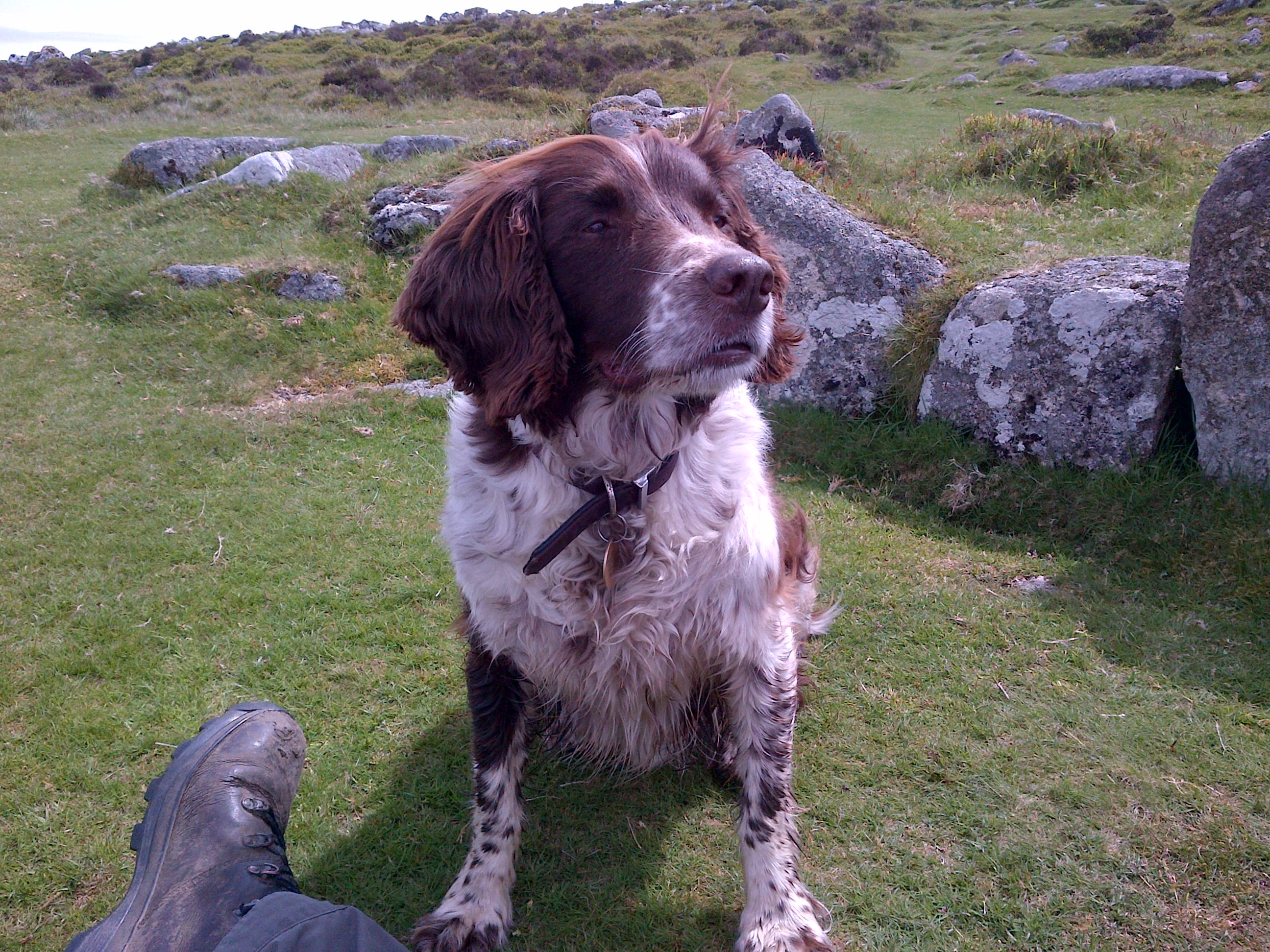 I have just read Ashley Jillian’s post on Social Media Etiquette and whilst I agreed with most of it, I do like GoodReads so I’d say if you like books then it’s quite a good place to do a book review and pass on some good recommendations. But, when did cats ever do socializing. I love the creatures feline aristocrats, snobs to their last claw, but social they are not. Now dogs, and that’s my baby, are great socialites. Rudi is really smart too. He was adopted from a rescue centre when he was eighteen months old, the product of a broken home. He’s a working Springer Spaniel and that spells energy. He loved hunting and we don’t, so he would go off and hunt for himself usually for an hour or so, leaving us hanging around waiting for him to get back to us. We tried all sorts of training techniques, but unlike most examples of bad behaviour disobeying a call to return is very hard to deal with, if you chastise the dog when it gets back to you, he’s more likely to stay away, so you give him a reward, in our case a small treat. Now he’s 11 and an old dog, so he doesn’t want to hunt so much, but he is greedy so he plays a game of hide and seek with us. He goes off and hides behind trees and bushes and then comes back, sits down besides you and looks up at you and then at the pocket where he knows you have the dog biscuits, willing you to get the bag of treats out and give him one. Like I said smart.

 scribblingadvocate