The Fatal Step
This is the working title of my new novel and so far I am about half way through the first draft. Some how the summer has not been conducive to writing – who wants to be stuck in front of a computer when the sun is shining outside. I think too, I am rather daunted by the task I have set myself. I didn’t think about it with Crucial Evidence. I’d started that as part of my dissertation for my MA and I just kept going until I’d finished. Then I drafted and redrafted without thinking, each time telling myself that this time it would work and when I sent it to agents someone would love. They didn’t and I began to realize that it wasn’t my writing that was the real problem but the type of book I wanted to write. Also talking to agents at places like Winchester Writers’ Conference and at The London Book Fair I knew any publisher would want a series of novels and I didn’t want to be tied to writing a book a year. In the end I decided to publish the book myself. In the process I’ve learnt at lot about writing and publishing, but that makes the mountain I have to climb much higher and harder than the first. I know how long it takes and how difficult it can be.
But you have to begin somewhere so this is the first page of my second novel. It follows the career of barrister Cassie Hardman as she gets her first leading brief in a murder case.
‘As Cassie hurried along the driveway from Snaresbrook Crown Court towards the tube station, she turned on her mobile phone. Amongst the emails from fashion houses, department stores and restaurants, there was a message showing the subject matter as Paul Sadler. He had been the defendant in a rape trial, who she had successfully defended at the Old Bailey the week before last. She didn’t recognise the name of the sender, Malcolm Delaney. Normally she was very careful about opening emails from unknown people but it was from someone who knew about her involvement in the Sadler case. She clicked the message open and read, ‘Miss Hardman, I wanted to congratulate you on your representation of Mr Sadler. Your cross examination was very effective and your closing remarks were obviously persuasive. Clearly they carried the jury along, as you know from the verdict. I would like the opportunity of congratulating you in person, and would like to invite you to have lunch or dinner with me. We can arrange a time and place later. I look forward to hearing from you. Malcolm’
The email gave no clue as to how Malcolm Delaney, knew she had represented Paul Sadler or what Delaney’s connection to the case was. Was he a police officer, a member of the court staff or just a spectator from the public gallery? She knew there were a number who came regularly to watch the proceedings at the Bailey; the staff described them as ‘groupies’ and she had been told by one of the ushers that some of them would ask which barristers were appearing in which court and make a point of watching their favourites’ cases. The wording of the message was a little old fashioned so perhaps it was one of them. The thought that one of the men from the gallery wanted to invite her to dinner amused her, but nothing more.
Back in Chambers, the senior clerk, Jack, summoned her into his room and closed the door behind her. On his desk were four lever arch files, tied with pink tape, the front sheet bore the title R v David Winston Montgomery. Jack beamed at her. ‘I’ve managed to get you a leading brief in a murder at the Bailey. I assume you’ll want to apply for silk in a couple of years. This is a good one; you’re ready for it, even though it’s a murder. None of the silks want this. Scared they’ll get tarred with a racist brush, I dare say. A woman won’t of course. Judge Crabtree is in a bit of a panic thinking the defendant might want to represent himself. I said, to Colin in the list office, my Miss Hardman can handle it. Spoke to Tim. Didn’t take long to persuade him you could do it. So there you are a leading brief in a murder.’
Any comments to make about that so important first page.
Middle Temple Lane London
One of my favourite books is Bleak House by Charles Dickens. Indeed it was the first book on the reading list when I began to study law at the University of Sheffield. In it Esther Summerson describes going into Old Square Lincoln’s Inn ‘we passed into sudden quietude under an old gateway, and drove on through a silent square..’ and in The Mystery of Edwin Drood the change as one passes into the Inns of Court in this case Staple Inn is evoked in these words – ‘It is one of those nooks the turning into of which out of the clashing street imparts to the relieved pedestrian the sensation of having put cotton in his ears and velvet on the soles of his boots.’
I’m not sure it is so quiet these days but walking into Middle Temple towards Fountain Court one does leave much of the bustle of modern London at the entrance. Today the gateway under the sign of the Knights Templars is guarded by a modern barrier to prevent any entry by motor vehicles. It does look rather incongruous.
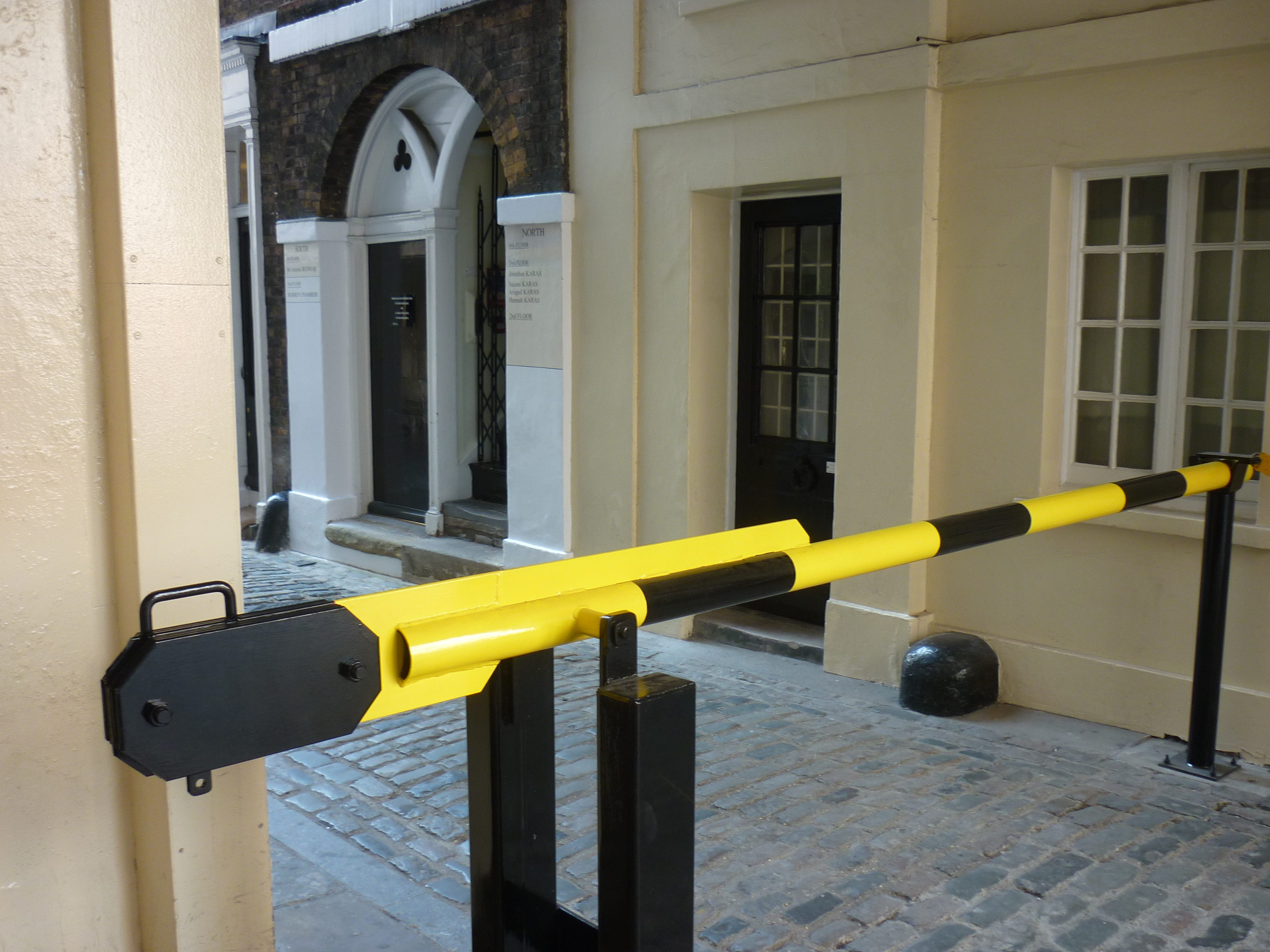
Gate to Middle Temple
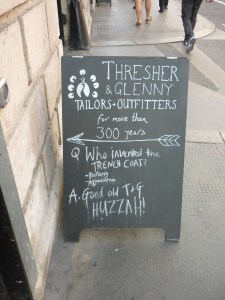
There is a small shop at the entrance that is now the premises of Thresher and Glenny Tailors and Outfitters for three hundred years, the blackboard proclaims along with the boast that they were the inventors of the Trench Coat and through the window I could see a khaki coloured coat looking rather battered as if it had lived through two world wars, as indeed it may have.
As I walked down Middle Temple Lane where my imaginary Burke Court is set squeezed in between other sets of Chambers, rather like platform 9 and 3/4 at Kings Cross nothing has changed for two centuries, although I suspect it is rather cleaner than it was. I did see a noticeboard with posters warning about terrorist threats, thefts and events in Middle Temple Gardens; similar lunches may well have been enjoyed in the Garden, indeed the Inns were known for their conviviality, but City of London Police posters would not have been evident until recently.
In Fountain Court, where John Westlock woos Ruth Pinch in Martin Chuzzlewit, the fountain splashes into the round stone basin, the mulberries stain the ground around it and a young man eats his lunchtime sandwich from a Pret A Manger carrier bag. 
I have described The Temple in the following passage taken from my novel, Crucial Evidence-
‘Cassie’s chambers were at 3 Burke Court, part of that area of London inhabited by lawyers for centuries and known as The Temple. Walking through the arch bearing the Pascal Lamb, was like time travelling; each time, she was stepping out of the tumult of the twenty-first century into the ordered calm of the eighteenth. She was reminded of her home town, where similar Georgian buildings surrounded the castle, built by John O’Gaunt, which remained a centre of law and punishment, judges and offenders at its heart. So unlike The Temple which turned its back on the bulk of the Royal Courts of Justice across the Strand, a row of the banks and sandwich shops providing a barricade to the noise of traffic and the bustle of pedestrians, and creating a sanctuary of narrow lanes and courtyards for its lawyer inhabitants.’
As I have remarked here the changes are ‘de minimis’ to quote a legal phrase.
John Grisham and class actions
I’ve been away and out of contact with the internet again, but at least it has given me enough time to read some books and to do some thinking about my next novel. I’ve written the first 22,000 words so a long way to go on that. As far as the reading, I found a copy of The King of Torts by John Grisham and read it in a couple of days. It’s an awful title but seems to derive from the way class actions are brought in the USA. The protagonist is Clay Carter, a youngish lawyer working for the Office of Public Defender in Wasington DC. He is assigned the case of Tequila Watson who, inexplicably, has become a killer and murdered an acquaintance known as Pumpkin. Carter begins to explore Watson’s backgound and is puzzled by the lack of motive and the absence of any history of violence. Watson is a drug addict who has been in a rehabilitation program and when Carter makes enquiries at the project he is not convinced he is being told the whole truth. 
Overworked and underpaid, Carter is ripe pickings for Max Pace who tells him a major Drug Company is willing to pay compensation to Pumpkin’s family and his legal fees if he is acting on their behalf. The secret he must keep is that Watson along with others were treated as guinea pigs with a drug that ‘cures’ addiction but has a side effect in about 8% of the addicts that makes them a killer. Carter quits his job with the Office of Public Defender and earns himself about $15 million. He justifies his actions to himself by arguing that Watson has no defence to the charge of murder. I don’t know if that would be the case in the US but I think under English Law he would have a defence to murder of not to manslaughter. If the drug that turned him into a killer was given to him by the staff at the rehabilitation project as part of his care program then he would be able to claim his mental state was not self-induced and therefore he was not responsible. I had a similar case when Diego Cogolato killed the dress designer Ossie Clark, under the influence of a combination of illegal drugs and prescribed drugs that made him believe Clark was the devil and he heard voices telling him to kill.
Carter is then told about another drug that is widely prescribe and has the side effect of causing growths in the bladder. He files a claim against the Pharmaceutical Company and advertises for other users to contact his law firm so that a large number of complainants are joined in the same action against the company, a class action. These actions enable lawyers involved in the proceedings to earn large sums of money. The novel describes the way these proceedings take place and the dangers in them. I won’t say anymore because it will spoil the story. In the UK these type of actions are rare although the courts can give consent for what is called a Group Litigation Order but the proceedings are controlled by the Judge. Also cost capping orders are made which limit the amount lawyers can earn. There are no juries in civil cases of this type in England so exemplary damages are rarely given. Although there are proposals to have this kind of collective action in certain cases at the moment any move towards that is very slow.
This book perhaps under scores why American writers of legal thrillers have so much more to write about as the US system provides more drama than the UK one. I was certainly told that it was very difficult to sell a legal thriller/mystery to the publishing industry and that only John Grisham can write them. Are there any writers using the English Criminal Justice System as Grisham uses the US one?
Reviews 2
A librarian friend commented that he thought the plot of my novel Crucial Evidence was ‘dodgy’ because he couldn’t see why the police had arrested Barker for the murder of Shelley Paulson and why they were so convinced he was guilty just on the basis of a witness identifying him as the killer. It’s an interesting comment and I have questioned myself as to why he thinks that is a fault in the plot. Is it because when a reader opens a crime novel they expect it to begin with a murder followed by a detective following up clues which lead to the identification of the killer and his arrest? Of course that is what many crime stories do, but I wanted to write something different and my story begins after the investigation has finished and at the point where lawyers have been instructed to represent Barker and the trial is about to begin. It is written from the point of view of the barrister, Cassie Hardman and she would not be concerned with why Barker was arrested only whether there was enough evidence to support a prosecution.
Do crime novels present an unrealistic view of policing and of their powers of arrest? Don’t police officers act on anonymous tip offs and informants whose names they don’t reveal? They would be criticised if they did not and programmes like Crime Watch would have little or no part to play in investigation. An identification of the perpetrator of an offence is good evidence and if the accused has admitted he was close to the scene of the murder it seems reasonable for the police to believe he is the killer. Again on the basis of that evidence the relatives of the deceased would expect the accused to the prosecuted and let the jury decide, wouldn’t they?
Colin Stagg the man accused wrongly of killing Rachel Nickell on Wimbledon Common was arrested because they had information he frequented the common. They arrested him and decided he was rather strange and therefore he must be guilty. There was virtually no evidence against him apart from a forensic psychologist’s assessment made on the basis of letters written to an undercover policewoman offering sex if he admitted to the crime. He did not make any admissions, but was charged with the murder because the police were convinced he was guilty. I remember well the TV shots of Rachel Nickell’s grieving parents as they were interviewed outside the Old Bailey, saying if only the jury had heard the whole story, They were clearly convinced their daughter’s murderer was walking free, and that conviction can only have come from their conversations with police officers.
Is truth stranger than Fiction?
#BBCSilk Series 3 Episode 5 & 6
I was away and without TV or internet access for over three weeks,so I have just caught up with the last two episodes. As they are both about the same story line I thought it was appropriate to write about them together. Although the story line made great drama, any attempt to be realistic was abandoned in these episodes. 
Martha takes on the case of Seam McBride, a former boyfriend from her home town, who is charged with murder. At the beginning of episode 5 she tells him no barrister would agree to represent such a close friend, and then proceeds to ignore her own advice. The reason for not representing somebody you know well was illustrated when the names of people booking rooms at the hotel where the murder took place were those of other pupils in the same class as Martha and McBride. It was a piece of evidence that pointed to his guilt. She knew that, yet in order to keep defending him she had to keep quiet about it. The effect of that would probably be to mislead the court and that is unethical and puts her in breach of the professions’ code of conduct. Of course she would have known that information before the case started as the hotel’s register and bookings list would have been part of the prosecution case.
She also is so sure of his innocence. ‘I can tell by looking in their eyes if they are guilty or not,’ she says. She is so committed to the idea that the police make the evidence fit the case for guilt that she loses all objectivity. The discovery of the gun and of McBride’s jacket add to the weight of evidence against him and Martha really doesn’t know how to deal with this apart from accusing the police of framing her client. She really should have asked for the jury to be discharged so that the jacket and the gun could be forensically examined. She might then have found out that the gun was fired by a left handed man rather than the right handed McBride.
Recalling bent solicitor Micky Joy to testify he says that lawyers just play games in court and the first casualty is truth. Coming from a dishonest lawyer that was a bit of a liberty. I am sure though it’s what many people believe, but jury trial is not meant to find the truth but to establish guilt or innocence, in the belief that the system we use of testing the evidence by cross examination ensures that the guilty are convicted and the innocent go free. Most lawyers believe it works and that is the reason they so passionately defend our adversarial trials.
For the rest of the two episodes they reflected some of the life of a set of Chambers. For example the interest in boxing was quite common as young men were taught to box, often in clubs supported by Oxbridge Universities, in order to divert them from criminal activity. The allegation of sexual harassment against Billy showed the strong loyalty in the clerks’ room to a flawed but tremendously humane personality like Billy.
So is this the last of Martha Costello and Shoe Lane Chambers. Perhaps not, but I think most barristers even if they find the series too flawed to really enjoy it would applaud Maxine Peake’s support of their cause in fighting for justice4all against the current Lord Chancellor.
London Book Fair 2014
After listening to the talks in the Author HQ at LBF and hearing the questions people ask the commercial aspect of writing is very much to the fore- I suppose that’s not really surprising.
A successful writer of commercial fiction needs to write at least two books a year. I don’t think I can do that. I know if one writes a thousand words a day, in theory, one could finish a book in about three months, but then there is the redrafting and the editing and I suspect I am quite hard on myself during that process. Certainly Crucial Evidence took me over two years to write and eight drafts before I felt ready to publish it, and before the feedback I was getting from other writers, agents and publishers suggested it was well written enough. What they were unsure of was if there was a market for a courtroom drama/ legal mystery. I think what I want is to write something that other people enjoy reading. So far my novel is getting 4 and 5 star reviews and I do find that very satisfying, so perhaps that will do for me.
Silk on BBC
I really enjoy this series, although at times the errors in the legal process make me want to squirm. The courtroom scenes are awful – it just isn’t like that and no-one who behaved as Martha Costello does would ever get Silk.
However the tensions that arose in this first episode are very real. I’ve been in the Court of Appeal (awful place three ghouls ready to tear every comment, every argument to shreds particularly if you defend ) and wanted to shout at the judges that they are being unfair and can’t they see how the evidence has been concocted. But, you don’t do it, you sit in your seat, stand when you have to stand you do it, and show respect to the court even if you don’t feel it.
Then there is the criticism that Martha is too emotional. Clive Reader tells her in this first episode that she is acting like the client’s mother not his lawyer and that is another conflict in a legal life, trying to be as objective as you can because that is the best thing for your client. The reason for that is that if you fight a case you can’t possibly win and the client is convicted then he will be given a tougher sentence than he would if he pleaded guilty. In this episode I believe the correct course of action would have been for the client David Cowdray to have pleaded guilty to manslaughter ( the Crown would probably have accepted that on the basis that he could not have reasonably foreseen that pushing the police officer would result in him falling and hitting his head on a metal lamp post which then resulted in his death ) The court would then have asked for Social Enquiry Reports which would have identified his schizophrenia. Martha could then have argued that instead of a prison sentence he should receive a Hospital Order for him to be treated for his illness. So bad law but good story line.
There is another rule broken for the sake of the drama; never ask a question you don’t know the answer to. The photographs taken of the police officers together outside a house while one of them was still giving evidence did reveal a breach of the rules, but no barrister would use that without knowing whose house it was. In the scene where David’s girlfriend confirms that he had a camera and the police took it, Martha realises she can’t call her as a witness because when she was cross examined by counsel for the prosecution she would give evidence that would support the Crown’s case. These are the sort of decisions a barrister makes every day, the programme makes them more extreme.
The senior clerk Billy Lamb could have been based on my original clerk. Old fashioned, not really interested in change. I am looking forward to the arguments between him and the new practice manager Harriet.
Looking forward to Episode 2.
Crucial Evidence Published
When I was awarded the degree of MA in Creative Writing in December 2009, I had about 50,000 words of a novel already written. Today three years and many words later, my novel has been published and I have a printed copy in my hand. The cover with the bar code of a DNA sample on the cover feels smooth under my fingers and there is the smell of new paper. I’m not sure I always wanted to be a writer. Certainly when I was a teenager I dreamt of writing a bestselling novel and I wrote short stories about young love.
Then life took over. I went to University and studied Law. I thought about writing academic books about the philosophy of law – after all why do people by and large obey the law- it’s a question that’s difficult to answer. But I didn’t really want to stay on at University, I wanted to get on with living and experiencing everything. I became a practising lawyer and if I wrote stories then it was in the form of jury speeches.
The life of a barrister leaves little time for anything other than work so although from time to time I would try writing a crime novel I never succeeded in finishing one. Now I have and I have a great sense of achievement. I have taken the road of direct publishing as the traditional route takes so long and is such a gamble. 
The story is of a mid thirties Barrister called Cassie Hardman. She is instructed to represent a young man, Lenny Barker, who is pleading not guilty to the brutal murder of prostitute Shelley Paulson. Initially Cassie believes him to be guilty until she discovers compelling new evidence. She risks her career and her ambition to become a QC to ensure Barker has a fair trial and will stop at nothing to locate the missing witness. Will she find the man in question before the jury retire to consider their verdict at the Old Bailey? And if Barker is acquitted who is really responsible.
Comparing Colours
There has been with the publication of my novel. The paperback copy of the book arrived last week. I was thrilled to finally see my novel in a tangible form. The book looked great and had a nice feel to it but… I thought the version of the front cover I had approved was the one to the right. On it you can clearly read the words a novel etc. However on the front of the paperback the colour was rather darker and the word a was invisible. It seems I agreed to this some time ago before the final cover spread was prepared for printing.
I was sure the version I had accepted was this one but if you look back to my post called Cover Spread you can see, just, the difference. I just could not let it stay with such a bad mistake. Fortunately as I have opted for print on demand it can be corrected and the final version will have all the words visible if partly obscured.
The mistake shows two problems, one is trying to compare colours on the computer. Even if you print a copy, as I did, there can be differences in the depth of colour because of the different printer and ink levels. The other is the ability we all have to read a sentence or even a paragraph when part of the letters are concealed. I have learnt a lesson that one needs to be extra careful when agreeing to any part of the process that turns a manuscript into a book.
Work in Progress
I was asked to do this by Catherine Lumb. I think it’s an interesting excercise to make you think about your writing.
What is the title of the book/WIP?
The book is called Crucial Evidence. Apart from WIP it’s had about five titles including ‘Defending the Innocent.’ and ‘Missing Alibi’
Where did the idea come from?
I know that defending an innocent man is the hardest thing a barrister can do. I expanded on that theme so that my main character goes to unusal lengths to ensure her client gets a fair trial.
What Genre is your WIP.
It’s a crime novel, legal drama.
Which actors would you chose to play your characters in a movie rendition.
I am tempted to say Maxine Peake as she plays a very similar character in Silk, but prehaps she should play my police officer, Alexis Seymour, and Anne Marie Duff could play Cassie Hardman, my barrister, but perhaps she’s too attractive for Cassie.
What is your one sentence synopsis of your WIP
Female barrister Cassie Hardman, sure her client is innocent of murder, searches for a crucial witness, and with Police woman, Alexis Seymour, finds the witness and then identifies the real killer.
Is your WIP published or represented?
I have sent the book to a number of Literary Agents without any sucess, but this year the consulting editor of a major publishing house asked to read the whole book. She didn’t want to take it any further after reading the novel, but she made some suggestions about the book and I am now redrafting it with those in mind with the intention of resubmitting it again.
How long did it take to write it?
About three years so far. I keep on rewriting it when I see flaws or I’ve had comments about it from Literary Agents, which make sense to me.
What other books within your genre would you compare it with.
‘Presumed Innocent’ by Scott Turow, the outstanding example of a legal thriller, and John Grisham’s ‘A Time to Kill.’
Which authors inspired you to write this WIP
Charles Dickens. ‘Bleak House’ is a great legal drama with strong identifiable characters. You can find the same types in the legal profession today.
Tell us anything else that might pique our interest in this project?
If you have ever asked yourself how can a barrister represent a person they believe is guilty, you will find the answer.

 scribblingadvocate