The Fatal Step
This is the working title of my new novel and so far I am about half way through the first draft. Some how the summer has not been conducive to writing – who wants to be stuck in front of a computer when the sun is shining outside. I think too, I am rather daunted by the task I have set myself. I didn’t think about it with Crucial Evidence. I’d started that as part of my dissertation for my MA and I just kept going until I’d finished. Then I drafted and redrafted without thinking, each time telling myself that this time it would work and when I sent it to agents someone would love. They didn’t and I began to realize that it wasn’t my writing that was the real problem but the type of book I wanted to write. Also talking to agents at places like Winchester Writers’ Conference and at The London Book Fair I knew any publisher would want a series of novels and I didn’t want to be tied to writing a book a year. In the end I decided to publish the book myself. In the process I’ve learnt at lot about writing and publishing, but that makes the mountain I have to climb much higher and harder than the first. I know how long it takes and how difficult it can be.
But you have to begin somewhere so this is the first page of my second novel. It follows the career of barrister Cassie Hardman as she gets her first leading brief in a murder case.
‘As Cassie hurried along the driveway from Snaresbrook Crown Court towards the tube station, she turned on her mobile phone. Amongst the emails from fashion houses, department stores and restaurants, there was a message showing the subject matter as Paul Sadler. He had been the defendant in a rape trial, who she had successfully defended at the Old Bailey the week before last. She didn’t recognise the name of the sender, Malcolm Delaney. Normally she was very careful about opening emails from unknown people but it was from someone who knew about her involvement in the Sadler case. She clicked the message open and read, ‘Miss Hardman, I wanted to congratulate you on your representation of Mr Sadler. Your cross examination was very effective and your closing remarks were obviously persuasive. Clearly they carried the jury along, as you know from the verdict. I would like the opportunity of congratulating you in person, and would like to invite you to have lunch or dinner with me. We can arrange a time and place later. I look forward to hearing from you. Malcolm’
The email gave no clue as to how Malcolm Delaney, knew she had represented Paul Sadler or what Delaney’s connection to the case was. Was he a police officer, a member of the court staff or just a spectator from the public gallery? She knew there were a number who came regularly to watch the proceedings at the Bailey; the staff described them as ‘groupies’ and she had been told by one of the ushers that some of them would ask which barristers were appearing in which court and make a point of watching their favourites’ cases. The wording of the message was a little old fashioned so perhaps it was one of them. The thought that one of the men from the gallery wanted to invite her to dinner amused her, but nothing more.
Back in Chambers, the senior clerk, Jack, summoned her into his room and closed the door behind her. On his desk were four lever arch files, tied with pink tape, the front sheet bore the title R v David Winston Montgomery. Jack beamed at her. ‘I’ve managed to get you a leading brief in a murder at the Bailey. I assume you’ll want to apply for silk in a couple of years. This is a good one; you’re ready for it, even though it’s a murder. None of the silks want this. Scared they’ll get tarred with a racist brush, I dare say. A woman won’t of course. Judge Crabtree is in a bit of a panic thinking the defendant might want to represent himself. I said, to Colin in the list office, my Miss Hardman can handle it. Spoke to Tim. Didn’t take long to persuade him you could do it. So there you are a leading brief in a murder.’
Any comments to make about that so important first page.
Middle Temple Lane London
One of my favourite books is Bleak House by Charles Dickens. Indeed it was the first book on the reading list when I began to study law at the University of Sheffield. In it Esther Summerson describes going into Old Square Lincoln’s Inn ‘we passed into sudden quietude under an old gateway, and drove on through a silent square..’ and in The Mystery of Edwin Drood the change as one passes into the Inns of Court in this case Staple Inn is evoked in these words – ‘It is one of those nooks the turning into of which out of the clashing street imparts to the relieved pedestrian the sensation of having put cotton in his ears and velvet on the soles of his boots.’
I’m not sure it is so quiet these days but walking into Middle Temple towards Fountain Court one does leave much of the bustle of modern London at the entrance. Today the gateway under the sign of the Knights Templars is guarded by a modern barrier to prevent any entry by motor vehicles. It does look rather incongruous.
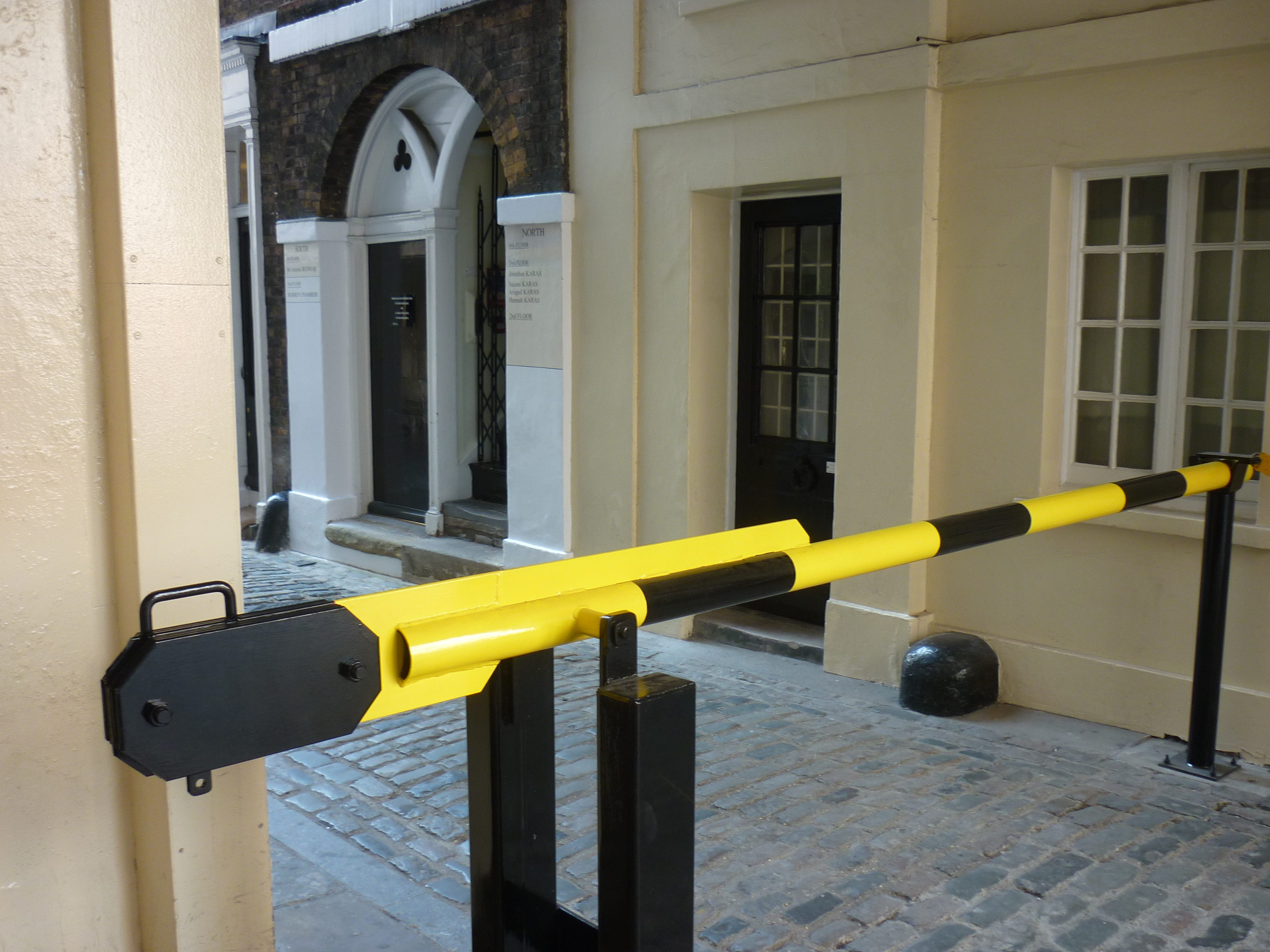
Gate to Middle Temple
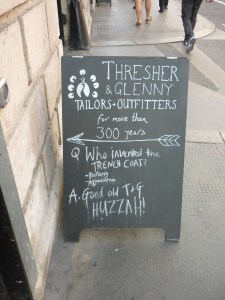
There is a small shop at the entrance that is now the premises of Thresher and Glenny Tailors and Outfitters for three hundred years, the blackboard proclaims along with the boast that they were the inventors of the Trench Coat and through the window I could see a khaki coloured coat looking rather battered as if it had lived through two world wars, as indeed it may have.
As I walked down Middle Temple Lane where my imaginary Burke Court is set squeezed in between other sets of Chambers, rather like platform 9 and 3/4 at Kings Cross nothing has changed for two centuries, although I suspect it is rather cleaner than it was. I did see a noticeboard with posters warning about terrorist threats, thefts and events in Middle Temple Gardens; similar lunches may well have been enjoyed in the Garden, indeed the Inns were known for their conviviality, but City of London Police posters would not have been evident until recently.
In Fountain Court, where John Westlock woos Ruth Pinch in Martin Chuzzlewit, the fountain splashes into the round stone basin, the mulberries stain the ground around it and a young man eats his lunchtime sandwich from a Pret A Manger carrier bag. 
I have described The Temple in the following passage taken from my novel, Crucial Evidence-
‘Cassie’s chambers were at 3 Burke Court, part of that area of London inhabited by lawyers for centuries and known as The Temple. Walking through the arch bearing the Pascal Lamb, was like time travelling; each time, she was stepping out of the tumult of the twenty-first century into the ordered calm of the eighteenth. She was reminded of her home town, where similar Georgian buildings surrounded the castle, built by John O’Gaunt, which remained a centre of law and punishment, judges and offenders at its heart. So unlike The Temple which turned its back on the bulk of the Royal Courts of Justice across the Strand, a row of the banks and sandwich shops providing a barricade to the noise of traffic and the bustle of pedestrians, and creating a sanctuary of narrow lanes and courtyards for its lawyer inhabitants.’
As I have remarked here the changes are ‘de minimis’ to quote a legal phrase.
The Absurd and Abuse
A recent exchange on Facebook reminded me of one of the more absurd episodes of my life. For reasons which I won’t go into I had become involved with the Cambridge Settlement in the east end of London. I had never been to Cambridge University but the project needed a woman lawyer as a group of women wanted to establish a Battered Wives Centre and it was to be a rule that no man would be allowed over the threshold. As the Cambridge Settlement didn’t have a woman lawyer I was volunteered by a friend. 
So it was that one February night I found myself climbing over the wall of a large property in the East India Dock Road and helping to force an entry into the house. The building had been the home and surgery of a local doctor who had been provided with better premises from which to work and the property had been purchased by the now defunct GLC , prior to redevelopment of the site. They were not averse to unused properties being squatted and I duly arranged for us to pay rates and for the services to be reconnected. That was the easy bit.
The group of about four women who were the first group of wives trying to escape their abusive husbands moved in and with them came a number of social workers assigned by the local authority to ensure the children were not at risk. A number of house rules were agreed including that there was to be a meeting every Monday which all the residents had to attend. The idea of the meeting was to enable any issues surrounding the running of the house to be aired, the finances to be discussed and if there were disputes between the women for them to be resolved. Some of the social workers attended as well as me.
The women living at the house each had a separate room in which to live and sleep, but they shared the kitchen, bathrooms and a downstairs living room where the only TV was installed. It was here that the Monday Meeting was to take place. One of the mantra’s repeated all the time by the social workers was ‘There is no excuse for violence.’ Sure I thought although not without some reservations.
As the hostel began to fill up – if my recollections is right there were twelve rooms – the inevitable tensions arose. Someone would jump the queue for the bathroom or spend too long under the shower; not everyone was as good at washing up their plates as they should, the fridges rota wasn’t being adhered to. I’m sure you can think of many more of the small irritations that can arise in such cramped conditions.
Then, well let’s call her Pat, arrived. She had three children all under six, who ran wild around the house. They were always filthy and I found myself bathing them more than once. She always left the kitchen in a mess, the bathrooms dirty. She was disruptive, a heavy smoker who shouted and screamed all the time. She became the centre of heated debate at the Monday meeting and each time she was threatened with having to leave she would promise to behave.
One evening her husband came to the door and I went out to speak to him. He asked about the children and asked if they were OK as his wife was a very poor carer. He volunteered that he had slapped her across the face when he had come home from work to find the children hungry and very grubby. I had some sympathy for him and said so to one of the social workers we called Etty. She was furious with me and told me there was no excuse for violence.
A few weeks later when the Monday meeting was about to start, Pat was in the living room watching Coronation Street. Her behaviour had not improved despite the many promises. Etty asked Pat to turn off the TV, and she refused. Etty asked her again to which Pat replied, ‘I don’t want to attend your f….. meeting. I’m watching TV.’
Etty got up and turned off the TV. Pat retaliated by turning it back on. Etty turned it off again, only for Pat to turn it on. This was repeated another couple of times and then as Pat went to switch the TV on for the fifth time, Etty got up, grabbed Pat by the arm, swung her round and hit her across the face with the flat of her hand as hard as she could.
So, no excuse for violence then.
Reviews 2
A librarian friend commented that he thought the plot of my novel Crucial Evidence was ‘dodgy’ because he couldn’t see why the police had arrested Barker for the murder of Shelley Paulson and why they were so convinced he was guilty just on the basis of a witness identifying him as the killer. It’s an interesting comment and I have questioned myself as to why he thinks that is a fault in the plot. Is it because when a reader opens a crime novel they expect it to begin with a murder followed by a detective following up clues which lead to the identification of the killer and his arrest? Of course that is what many crime stories do, but I wanted to write something different and my story begins after the investigation has finished and at the point where lawyers have been instructed to represent Barker and the trial is about to begin. It is written from the point of view of the barrister, Cassie Hardman and she would not be concerned with why Barker was arrested only whether there was enough evidence to support a prosecution.
Do crime novels present an unrealistic view of policing and of their powers of arrest? Don’t police officers act on anonymous tip offs and informants whose names they don’t reveal? They would be criticised if they did not and programmes like Crime Watch would have little or no part to play in investigation. An identification of the perpetrator of an offence is good evidence and if the accused has admitted he was close to the scene of the murder it seems reasonable for the police to believe he is the killer. Again on the basis of that evidence the relatives of the deceased would expect the accused to the prosecuted and let the jury decide, wouldn’t they?
Colin Stagg the man accused wrongly of killing Rachel Nickell on Wimbledon Common was arrested because they had information he frequented the common. They arrested him and decided he was rather strange and therefore he must be guilty. There was virtually no evidence against him apart from a forensic psychologist’s assessment made on the basis of letters written to an undercover policewoman offering sex if he admitted to the crime. He did not make any admissions, but was charged with the murder because the police were convinced he was guilty. I remember well the TV shots of Rachel Nickell’s grieving parents as they were interviewed outside the Old Bailey, saying if only the jury had heard the whole story, They were clearly convinced their daughter’s murderer was walking free, and that conviction can only have come from their conversations with police officers.
Is truth stranger than Fiction?
#BBCSilk Series 3 Episode 5 & 6
I was away and without TV or internet access for over three weeks,so I have just caught up with the last two episodes. As they are both about the same story line I thought it was appropriate to write about them together. Although the story line made great drama, any attempt to be realistic was abandoned in these episodes. 
Martha takes on the case of Seam McBride, a former boyfriend from her home town, who is charged with murder. At the beginning of episode 5 she tells him no barrister would agree to represent such a close friend, and then proceeds to ignore her own advice. The reason for not representing somebody you know well was illustrated when the names of people booking rooms at the hotel where the murder took place were those of other pupils in the same class as Martha and McBride. It was a piece of evidence that pointed to his guilt. She knew that, yet in order to keep defending him she had to keep quiet about it. The effect of that would probably be to mislead the court and that is unethical and puts her in breach of the professions’ code of conduct. Of course she would have known that information before the case started as the hotel’s register and bookings list would have been part of the prosecution case.
She also is so sure of his innocence. ‘I can tell by looking in their eyes if they are guilty or not,’ she says. She is so committed to the idea that the police make the evidence fit the case for guilt that she loses all objectivity. The discovery of the gun and of McBride’s jacket add to the weight of evidence against him and Martha really doesn’t know how to deal with this apart from accusing the police of framing her client. She really should have asked for the jury to be discharged so that the jacket and the gun could be forensically examined. She might then have found out that the gun was fired by a left handed man rather than the right handed McBride.
Recalling bent solicitor Micky Joy to testify he says that lawyers just play games in court and the first casualty is truth. Coming from a dishonest lawyer that was a bit of a liberty. I am sure though it’s what many people believe, but jury trial is not meant to find the truth but to establish guilt or innocence, in the belief that the system we use of testing the evidence by cross examination ensures that the guilty are convicted and the innocent go free. Most lawyers believe it works and that is the reason they so passionately defend our adversarial trials.
For the rest of the two episodes they reflected some of the life of a set of Chambers. For example the interest in boxing was quite common as young men were taught to box, often in clubs supported by Oxbridge Universities, in order to divert them from criminal activity. The allegation of sexual harassment against Billy showed the strong loyalty in the clerks’ room to a flawed but tremendously humane personality like Billy.
So is this the last of Martha Costello and Shoe Lane Chambers. Perhaps not, but I think most barristers even if they find the series too flawed to really enjoy it would applaud Maxine Peake’s support of their cause in fighting for justice4all against the current Lord Chancellor.
Silk Episode 2
 How could Clive Reader ask such an obvious leading question? There were very few inaccuracies in this episode, and I suspect that was because there were fewer courtroom scenes, but that leading question did stand out. In case anyone doesn’t know what a leading question is – it’s a question that suggests the answer to the witness. It used to puzzle me when I first qualified but I was told I would know one when my opponent asked one and the advice was right.
In contrast I thought the scene where Caroline Warwick cross examines the defendant in the rape trial was worthy of an experienced barrister. Of course she really shouldn’t have been sent off to Bury St Edmunds to prosecute in a rape trial and her indignation is understandable. Unfortunately women are instructed in sexual abuse cases far too often, and I remember a very senior female Silk complaining about being given yet another rape trial. One thing that did jar however was her rudeness to the barrister defending in the case. Silks try to be nice to more junior members of the Bar as they can often be the source of work. Although Martha Costello is shown representing a defendant without a junior barrister, Silks usually have a junior barrister with them. If a junior barrister is instructed and wants a Silk to lead them in the case they are unlikely to suggest someone who has been rude to them.
Amy Lang is a new pupil in chambers – a trainee barrister. Once a young lawyer passes their exams, they are called to the bar in a ceremony at the Inn of Court of which they are a member, but they are not allowed to practice until they have completed pupillage. For twelve months they serve a kind of apprenticeship, accompanying their pupilmaster (never a Silk) to court, reading their briefs and doing any paperwork they are asked to do. The first six months they can not appear in court or accept instructions on their own behalf and now they are assisted by their chambers with a grant. In the second six they are able to work and will receive payment – fees for that work. Amy should have already done six months as a pupil so her ignorance about the acronyms was a little surprising. Poor Amy makes a complete hash of her first appearance in court – she isn’t the only one and won’t be the last- but a ruling that your instructing solicitors should pay the costs of the hearing is a real no-no. A barrister is meant to cover the back of their instructing solicitors . She was lucky that Billy was in a good mood-upsetting solicitors who regularly instruct chambers could have ruined her chances of success

Waiting for the jury to return with a verdict is a difficult time,many barristers escape to the Bar mess, drink coffee with friends, read the newspaper and a few try to work, but concentrating is often impossible. For Martha the client comes first, so she spends the time with him. It is a reflection of the type of barrister she is;as Clive says she always ends up liking her clients, so she stasy with him.
Silk on BBC
I really enjoy this series, although at times the errors in the legal process make me want to squirm. The courtroom scenes are awful – it just isn’t like that and no-one who behaved as Martha Costello does would ever get Silk.
However the tensions that arose in this first episode are very real. I’ve been in the Court of Appeal (awful place three ghouls ready to tear every comment, every argument to shreds particularly if you defend ) and wanted to shout at the judges that they are being unfair and can’t they see how the evidence has been concocted. But, you don’t do it, you sit in your seat, stand when you have to stand you do it, and show respect to the court even if you don’t feel it.
Then there is the criticism that Martha is too emotional. Clive Reader tells her in this first episode that she is acting like the client’s mother not his lawyer and that is another conflict in a legal life, trying to be as objective as you can because that is the best thing for your client. The reason for that is that if you fight a case you can’t possibly win and the client is convicted then he will be given a tougher sentence than he would if he pleaded guilty. In this episode I believe the correct course of action would have been for the client David Cowdray to have pleaded guilty to manslaughter ( the Crown would probably have accepted that on the basis that he could not have reasonably foreseen that pushing the police officer would result in him falling and hitting his head on a metal lamp post which then resulted in his death ) The court would then have asked for Social Enquiry Reports which would have identified his schizophrenia. Martha could then have argued that instead of a prison sentence he should receive a Hospital Order for him to be treated for his illness. So bad law but good story line.
There is another rule broken for the sake of the drama; never ask a question you don’t know the answer to. The photographs taken of the police officers together outside a house while one of them was still giving evidence did reveal a breach of the rules, but no barrister would use that without knowing whose house it was. In the scene where David’s girlfriend confirms that he had a camera and the police took it, Martha realises she can’t call her as a witness because when she was cross examined by counsel for the prosecution she would give evidence that would support the Crown’s case. These are the sort of decisions a barrister makes every day, the programme makes them more extreme.
The senior clerk Billy Lamb could have been based on my original clerk. Old fashioned, not really interested in change. I am looking forward to the arguments between him and the new practice manager Harriet.
Looking forward to Episode 2.
Crucial Evidence Published
When I was awarded the degree of MA in Creative Writing in December 2009, I had about 50,000 words of a novel already written. Today three years and many words later, my novel has been published and I have a printed copy in my hand. The cover with the bar code of a DNA sample on the cover feels smooth under my fingers and there is the smell of new paper. I’m not sure I always wanted to be a writer. Certainly when I was a teenager I dreamt of writing a bestselling novel and I wrote short stories about young love.
Then life took over. I went to University and studied Law. I thought about writing academic books about the philosophy of law – after all why do people by and large obey the law- it’s a question that’s difficult to answer. But I didn’t really want to stay on at University, I wanted to get on with living and experiencing everything. I became a practising lawyer and if I wrote stories then it was in the form of jury speeches.
The life of a barrister leaves little time for anything other than work so although from time to time I would try writing a crime novel I never succeeded in finishing one. Now I have and I have a great sense of achievement. I have taken the road of direct publishing as the traditional route takes so long and is such a gamble. 
The story is of a mid thirties Barrister called Cassie Hardman. She is instructed to represent a young man, Lenny Barker, who is pleading not guilty to the brutal murder of prostitute Shelley Paulson. Initially Cassie believes him to be guilty until she discovers compelling new evidence. She risks her career and her ambition to become a QC to ensure Barker has a fair trial and will stop at nothing to locate the missing witness. Will she find the man in question before the jury retire to consider their verdict at the Old Bailey? And if Barker is acquitted who is really responsible.
Winter Writing Retreat

Just returned from Abbey Dore Court in Herefordshire after attending a great weekend with a group of women writers on a retreat led by Lucy English and Rachel Bentham. Operating as Wordsmiths they had organised workshops, tutorials and discussions on writing and in particular on women’s attitudes to writing. The group comprised writers at all levels, but what a talented lot they were. Novels with great characters and covering many genres, including historical, crime, modern feminine. We acted out dialogue we’d written – we were really good at arguing in fiction.
We ate meals round the huge mahogany table in the dining room, had breakfast, mid morning coffee and afternoon tea snuggled round a light blue Aga, and finished the evenings round the wood burner in a former ballroom. We talked, played Actuality and read out our work.
Abbey Dore Court is a large quirky house close to the remains of Dore Abbey. A great place to hold a writers retreat. See http://www.thewordsmiths.org
Proof Reading and Cover Design
I have now agreed a proof copy of my novel Crucial Evidence to go to the printers and for the ebook formats. It took four copies to hopefully eliminate all the irritating typo’s, minor grammatical mistakes etc, before I was satisfied. My husband read the proof as well just to make sure – I was sure I was missing mistakes because I had read it so often.
He raised with me the question of hyphens as there were times when he thought I should have a hyphen between words for example cross examination. I checked the original copy edit and found that Lucy, the copy editor had taken them out.
I am currently reading ‘For Who the Bell Tolls’ by David Marsh, who edits The Guardian’s style guide. I consulted the book and discovered that the hyphen is going out of fashion. One reason is that the computer breaks up hyphenated words at the end of sentences. So, he says, if they are not needed to ensure the clarity of a sentence don’t use them. Incidentally the book is a good read as well as really helpful about rules of grammar they’re not as many you think – is the message.
The next stage with the book is completing the cover design and the blurb for the back. The front cover looks like this
I really like it – I hope everyone else does as well.
Publication should happen at the beginning of February 2012.
Best Wishes to all for the Festive Season and a Happy New Year.

 scribblingadvocate