#BBCSilk Series 3 Episode 5 & 6
I was away and without TV or internet access for over three weeks,so I have just caught up with the last two episodes. As they are both about the same story line I thought it was appropriate to write about them together. Although the story line made great drama, any attempt to be realistic was abandoned in these episodes. 
Martha takes on the case of Seam McBride, a former boyfriend from her home town, who is charged with murder. At the beginning of episode 5 she tells him no barrister would agree to represent such a close friend, and then proceeds to ignore her own advice. The reason for not representing somebody you know well was illustrated when the names of people booking rooms at the hotel where the murder took place were those of other pupils in the same class as Martha and McBride. It was a piece of evidence that pointed to his guilt. She knew that, yet in order to keep defending him she had to keep quiet about it. The effect of that would probably be to mislead the court and that is unethical and puts her in breach of the professions’ code of conduct. Of course she would have known that information before the case started as the hotel’s register and bookings list would have been part of the prosecution case.
She also is so sure of his innocence. ‘I can tell by looking in their eyes if they are guilty or not,’ she says. She is so committed to the idea that the police make the evidence fit the case for guilt that she loses all objectivity. The discovery of the gun and of McBride’s jacket add to the weight of evidence against him and Martha really doesn’t know how to deal with this apart from accusing the police of framing her client. She really should have asked for the jury to be discharged so that the jacket and the gun could be forensically examined. She might then have found out that the gun was fired by a left handed man rather than the right handed McBride.
Recalling bent solicitor Micky Joy to testify he says that lawyers just play games in court and the first casualty is truth. Coming from a dishonest lawyer that was a bit of a liberty. I am sure though it’s what many people believe, but jury trial is not meant to find the truth but to establish guilt or innocence, in the belief that the system we use of testing the evidence by cross examination ensures that the guilty are convicted and the innocent go free. Most lawyers believe it works and that is the reason they so passionately defend our adversarial trials.
For the rest of the two episodes they reflected some of the life of a set of Chambers. For example the interest in boxing was quite common as young men were taught to box, often in clubs supported by Oxbridge Universities, in order to divert them from criminal activity. The allegation of sexual harassment against Billy showed the strong loyalty in the clerks’ room to a flawed but tremendously humane personality like Billy.
So is this the last of Martha Costello and Shoe Lane Chambers. Perhaps not, but I think most barristers even if they find the series too flawed to really enjoy it would applaud Maxine Peake’s support of their cause in fighting for justice4all against the current Lord Chancellor.
Proof Reading
The route to publication has moved on another step. I have checked through the printers proof again. This time instead of doing it on the computer screen I printed a hard copy of my novel. There are 350 pages so I printed four pages using both sides of an A4 sheet of paper. It is beginning to look like a book, with an acknowledgements page and the publication details as well as the publication rights. I found only six changes needed making. I’m sure there are others but I’m missing them. I will get it returned to me again to check there are no more changes necessary. I do hope there are none, as I’m sure the law of diminishing returns sets in and I will fail to spot any mistakes in it.
I think the next version will have the front and back cover in place. We have yet to finalise the draft blurb, so that’s another step

Sculpture/fountain by Naum Gabo at Guy’s and St Thomas’s Hospital, London, U.K. (Photo credit: Wikipedia)
to get through. Interestingly I met a writer friend on Tuesday, who complained that the blurb for her book was written by the publisher and she was not consulted. One of the differences between traditional publishing and independent is the lack of control, once a writer has sold the publication rights, over the presentation of the novel to the public.
The same author expressed how dissatisfied she was with the marketing of her book. I am paying for a marketing campaign, so I do expect some publicity to be generated. The other job I had this week was to answer a questionnaire about my book which included providing another summary of the story and biography which included any media interest in my personal story. During my Twenty-five years at the Bar I did do a number of cases which attracted a great deal of publicity at the time, but most of it was some years ago. I thought two might still attract some media interest today.
The first was the killing of the fashion designer Ossie Clark by his lover Diego Cogolato. Ossie Clark was very successful designer in the 1960’s along with his then wife Celia Birtwell. There is a wonderful painting of them both by David Hockney in the National Portrait Gallery. By 1996 Ossie was living in a one bedroomed council flat in West London and Cogolato under the influence of a mixture of drugs killed him. He was diagnosed as suffering from a drug-induced psychotic state. He pleaded guilty to manslaughter and after I mitigated on his behalf he received a sentence of six years.
The other case featured in the newspapers only five years ago, when a young woman called Alex Griffiths was successful in her A level examinations. The Times, no doubt looking for a different angle to report on the announcement of the results chose to write an article about her, because as the baby she was stolen from St Thomas’s Hospital within hours of her birth. A nation-wide search followed, and she was found alive and well three weeks later. I represented the woman who stole her, coincidently also called Griffiths, Janet Griffiths. She too was diagnosed with mental health issues, in this case she had Munchausen’s, not the by- proxy type that has been much in the news over the last few years, but the original illness. She received a hospital order and was released after about eight months. She was to die about four year later of cancer. It is not often a barrister gets to know what happens to the victims and defendants in cases in which they appear, but I am pleased that on this occasion I did.
Readers

Caricature of Mr Charles Frederick Gill (1851-1923), Barrister and Recorder of Chichester. Caption read “Gill Brass”. (Photo credit: Wikipedia)
I have been thinking about who might want to read my book Crucial Evidence. I have always assumed it would appeal to a large number of readers, mainly because whenever I was asked what I did for a living and I said I was a barrister, I was always asked about my profession and how the criminal justice system worked. Sometimes I got so fed up with being questioned about my life at the Bar, I would lie and say I was the station announcer at Waterloo, and reel of a list of stations from lines I travelled frequently. However as my writing progressed I thought that perhaps some men would be put off by the rather feminist stance the book takes. Two women, a barrister and a police-officer, are the main protagonists and their ability to work in male dominated professions is one of the themes in the novel. Because of that I adjusted my views to thinking that perhaps men would not be keen to read it.
Then when I was about half way through the writing process the series Silk was broadcast and achieved viewing figures of two million. My novel has similarities with the TV programme, so I thought it would appeal to anyone who watched that show. The story line is about the trial for murder of a rather inadequate young man, rather than the investigation of the murder, although there are elements of the investigatory process. That may raise questions as to whether the enthusiastic crime novel reader will like the more ambiguous approach taken by the lawyers. I do hope so, but what do others think.
Literary Supper
For the last seven years, my reading group has organised a Literary Supper. We invite a speaker and ask them to speak for about half an hour, usually about their writing life and then we have supper. One of our number organises a quiz which we distribute round the tables and that gets people talking. So far we have had some wonderful speakers. We started with the crime writer, Francis Fyfield, who I got to know when I was a solicitor in private practice in London and she worked for what was then the Metropolitan Police solicitors.

television (Photo credit: jeevs)
After that we had Tim Heald, who writes both crime novel and biographies. By then I had begun the creative writing MA at Exeter University so I persuaded Sam North, who was long listed for the Booker Prize for his novel ‘The Unnumbered.’
Philip Hensher was also teaching on the course and he came to speak just after his novel ‘Northern Clemency’ had been shortlisted for the Booker Prize.
It was a bit hard to follow that, but we then had a very unusual speaker. Peter Goodchild was a TV producer with a particular interest in science and scientists and he talked about the Television series on Oppenheimer and how the script was written.
Last year I had been to CrimeFest in Bristol and met Rebecca Tope, another crime write and she came on route to delivering two pigs (she has as small holding as well as writing) to a local farmer. The next one is at the end of this month, and we have invited Helena Drysdale who writes fascinating travel books.
To begin with we did the supper ourselves mainly courtesy of Marks and Spencers, but last year and this we are having it at the Sheldon Centre and they do the supper for us using their home-grown vegetables. Most of the organising is down to me. I invite the speaker, do the publicity, print the tickets, collect the money and then pay the speaker and the caterers. Every year I swear I will not do it again, but it’s so popular that I can sell 50 tickets without much difficulty and everyone says how much they enjoy it and look forward to it. I guess I’m stuck with it. Anyone want to be the guest next year?
Hollywood
Not the town in California, but the exhibition at the Victoria and Albert Museum in central

English: Victoria and Albert Museum in London Svenska: Victoria and Albert Museum i London (Photo credit: Wikipedia)
London, where there is an exhibition of clothes designed for some of the most famous characters in films.
Amongst the exhibits was the navy tailored suit, Meryl Streep wore when she played Mrs Thatcher and next to it the outrageous playsuit she wore in Mama Mia. One clearly spoke of power and control and the other of sex and outrageous behaviour; there is no way they could be interchanged.
Another exhibit explained how the clothing for Harrison Ford as Indianna Jones was designed and then aged to provide the lived in look of a 1940’s explorer. The designer had used as a blueprint, the early adventure films.
I began to think about the importance of clothing to establishing character. I do imagine them in various clothes until I find something I think is appropriate for their personalities and for different events in the story line. Obviously, a barrister will wear a wig and a gown over a dark suit, when she is in court, but what about when the character is not working.? Is she a jeans and T-short type or would she wear a skirt and blouse. What about a female detective? Would she wear trousers to work with a trench coat or something more feminine?
Do you imagine characters in different outfits and do you use the clothes to help define the character to the reader.
London
Just spent a few days in London, reminding myself why I like the city so much. Of course there are the usual tourist things, the theatre and art galleries, the major sights. We went to see The Magistrate at the National, and it was a very enjoyable evening, a bit like a panto. But it’s not that, although the cultural  life was the reason I moved to London. I think the attraction for me is the energy that so many people hurrying around seem to engender. There is always the possibility of some suprise, of changes occuring that create a new experience. The Shard glittering in rain, a new art gallery, an extension of the Serpentine Gallery, being built in Hyde Park. It’s still wrapped in its plastic sheeting so its shape is a secret but the architect is Zaha Hadid, so it should be an exciting addition to the landscape. I came across a class for nervous cyclist (or even teaching those who can’t) in Little Wormwood Scrubs Park. I watched an elderly woman on a three wheeler set off cautiosly round the park, and two girls who said they hadn’t ridden bikes for years racing round. That’s another new addition to the street scene, the blue rows of ‘Boris’ bikes. These are the sort of places and events I need to keep my novels up to date.
I’ve also discovered a pedestrian route under the Westway which would make a great setting for a crimestory. It runs between a number of sports facilities, a sand ring with two disconsolate looking ponies, empty fives courts, a climbing frame and a sculpture that looks like a set of coloured pencils bent in peculiar shapes. Next time I go I must take a camera and photograph the route.
The photograph is the set for The Magistrate from the back of the circle.
Does anyone have any other ways of keeping the locus of their novels real.
Uzes
We are going to France next week to complete the sale of our cottage there. I wrote this piece some time ago after I had seen this girl begging by the expensive chocolatiere. in the square of our nearest town, Uzes.
Chocolate Candy
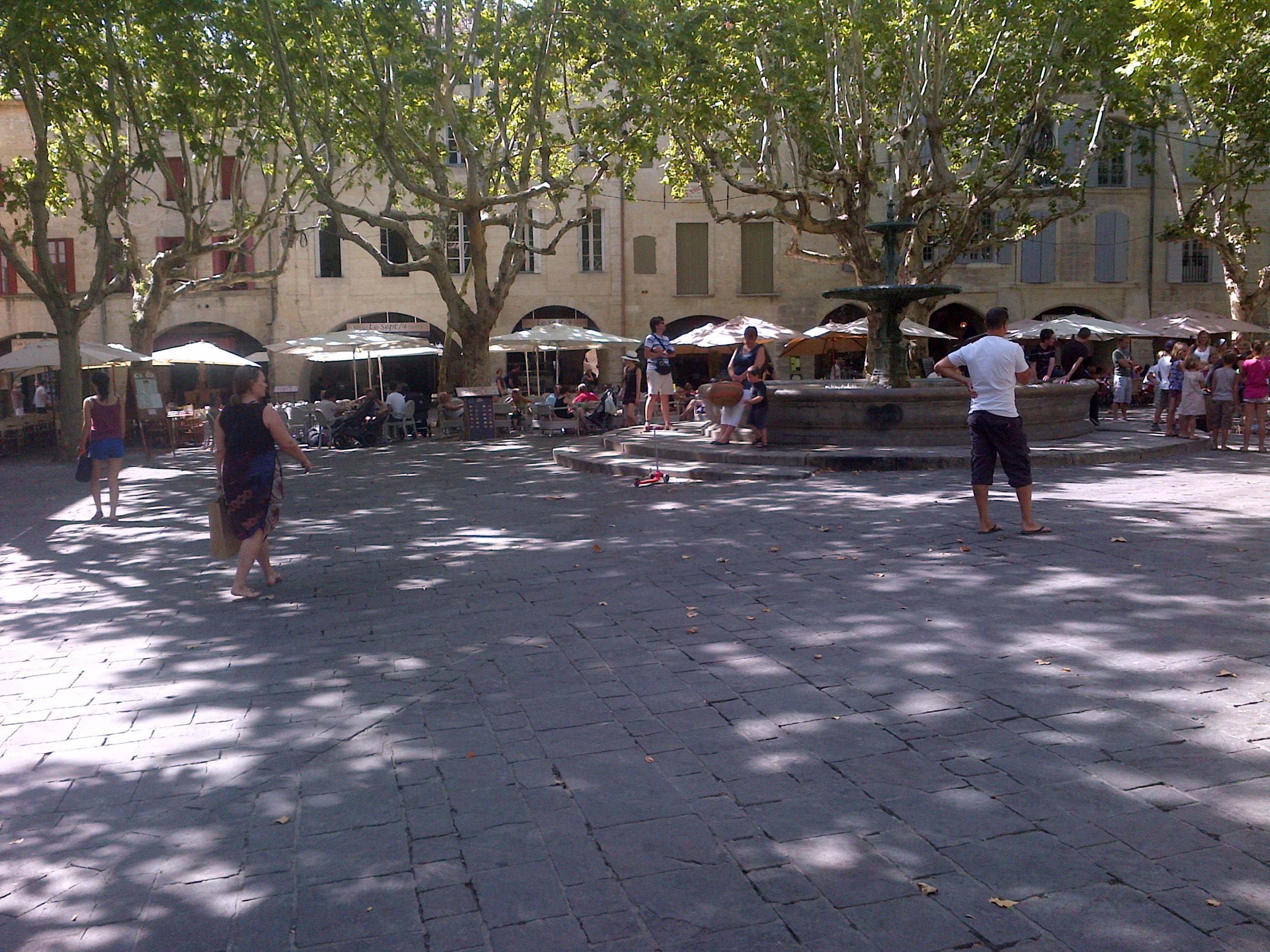
It was just after four in the afternoon when James strolled into the Place aux Herbes, in the small city of Uzes. The square lay languid under the upturned blue enamelled bowl of the sky. The seventeenth century former silk merchants’ houses were built of topaz coloured stone which glowed in the sun, their olive- green shutters closed to stop it from penetrating the interiors. The same strong light shone through the canopy of the plane trees created patterns across the paving stones, and under the vaulted arcades the shadows were the colour of a raven’s wing.
James felt his shirt sticking to his back and he slid his finger along the neckband of his linen grand-dad shirt. He took a seat at one of the many cafes, whose chairs and tables formed fingers in the open space, stretched his long limbs out in front of him and threw the battered panama he had inherited from his father, onto the table. He ordered a beer in his schoolboy French. It arrived quickly. Condensation on the outside of the glass formed a pool of water on the table. He sipped the cool amber liquid slowly, the antiseptic taste bursting on his tongue.
From behind a pair of sunglasses he settled down to observe the town, as it shook itself awake from its siesta. Tourists, dressed in light loose clothes, wearing sunhats and dark glasses, strolled across the square, the heat a brake on their energy. Children played in the fountain, dabbling their hands in the translucent green water. A golden retriever leapt up into the basin to cool off, and showered them as he jumped out, making them squeal and laugh.
After he had been sat for some time, from between the arches of the arcade, emerged the most beautiful girl he had ever seen. She had the golden glow that looked like it had been perfected on the beaches of the Cote D’Azur. Her hair was spun gold, pulled back into a bun and held in place by a red ribbon. Her face was long and thin with high cheek bones and a well formed nose above bow-shaped lips. As she passed in front of him she looked directly at him, and he could see her eyes were a startling pale blue framed with long dark lashes. She was tall and slim, almost boyish. Her clothes were shabby chic, cut-off jeans and a tight white T-shirt, and she carried a grubby blue canvas bag. Over her arm hung a red and white beach towel, and by her side trotted a grey-brown shaggy dog.
James watched her amble across the square, the roll of her walk accentuating the slight curve of her hips. He thought she looked like a starlet, what was the French, une vedette, and he imagined her dressed in a clinging white gown, walking along a red carpet with an admiring crowd applauding her. Or perhaps flouncing along a catwalk in Paris, London or Milan, wearing a well cut trouser suit, under the appraising eye of the fashionistas. Then he thought of taking her to his firm’s annual dinner, introducing her to his friends, her smile dazzling them, and he being warmed by their murmurs of approval. Other thoughts, of her naked and in his bed, came as well.
By now she had reached the far side of the square and was about to disappear from view. James dropped some euros onto the table, to pay for his unfinished drink, grabbed his hat, and rushed after her. He rehearsed the words he would need to ask her if she would have a drink with him. ‘Prenez une tasse du café.’ ‘No,’ he thought, ‘une coupe de champagne.’ Surely she only drank champagne.
Back out onto the Boulevard Gambetta, James cast around and saw her to his right, some way ahead, walking purposefully, the dog loping at her side. He hurried to catch up. She stopped in front of Deschamp’s, the chocolatiere, and within a few seconds he was besides her, in front of the large glass window. They stood side by side looking at the tasteful display inside. Chocolates arranged precisely on glass salvers, in pyramids, circles and triangles, a few to each plate. The sort of chocolates his mother would buy to take to a dinner party. They came in a variety of shapes, enrobed in dark and pale brown chocolate, as well as creamy white. By each cluster was a small label written in an elegant script, describing the different flavours, cherry, violet, caramel, apricot and orange. The very sight of them made his mouth water. He looked at the girl, and saw her long dark eye-lashes quiver, as she stared at the chocolate coated candy, as if trying to decide what to buy. He thought he would pre-empt her by purchasing some, then give them to her and ask her to have a drink with him.
Inside the shop he made a small selection, and waited impatiently whilst the ‘vendeuse,’ she was far too elegant to call a sales assistant, put them into a small oblong box of gold coloured cardboard. ‘Pour offrir, Monsieur?’ James kept glancing behind him, making sure the young woman was still outside. ‘Oui,’ he replied abstractedly. The vendeuse placed the box in transparent cellophane, tied it with a long strand of thin gold tape and handed it to James together with a few coins, the change from the ten euro note he had given her. As he turned to leave, the girl moved towards the door. He opened it and held it ajar to allow her to enter and for a moment they stood face to face, looking into each others eyes. He was about to speak when she moved to one side, folded the beach towel carefully, placed it on the ground against the wall, and sat down on it. The dog, which had been stood patiently by her side, flopped down next to her and placed it’s head on her bare knees, paws outstretched. From her bag she took a battered straw sunhat, which, instead of putting on her head, she placed on the ground in front of her. She was very still, leaning slightly against the wall, her long neck bent forward and her head bowed.
James stepped out onto the pavement and stopped next to her, his shadow falling across her face. She didn’t look up, but he could see her blue eyes had lost their liveliness and the pretty lips were turned down. One hand rested in her lap and the other was motionless on the dog’s head. Then he saw, in the hat, a piece of card with the words ‘Pour manger S.V.P.’ He closed his eyes for a moment, before bending down and placing the box of chocolates and the coins he was still holding into the upturned hat, before walking away.
.

 scribblingadvocate