To the Grandfather I didn’t know
Last night August 4th 2014, like many others I watched the broadcast from Westminster Abbey. We had switched off all our lights at 10pm and had a single candle glowing in the dark, as we commemorated the date and time a century ago when Britain plunged into World War I. My Grandfather was not killed during the war, but he died early from the injuries he received. He was gassed and never fully recovered from that, so that my Grandmother, a weaver, as many women were in Lancashire, continued to work after the war ended in 1918. 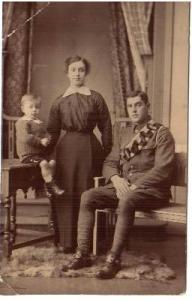
He died before my mother was married in 1939. Her brother Jack the child in the photograph was the one who walked her down the aisle to giver her away; my Grandmother would have walked alone. Although he knew he had one grandchild, Keith the eldest son of my Uncle Jack, he never knew about Roger, Keith’s brother nor myself or my younger brother Stewart. My Grandmother was a widow for over thirty years, dying when I was 26. Not for her the comfort of a shared life, shared memories and experiences into old age.
We, his grandchildren, never knew him and I don’t remember either my Grandmother or my Mother reminiscing about him. I don’t know which regiment he served with or what he did during the war. I know he loved horses and from time to time my mother said he would groom and harness the team of horses that drew the hearse in the small town of Haslingden Lancashire; black horses whose coats gleamed and who wore black ostrich plumes on their heads. He must have been interested in Art because I have a set of three books published by Odhams Press of Long Acre London in 1934 called The Worlds Greatest Paintings. My mother said they were an offer by one of the daily newspapers.
Of course, compared with too many, my family were lucky he did come back alive when so many didn’t. But the only way I can remember him is by this photograph; for me he will always be a handsome soldier with a pretty wife and young son.
Fleet Street London
The protagonist in my novel Crucial Evidence, Cassie Hardman walks from the Old Bailey to her chambers in Middle Temple Lane and as my novel is set in contemporary London I wanted to find out how much it had changed since the days when I took the same route. At the beginning of my career Fleet Street was the home of the newspapers. Here journalists and lawyers rubbed shoulders in the pubs and bars, although only males if El Vinos was your drinking hole of choice.
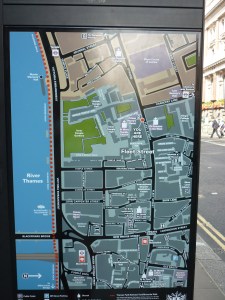
Fleet Street
As you can see from the map along the street are some fascinating places redolent with history. I have already mentioned St Brides Church but not the Institute and Printing Library, which is attached to the church. Shoe Lane runs north and there is a library on the western side of that lane. Between Shoe Lane and Fetter Lane are a number of Courts, narrow lanes and squares of a type familiar to all who read Dickens. Dr Johnson’s House.a 300 year old town house nestles among these narrow lanes at 9 Gough Square (see http://www.drjohnsonshouse.org) On Fleet Street is the public house with which the Dr is associated ‘The Cheshire Cheese.’
On the same side of the road is the building that was occupied by the Express group of newspapers. The curve of black glass a contrast to the shop fronts next to it. It is difficult to tell what the building is used for now. I noticed a number of serviced offices being advertised. One of the old Inns of Court, Sergeants Inn has become a hotel. The photograph shows it with the ground floor hidden by the red London bus.
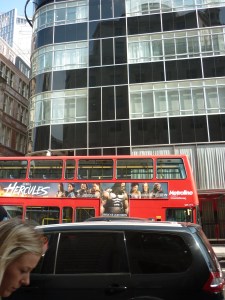
The Express Building
Some things remain the same, the signs outside the public houses, but there are now banks, coffee shops and the small stores the supermarkets have reinvented rather than the offices of newspapers. The Church on the right in the photograph of the map is St Dunstan’s in the West.
St Dunstan-in-the-West was a well-known landmark in previous centuries because of its magnificent clock. This dates from 1671, and was the first public clock in London to have a minute hand. The figures of the two giants strike the hours and quarters, and turn their heads. There are numerous literary references to the clock, including in Tom Brown’s Schooldays, the Vicar of Wakefield and a poem by William Cowper (1782):
When labour and when dullness, club in hand,
Like the two figures at St. Dunstan’s stand,
Beating alternately in measured time
The clockwork tintinnabulum of rhyme,
Exact and regular the sounds will be,
But such mere quarter-strokes are not for me.
The courtyard also contains statues of King Lud, the mythical sovereign, and his sons and Queen Elizabeth I, all of which originally stood in Ludgate. The statue of Queen Elizabeth I dates from 1586 and is the only one known to have been carved during her reign. Taken from the website http://www.stdunstansinthewest.org Here too there has been change as the church now caters to the Romanian community in the city.
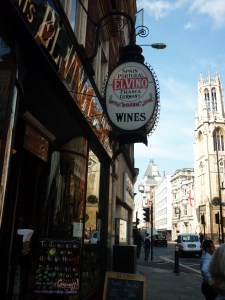
El Vinos
El Vino’s was of course the inspiration for Pomeroys Wine Bar beloved of Rumpole in John Mortimer’s books.
One of the other changes I noticed was that the vehicles using the street were mainly the buses, taxis and the little white van. Private cars pushed out by the congestion charge no doubt. Parking was always a nightmare, very expensive and difficult to find a space.
Old Bailey London
My novel Crucial Evidence is set in the London with which I was very familiar. Until a few years ago I was often working at the Central Criminal Court, more commonly known as the Bailey to the lawyers who work in there. The original Edwardian building houses the famous Number 1 Court and the hall with its painted ceiling. Next to that, opened in 1970 by the then Lord Mayor of London, is a newer building in which the courtroom 12, where much of my novel takes place, is situated. My journey to work was by Central Line Tube from Notting Hill Gate to St Paul’s. The map shows where the Old Bailey is on the edge of the City of London.

Map of area around the Central Criminal Court
I would walk along Newgate Street to the Old Bailey which is the name of the street which gives its name to the court. Quite often, when a terrorist trial was taking place the police would hold the traffic and pedestrians back at the junction with Warwick Lane to allow the prison van to sweep into the yard of the court. They would be dressed in bullet proof vests and carrying guns. I thought it was a bit stupid to hold up to twenty people where they would be in the line of fire if anyone tried to free the prisoners. The police may have prevented the escape but they risked a number of dead bystanders.

Junction of Newgate Street and Warwick Lane
I wanted to see if the area had changed since I had last been there and if, when I described the places my main character, barrister Cassie Hardman would see on her journeys around the area, they were the same as I remembered them. In the novel Cassie stands in the Bailey looking out onto a wet street scene. She describes the cobbles of Seacoal Lane glistening in the rain. If you look at the map, the lane has vanished into the middle of an office block. In another scene she looks sees the spire of St Brides Church – the journalist’s place of worship – now a new building under construction will hide it from view, if it has not already done so.

St Bride’s Spire

Artists Impression of a new office block on Old Bailey
I will have to do some editing when I come to the part in may next novel, whose working title is The Fatal Step where Cassie is looking out of the windows of the Bailey. At the moment as she gazes across the city the spire of St Brides in sparkling sunlight, but it will not be visible so instead she’ll have to look at the glass of the building opposite. But at least it was worth while going to London and walking around to see these changes for myself and, of course see how or when I can work them into my story. I’ll continue my walk along Fleet Street another time, but there have been changes there as well. Creating that sense of place in a novel really does rely on knowing the streets scenes you are writing and there is nothing like walking around with a camera and capturing it to take back to your desk.
Chudleigh Literary Festival
How time flies it’s nearly two weeks since the Chudleigh Literary Festival took place and I’m still trying to absorb everything I learnt at the workshops.
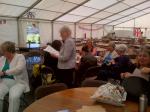
Workshop
We started with character building with Patrica Fawcett. We had to create a character from a photograph. I know it’s quite a common teaching aid but I’m always surprised by the way the characters evolve when I begin writing. Naming the character can be difficult and until you decide what their social status is – I always think of Hugo as being a bit snobbish so if my character is from a social housing estate then I’d call him something else.
Then we looked at place specific writing led by Oriana Ascanio. She took us like a crocodile of school children into the churchyard to write about a burial from the point of view of a huge pine – again a change of perspective is always challenging. The next exercise was to imagine you are a saint and part of you is kept somewhere in the Church. Some people did some amazing things with that being the patron saint of lost things was one, but I found imagining my self as a saint a bit difficult.
Our next workshop was on how to write your memoir. Sophie King encouraged everyone to try write their life story as she believed we all have something to tell the next generation. She asked us to think about the major events in our lives and write about one. Again the group came up with some really interesting stories. Then it was poetry with Jennie Osborne. I haven’t written poetry for some time but listening to the sounds of your writing are important if you write prose. Again it was events from childhood that provided the most inspiration for the pieces we wrote.
The final event of the day was a ‘Meet the Authors Supper’ when about fifteen authors came and had supper with us. Their was a lot of laughter and exchanges of writing experiences over a meal and a glass of wine.

Chudleigh Writers’ Circle Stall
Literary Festivals
It’s summer and here in Devon it is the time for Literary Festivals both large and small.
I spent the whole of Monday at beautiful Dartington Hall where the Ways With Words Festival has held for the last twenty years. The highlight of the day or rather highlights among so many stars were the talks by Jill Dawson and John Goodby. Jill Dawson talked about her latest book ‘The Tell Tale Heart’ and explained how she works from real life events into fiction. She talked about writing in the gaps between the known facts. I think all writers do that to a greater or lesser degree. After all facts don’t have feelings and it is in that unknown place the writer can work.
I have been trying to read Dylan Thomas’s poems from a collection I bought many years ago at the boathouse in Laugharne South Wales, where he worked. The collection says on the cover that it ‘contains most of the poems  I have written, and all, up to the present year that I wish to preserve.’ The collection was published in 1952, a year before his death. I have been struggling with them so I was pleased to listen to John Goodby talking about Thomas’s use of word with multiple meanings, and his use of puns. I wanted to know if the collection was chronological as I found it hard to equate the poems I was reading (I’d got as far as Death has no Dominion) with ones like Fernhill and of course the humour in Under Milk Wood. Professor Goodby said I should wait until his annotated collection of Thomas’s poems is published in October which includes other poems and demonstrates how he developed over the years. It does make one query whether the author is the best judge of his own work? Is he too influenced by his own mood at the time?
Chudleigh Literary Festival
This is going to be a really exciting event beginning on Tuesday 9th July with Tony Hawks, author of ‘Round Ireland with a Fridge’ among other books, comedian and broadcaster -think ‘Just a Minute’. 
The next day 9th July there are a series of inspiring workshops by established authors to motivate writers both experienced and beginners alike. Patricia Fawcett, the author of seventeen novels including A Family Weekend, The Absent Child and her latest Best Laid Plans, will lead a workshop on ‘Creating your Character’.
Sophie King, journalist and award winning author of Tales from the Heart and The School Run amongst others will speak about ways to write ‘Your Life Story in Ten Easy Steps.’ Sophie also writes under the name Janey Fraser, After the Honeymoon, Happy Families and The Aupair.
Oriana Ascanio, the creative director at Resident Writers has chosen ‘Place-Specific Writing for her workshop.
And finally ‘The Stuff of Poetry’ workshop will have the benefit of Jennie Osborne who has published a collection of poems entitled How to be Naked. She is a member of Moor Poets.
And after that there is a stimulating event ‘Meet the Authors Supper.’ over an informal meal in the Chudfest Marquee there will be the opportunity to meet a number of local authors. This should be a great social and networking event. So far eighteen published authors have accepted including Michael Jecks, Simon Hall, Becky Gethin and Sophie Duffy.
 I am really looking forward to it and will be there ready to talk about my own novel Crucial Evidence

The Absurd and Abuse
A recent exchange on Facebook reminded me of one of the more absurd episodes of my life. For reasons which I won’t go into I had become involved with the Cambridge Settlement in the east end of London. I had never been to Cambridge University but the project needed a woman lawyer as a group of women wanted to establish a Battered Wives Centre and it was to be a rule that no man would be allowed over the threshold. As the Cambridge Settlement didn’t have a woman lawyer I was volunteered by a friend. 
So it was that one February night I found myself climbing over the wall of a large property in the East India Dock Road and helping to force an entry into the house. The building had been the home and surgery of a local doctor who had been provided with better premises from which to work and the property had been purchased by the now defunct GLC , prior to redevelopment of the site. They were not averse to unused properties being squatted and I duly arranged for us to pay rates and for the services to be reconnected. That was the easy bit.
The group of about four women who were the first group of wives trying to escape their abusive husbands moved in and with them came a number of social workers assigned by the local authority to ensure the children were not at risk. A number of house rules were agreed including that there was to be a meeting every Monday which all the residents had to attend. The idea of the meeting was to enable any issues surrounding the running of the house to be aired, the finances to be discussed and if there were disputes between the women for them to be resolved. Some of the social workers attended as well as me.
The women living at the house each had a separate room in which to live and sleep, but they shared the kitchen, bathrooms and a downstairs living room where the only TV was installed. It was here that the Monday Meeting was to take place. One of the mantra’s repeated all the time by the social workers was ‘There is no excuse for violence.’ Sure I thought although not without some reservations.
As the hostel began to fill up – if my recollections is right there were twelve rooms – the inevitable tensions arose. Someone would jump the queue for the bathroom or spend too long under the shower; not everyone was as good at washing up their plates as they should, the fridges rota wasn’t being adhered to. I’m sure you can think of many more of the small irritations that can arise in such cramped conditions.
Then, well let’s call her Pat, arrived. She had three children all under six, who ran wild around the house. They were always filthy and I found myself bathing them more than once. She always left the kitchen in a mess, the bathrooms dirty. She was disruptive, a heavy smoker who shouted and screamed all the time. She became the centre of heated debate at the Monday meeting and each time she was threatened with having to leave she would promise to behave.
One evening her husband came to the door and I went out to speak to him. He asked about the children and asked if they were OK as his wife was a very poor carer. He volunteered that he had slapped her across the face when he had come home from work to find the children hungry and very grubby. I had some sympathy for him and said so to one of the social workers we called Etty. She was furious with me and told me there was no excuse for violence.
A few weeks later when the Monday meeting was about to start, Pat was in the living room watching Coronation Street. Her behaviour had not improved despite the many promises. Etty asked Pat to turn off the TV, and she refused. Etty asked her again to which Pat replied, ‘I don’t want to attend your f….. meeting. I’m watching TV.’
Etty got up and turned off the TV. Pat retaliated by turning it back on. Etty turned it off again, only for Pat to turn it on. This was repeated another couple of times and then as Pat went to switch the TV on for the fifth time, Etty got up, grabbed Pat by the arm, swung her round and hit her across the face with the flat of her hand as hard as she could.
So, no excuse for violence then.
John Grisham and class actions
I’ve been away and out of contact with the internet again, but at least it has given me enough time to read some books and to do some thinking about my next novel. I’ve written the first 22,000 words so a long way to go on that. As far as the reading, I found a copy of The King of Torts by John Grisham and read it in a couple of days. It’s an awful title but seems to derive from the way class actions are brought in the USA. The protagonist is Clay Carter, a youngish lawyer working for the Office of Public Defender in Wasington DC. He is assigned the case of Tequila Watson who, inexplicably, has become a killer and murdered an acquaintance known as Pumpkin. Carter begins to explore Watson’s backgound and is puzzled by the lack of motive and the absence of any history of violence. Watson is a drug addict who has been in a rehabilitation program and when Carter makes enquiries at the project he is not convinced he is being told the whole truth. 
Overworked and underpaid, Carter is ripe pickings for Max Pace who tells him a major Drug Company is willing to pay compensation to Pumpkin’s family and his legal fees if he is acting on their behalf. The secret he must keep is that Watson along with others were treated as guinea pigs with a drug that ‘cures’ addiction but has a side effect in about 8% of the addicts that makes them a killer. Carter quits his job with the Office of Public Defender and earns himself about $15 million. He justifies his actions to himself by arguing that Watson has no defence to the charge of murder. I don’t know if that would be the case in the US but I think under English Law he would have a defence to murder of not to manslaughter. If the drug that turned him into a killer was given to him by the staff at the rehabilitation project as part of his care program then he would be able to claim his mental state was not self-induced and therefore he was not responsible. I had a similar case when Diego Cogolato killed the dress designer Ossie Clark, under the influence of a combination of illegal drugs and prescribed drugs that made him believe Clark was the devil and he heard voices telling him to kill.
Carter is then told about another drug that is widely prescribe and has the side effect of causing growths in the bladder. He files a claim against the Pharmaceutical Company and advertises for other users to contact his law firm so that a large number of complainants are joined in the same action against the company, a class action. These actions enable lawyers involved in the proceedings to earn large sums of money. The novel describes the way these proceedings take place and the dangers in them. I won’t say anymore because it will spoil the story. In the UK these type of actions are rare although the courts can give consent for what is called a Group Litigation Order but the proceedings are controlled by the Judge. Also cost capping orders are made which limit the amount lawyers can earn. There are no juries in civil cases of this type in England so exemplary damages are rarely given. Although there are proposals to have this kind of collective action in certain cases at the moment any move towards that is very slow.
This book perhaps under scores why American writers of legal thrillers have so much more to write about as the US system provides more drama than the UK one. I was certainly told that it was very difficult to sell a legal thriller/mystery to the publishing industry and that only John Grisham can write them. Are there any writers using the English Criminal Justice System as Grisham uses the US one?
Salem Literary Weekend
I wasn’t able to attend the whole of the weekend but on Sunday afternoon I spent an enjoyable few hours in the company of some fantastic writers in a very unusual venue, the Salem Chapel in East Budleigh, Devon.
 The speakers were Graham Hurley who writes thrillers and crime novels. He told us how he spent six weeks with the police in Portsmouth where he then lived to try and understand how policing really works, before writing his Faraday novels beginning with Turnstone. Perhaps just as interesting was his description of how publishers operated and how little input an author often has in the production of his novel. ‘We know best’ is the mantra they trot out when the author says he wants a different cover for example and apart from the editor none of them will have read the book. Graham is an Essex boy (I’ll say no more) educated at Cambridge and was a scriptwriter and then a TV director making documentaries but all the time harbouring a desire to write novels. He has certainly had his dream fulfilled
This was followed by some heartfelt poems by John Payne on the theme of nature and farming. The poems sounded with his own experiences of the world he grew up in and his regret at the changes our modern world has brought about.
Rosemary Smith who is the inspiration behind this weekend, it’s organiser and, I suspect the general dogsbody as well, has written a number of romantic novels set in and around Budleigh Salterton. Some extracts from one of her published novels were read by one of her appreciative supporters and friends. They recall a bygone era when life was more gentile and were written in a manner consistent with that period.
After tea and biscuits and what Sunday afternoon would be complete without it, Mal Peet talked about his novels which, for marketing purposes are described as Young Adult, a description he deplores. His novel ‘Tamar won the Carnegie Medal. He began writing at the age of 52 about things he says he knew nothing about- ‘writers make things up -don’t they.’ He too was critical of the way publishers try to take charge of the book, and like Graham had changed his publisher in order to find someone more sympathetic to his writing.
All of them were upstaged by CL Raven, actually twins called Cathryn and Lynsey who write comic ghost stories and much more. They read sections from their doom laden apocalypse story and had the audience laughing all 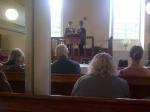 the way to oblivion and back. Their clothes were fantastic, just like their imagination.

 scribblingadvocate