The Magpie and Stump and Barristers’ Clerks
The photograph shows the Old Bailey from the north and the Edwardian entrance to the Central Criminal Court is the archway on the left of the picture. Facing it is a large white build which is on the site of a public house
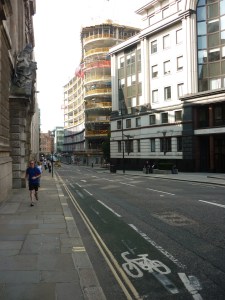
Old Bailey
called The Magpie and Stump. I think there is still a pub there tucked into the modern office building but not as I remember it.
There has been a Pub here, at the corner of Bishops Court, for over 300 years. When Newgate Prison stood opposite, where the Central Criminal Court is now, and public executions took place outside it, the upper rooms of the Pub, overlooking the street and the gallows below, were rented out to wealthy people, who wanted to watch the public executions.
While the lower classes were crammed into the street below, the rich were able to get a good view of the proceedings, while enjoying a “hanging breakfast” for a cost of 10 pounds or more. They must have been very rich-ten pounds seems a lot for breakfast even now, but I suppose they had steak, lamb chops, devilled kidneys and as much ale and porter as they could drink.
When the crowd of spectators below stampeded on one occasion, the Pub acted as a temporary hospital for many of the injured. The landlord is said to have collected several cartloads of discarded items of clothing from the street after the tragedy.
The Pub also supplied condemned prisoners with their very last pint of ale. The ale was taken across the road to the prisoners, in their condemned cells, on the morning of their executions. The last hanging took place there in 1868.
In 1718 it was described as being the hangout of ‘thieves, thieftakers and turnkeys, when I began my pupillage it was a meeting place for lawyers, police officers and journalists. Not much had changed then ! The interior was very theatrical , all red plush and brass fittings, The seats were arranged in booths so that conversations could be conducted in private and I suspect many a secret was spilled in those dark recesses.
Another group associated with the lawyers who worked in the Court were their clerks. Charles Dickens described one of a group of clerks at the Magpie and Stump as ‘a young man with a whisker, a squint, and an open shirt collar (dirty)’ putting emphasis on their shabby gentility which, he thought, was never quite overcome. Newspapers of the time supposed them ‘dapper’ and used phrases like ‘spruce young lawyer’s clerk’ or a barrister’s clerk ‘genteelly dressed’
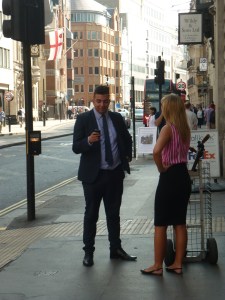
Barrister’s Clerks – Loitering with Intent
I took this photograph of two clerks I saw at the top of Middle Temple Lane, no doubt sharing gossip about their senior clerk and the barristers for whom they work. They are still very distinctive when you see them scampering about The Temple or up and down Chancery Lane. Now of course some of them are women and they have mobile phones.
Middle Temple Lane London
One of my favourite books is Bleak House by Charles Dickens. Indeed it was the first book on the reading list when I began to study law at the University of Sheffield. In it Esther Summerson describes going into Old Square Lincoln’s Inn ‘we passed into sudden quietude under an old gateway, and drove on through a silent square..’ and in The Mystery of Edwin Drood the change as one passes into the Inns of Court in this case Staple Inn is evoked in these words – ‘It is one of those nooks the turning into of which out of the clashing street imparts to the relieved pedestrian the sensation of having put cotton in his ears and velvet on the soles of his boots.’
I’m not sure it is so quiet these days but walking into Middle Temple towards Fountain Court one does leave much of the bustle of modern London at the entrance. Today the gateway under the sign of the Knights Templars is guarded by a modern barrier to prevent any entry by motor vehicles. It does look rather incongruous.
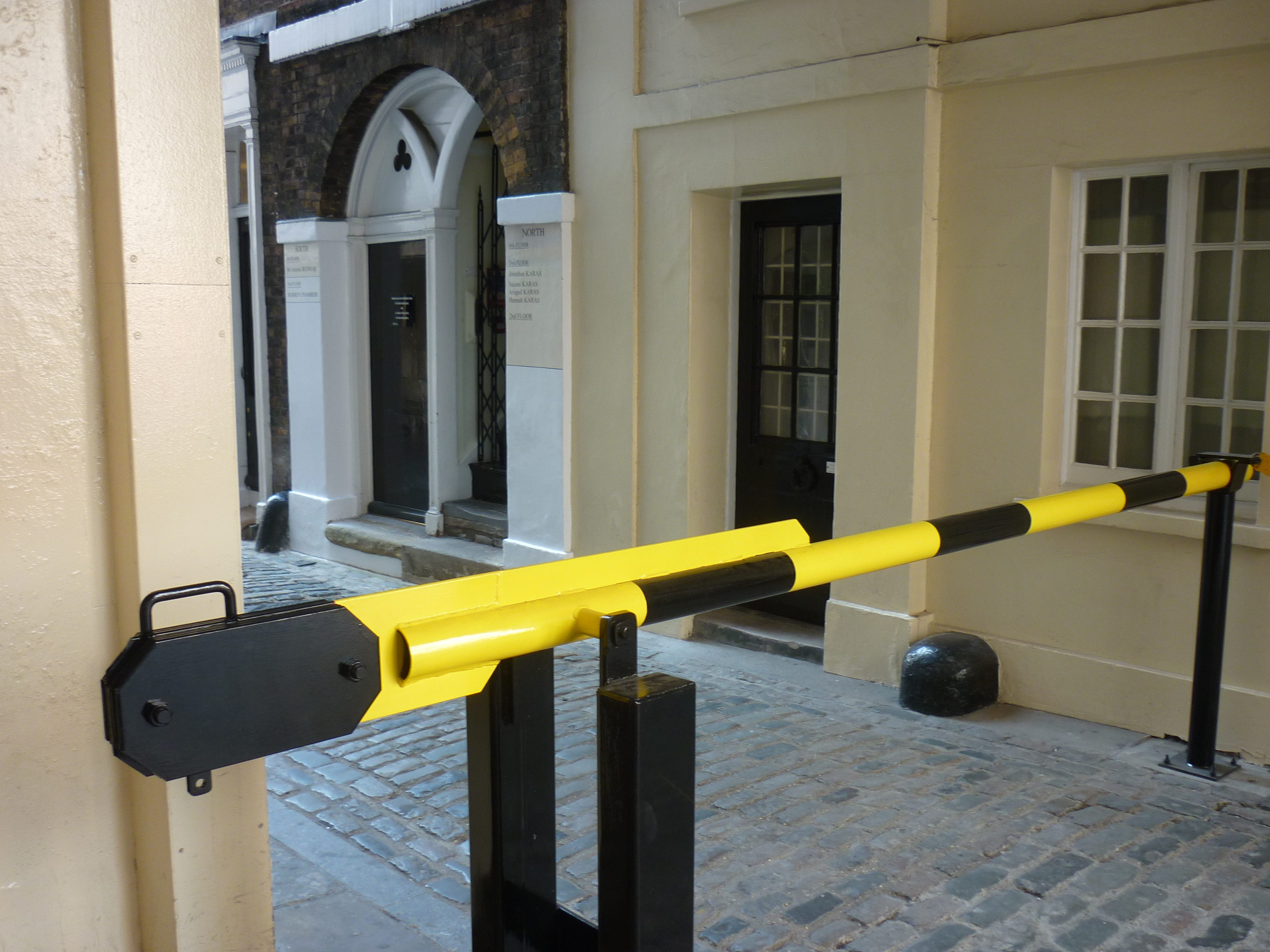
Gate to Middle Temple
There is a small shop at the entrance that is now the premises of Thresher and Glenny Tailors and Outfitters for three hundred years, the blackboard proclaims along with the boast that they were the inventors of the Trench Coat and through the window I could see a khaki coloured coat looking rather battered as if it had lived through two world wars, as indeed it may have.
As I walked down Middle Temple Lane where my imaginary Burke Court is set squeezed in between other sets of Chambers, rather like platform 9 and 3/4 at Kings Cross nothing has changed for two centuries, although I suspect it is rather cleaner than it was. I did see a noticeboard with posters warning about terrorist threats, thefts and events in Middle Temple Gardens; similar lunches may well have been enjoyed in the Garden, indeed the Inns were known for their conviviality, but City of London Police posters would not have been evident until recently.
In Fountain Court, where John Westlock woos Ruth Pinch in Martin Chuzzlewit, the fountain splashes into the round stone basin, the mulberries stain the ground around it and a young man eats his lunchtime sandwich from a Pret A Manger carrier bag. 
I have described The Temple in the following passage taken from my novel, Crucial Evidence-
‘Cassie’s chambers were at 3 Burke Court, part of that area of London inhabited by lawyers for centuries and known as The Temple. Walking through the arch bearing the Pascal Lamb, was like time travelling; each time, she was stepping out of the tumult of the twenty-first century into the ordered calm of the eighteenth. She was reminded of her home town, where similar Georgian buildings surrounded the castle, built by John O’Gaunt, which remained a centre of law and punishment, judges and offenders at its heart. So unlike The Temple which turned its back on the bulk of the Royal Courts of Justice across the Strand, a row of the banks and sandwich shops providing a barricade to the noise of traffic and the bustle of pedestrians, and creating a sanctuary of narrow lanes and courtyards for its lawyer inhabitants.’
As I have remarked here the changes are ‘de minimis’ to quote a legal phrase.
Fleet Street London 2
Researching Fleet Street for my novel I was reminded about the advice to look above shop window level to see what the buildings really looked like. I was doing just that when I noticed the number of different type of signs that shops displayed. The American interlopers MacDonalds and Starbucks had bland fascia boards on their shop fronts – so did Sainsburys so we can’t just blame trans-Atlantic invaders. Not surprisingly the pubs and wine bars had more distinctive signs.
So I wrote the following in my second Cassie Hardman novel,
‘She noticed the sign above the Punch public house, a gold painted profile of the character holding his truncheon aloft.
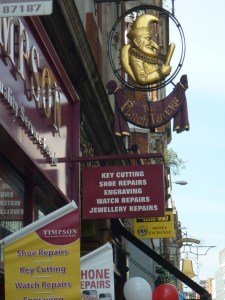
The Punch Tavern
Then she saw the three gold balls of a pawn brokers, next to a sign proclaiming they were pawnbrokers of distinction. She wondered how long there had been a need for them so close to the Temple and what the phrase ‘a pawnbrokers of distinction’ meant; did they only deal with people of distinction or only lend money against objects of distinction. Whichever it would rule her out.

Pawn Brokers of Distinction
In an optician’s window she was amused by a poster for spectacle frames by Lanvin; a hundred or so sketches of faces with little bits of colour, a green bow tie or purple earrings, but hardly any glasses.

Optiicans
They walked past what had once been the entrance to Sergeants Inn. Cassie glanced into the courtyard where there was a large green elephant. She pondered on what the animal was meant to represent or indeed why it was there at all.

Sergeants Inn
Soon they were under the oval sign of El Vino’s wine bar. The painted glass, in addition to the name, had the words Spain, Portugal, France, Germany Wines. What no Australian, New Zealand or Chilean, she thought. She remembered her pupil mistress telling her that at one time women were not allowed into the wine bar unless accompanied by a man and then they had to sit in the rear of the premises.
As they drew level with the faded sign of the three squirrels outside Gosling’s Bank, she heard James’s voice as if it was coming through water, asking her something about accounts. She shook her head as if to shake out fluid from her ear. ‘Sorry, I was miles away. You were saying?’
Gosling’s Bank
To the Grandfather I didn’t know
Last night August 4th 2014, like many others I watched the broadcast from Westminster Abbey. We had switched off all our lights at 10pm and had a single candle glowing in the dark, as we commemorated the date and time a century ago when Britain plunged into World War I. My Grandfather was not killed during the war, but he died early from the injuries he received. He was gassed and never fully recovered from that, so that my Grandmother, a weaver, as many women were in Lancashire, continued to work after the war ended in 1918. 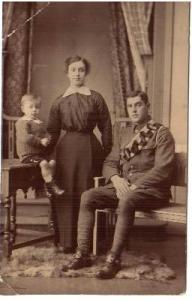
He died before my mother was married in 1939. Her brother Jack the child in the photograph was the one who walked her down the aisle to giver her away; my Grandmother would have walked alone. Although he knew he had one grandchild, Keith the eldest son of my Uncle Jack, he never knew about Roger, Keith’s brother nor myself or my younger brother Stewart. My Grandmother was a widow for over thirty years, dying when I was 26. Not for her the comfort of a shared life, shared memories and experiences into old age.
We, his grandchildren, never knew him and I don’t remember either my Grandmother or my Mother reminiscing about him. I don’t know which regiment he served with or what he did during the war. I know he loved horses and from time to time my mother said he would groom and harness the team of horses that drew the hearse in the small town of Haslingden Lancashire; black horses whose coats gleamed and who wore black ostrich plumes on their heads. He must have been interested in Art because I have a set of three books published by Odhams Press of Long Acre London in 1934 called The Worlds Greatest Paintings. My mother said they were an offer by one of the daily newspapers.
Of course, compared with too many, my family were lucky he did come back alive when so many didn’t. But the only way I can remember him is by this photograph; for me he will always be a handsome soldier with a pretty wife and young son.
Fleet Street London
The protagonist in my novel Crucial Evidence, Cassie Hardman walks from the Old Bailey to her chambers in Middle Temple Lane and as my novel is set in contemporary London I wanted to find out how much it had changed since the days when I took the same route. At the beginning of my career Fleet Street was the home of the newspapers. Here journalists and lawyers rubbed shoulders in the pubs and bars, although only males if El Vinos was your drinking hole of choice.
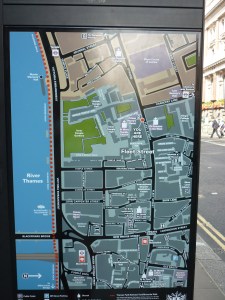
Fleet Street
As you can see from the map along the street are some fascinating places redolent with history. I have already mentioned St Brides Church but not the Institute and Printing Library, which is attached to the church. Shoe Lane runs north and there is a library on the western side of that lane. Between Shoe Lane and Fetter Lane are a number of Courts, narrow lanes and squares of a type familiar to all who read Dickens. Dr Johnson’s House.a 300 year old town house nestles among these narrow lanes at 9 Gough Square (see http://www.drjohnsonshouse.org) On Fleet Street is the public house with which the Dr is associated ‘The Cheshire Cheese.’
On the same side of the road is the building that was occupied by the Express group of newspapers. The curve of black glass a contrast to the shop fronts next to it. It is difficult to tell what the building is used for now. I noticed a number of serviced offices being advertised. One of the old Inns of Court, Sergeants Inn has become a hotel. The photograph shows it with the ground floor hidden by the red London bus.
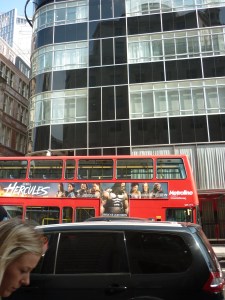
The Express Building
Some things remain the same, the signs outside the public houses, but there are now banks, coffee shops and the small stores the supermarkets have reinvented rather than the offices of newspapers. The Church on the right in the photograph of the map is St Dunstan’s in the West.
St Dunstan-in-the-West was a well-known landmark in previous centuries because of its magnificent clock. This dates from 1671, and was the first public clock in London to have a minute hand. The figures of the two giants strike the hours and quarters, and turn their heads. There are numerous literary references to the clock, including in Tom Brown’s Schooldays, the Vicar of Wakefield and a poem by William Cowper (1782):
When labour and when dullness, club in hand,
Like the two figures at St. Dunstan’s stand,
Beating alternately in measured time
The clockwork tintinnabulum of rhyme,
Exact and regular the sounds will be,
But such mere quarter-strokes are not for me.
The courtyard also contains statues of King Lud, the mythical sovereign, and his sons and Queen Elizabeth I, all of which originally stood in Ludgate. The statue of Queen Elizabeth I dates from 1586 and is the only one known to have been carved during her reign. Taken from the website http://www.stdunstansinthewest.org Here too there has been change as the church now caters to the Romanian community in the city.
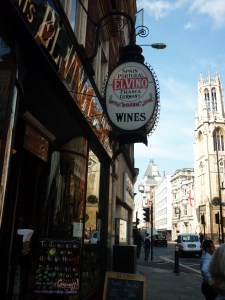
El Vinos
El Vino’s was of course the inspiration for Pomeroys Wine Bar beloved of Rumpole in John Mortimer’s books.
One of the other changes I noticed was that the vehicles using the street were mainly the buses, taxis and the little white van. Private cars pushed out by the congestion charge no doubt. Parking was always a nightmare, very expensive and difficult to find a space.
Old Bailey London
My novel Crucial Evidence is set in the London with which I was very familiar. Until a few years ago I was often working at the Central Criminal Court, more commonly known as the Bailey to the lawyers who work in there. The original Edwardian building houses the famous Number 1 Court and the hall with its painted ceiling. Next to that, opened in 1970 by the then Lord Mayor of London, is a newer building in which the courtroom 12, where much of my novel takes place, is situated. My journey to work was by Central Line Tube from Notting Hill Gate to St Paul’s. The map shows where the Old Bailey is on the edge of the City of London.

Map of area around the Central Criminal Court
I would walk along Newgate Street to the Old Bailey which is the name of the street which gives its name to the court. Quite often, when a terrorist trial was taking place the police would hold the traffic and pedestrians back at the junction with Warwick Lane to allow the prison van to sweep into the yard of the court. They would be dressed in bullet proof vests and carrying guns. I thought it was a bit stupid to hold up to twenty people where they would be in the line of fire if anyone tried to free the prisoners. The police may have prevented the escape but they risked a number of dead bystanders.

Junction of Newgate Street and Warwick Lane
I wanted to see if the area had changed since I had last been there and if, when I described the places my main character, barrister Cassie Hardman would see on her journeys around the area, they were the same as I remembered them. In the novel Cassie stands in the Bailey looking out onto a wet street scene. She describes the cobbles of Seacoal Lane glistening in the rain. If you look at the map, the lane has vanished into the middle of an office block. In another scene she looks sees the spire of St Brides Church – the journalist’s place of worship – now a new building under construction will hide it from view, if it has not already done so.

St Bride’s Spire

Artists Impression of a new office block on Old Bailey
I will have to do some editing when I come to the part in may next novel, whose working title is The Fatal Step where Cassie is looking out of the windows of the Bailey. At the moment as she gazes across the city the spire of St Brides in sparkling sunlight, but it will not be visible so instead she’ll have to look at the glass of the building opposite. But at least it was worth while going to London and walking around to see these changes for myself and, of course see how or when I can work them into my story. I’ll continue my walk along Fleet Street another time, but there have been changes there as well. Creating that sense of place in a novel really does rely on knowing the streets scenes you are writing and there is nothing like walking around with a camera and capturing it to take back to your desk.
Chudleigh Literary Festival
How time flies it’s nearly two weeks since the Chudleigh Literary Festival took place and I’m still trying to absorb everything I learnt at the workshops.
Workshop
We started with character building with Patrica Fawcett. We had to create a character from a photograph. I know it’s quite a common teaching aid but I’m always surprised by the way the characters evolve when I begin writing. Naming the character can be difficult and until you decide what their social status is – I always think of Hugo as being a bit snobbish so if my character is from a social housing estate then I’d call him something else.
Then we looked at place specific writing led by Oriana Ascanio. She took us like a crocodile of school children into the churchyard to write about a burial from the point of view of a huge pine – again a change of perspective is always challenging. The next exercise was to imagine you are a saint and part of you is kept somewhere in the Church. Some people did some amazing things with that being the patron saint of lost things was one, but I found imagining my self as a saint a bit difficult.
Our next workshop was on how to write your memoir. Sophie King encouraged everyone to try write their life story as she believed we all have something to tell the next generation. She asked us to think about the major events in our lives and write about one. Again the group came up with some really interesting stories. Then it was poetry with Jennie Osborne. I haven’t written poetry for some time but listening to the sounds of your writing are important if you write prose. Again it was events from childhood that provided the most inspiration for the pieces we wrote.
The final event of the day was a ‘Meet the Authors Supper’ when about fifteen authors came and had supper with us. Their was a lot of laughter and exchanges of writing experiences over a meal and a glass of wine.

Chudleigh Writers’ Circle Stall
Literary Festivals
It’s summer and here in Devon it is the time for Literary Festivals both large and small.
I spent the whole of Monday at beautiful Dartington Hall where the Ways With Words Festival has held for the last twenty years. The highlight of the day or rather highlights among so many stars were the talks by Jill Dawson and John Goodby. Jill Dawson talked about her latest book ‘The Tell Tale Heart’ and explained how she works from real life events into fiction. She talked about writing in the gaps between the known facts. I think all writers do that to a greater or lesser degree. After all facts don’t have feelings and it is in that unknown place the writer can work.
I have been trying to read Dylan Thomas’s poems from a collection I bought many years ago at the boathouse in Laugharne South Wales, where he worked. The collection says on the cover that it ‘contains most of the poems  I have written, and all, up to the present year that I wish to preserve.’ The collection was published in 1952, a year before his death. I have been struggling with them so I was pleased to listen to John Goodby talking about Thomas’s use of word with multiple meanings, and his use of puns. I wanted to know if the collection was chronological as I found it hard to equate the poems I was reading (I’d got as far as Death has no Dominion) with ones like Fernhill and of course the humour in Under Milk Wood. Professor Goodby said I should wait until his annotated collection of Thomas’s poems is published in October which includes other poems and demonstrates how he developed over the years. It does make one query whether the author is the best judge of his own work? Is he too influenced by his own mood at the time?
Chudleigh Literary Festival
This is going to be a really exciting event beginning on Tuesday 9th July with Tony Hawks, author of ‘Round Ireland with a Fridge’ among other books, comedian and broadcaster -think ‘Just a Minute’. 
The next day 9th July there are a series of inspiring workshops by established authors to motivate writers both experienced and beginners alike. Patricia Fawcett, the author of seventeen novels including A Family Weekend, The Absent Child and her latest Best Laid Plans, will lead a workshop on ‘Creating your Character’.
Sophie King, journalist and award winning author of Tales from the Heart and The School Run amongst others will speak about ways to write ‘Your Life Story in Ten Easy Steps.’ Sophie also writes under the name Janey Fraser, After the Honeymoon, Happy Families and The Aupair.
Oriana Ascanio, the creative director at Resident Writers has chosen ‘Place-Specific Writing for her workshop.
And finally ‘The Stuff of Poetry’ workshop will have the benefit of Jennie Osborne who has published a collection of poems entitled How to be Naked. She is a member of Moor Poets.
And after that there is a stimulating event ‘Meet the Authors Supper.’ over an informal meal in the Chudfest Marquee there will be the opportunity to meet a number of local authors. This should be a great social and networking event. So far eighteen published authors have accepted including Michael Jecks, Simon Hall, Becky Gethin and Sophie Duffy.
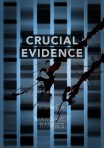 I am really looking forward to it and will be there ready to talk about my own novel Crucial Evidence


 scribblingadvocate