Life at the Bar – Going Equipped with Who’s Who.
The offence of going equipped to commit burglary doesn’t seem to feature in the courts these days, but as an articled clerk I was sent to sit behind Mark Carlisle on just such a case. The two defendants, both male, had been apprehended in one of the lanes in the countryside inland of Blackpool. The evidence against them consisted of observations by the police to whom they were well known and the various objects found inside their car, a grey Vauxhall, I think. 
The offence took place on a summer’s evening when an observant police officer had seen the two men, Ken and Norman, driving along a narrow lane that led down towards the River Wyre. He knew it was a dead end, so he radioed for help and an unmarked car arrived. When the Vauxhall emerged from the lane and turned along the main road, the police care followed at a discrete distance. The car then turned down another of the lanes which went towards the River, another dead end. The police stayed on the main road keeping watch. This was repeated a third time, but this time the police followed and as it reached the entrance to a large house set in extensive grounds, they indicated the Vauxhall was to pull over.
Norman and Ken got out of the car and went to meet the officers. As the two policemen, DC Smith and DC McKie, approached Norman, he pulled his wallet from the back pocket of his trousers and began searching through it.
‘Here’s my driving licence and I’ve got insurance as well,’ Norman said, waving the pieces of paper under the DC Smith’s nose.
‘Thanks,’ said the officer, pushing away Norman’s arm. ‘Let’s have a look in the car shall we.’
All four men strode towards the car. ‘What you doing round here?’ DC McKie said. He rolled his r’s and looked straight at Ken, who dropped his gaze.
‘Looking for work. Been told some guy wanted a job on his roof,’ Ken said.
‘What’s this guy’s name then?’ McKie said.
‘Don’t know, just told where he lived.’
By this time they had all reached the vehicle and the two officers opened the boot. Inside was a bag of tools, spanners, screw drivers, a couple of hammers, and laid across the base the dark metal of a crowbar glinted in the low summer sun.
‘Doing a roof were we; with a crowbar.’ McKie wasn’t expecting an answer.
Norman spluttered. ‘Yes, guv. We were going to see this guy about some work.’
‘Where does he live, this bloke you were going to see?’ Smith said, as he opened the front passenger door.
On the floor was a piece of paper torn from a reporter’s notepad, the type anyone can buy in WH Smith’s. ‘We had a map…’ Ken pushed past the officer, leant into the vehicle and picked up the sheet of paper. ‘We’d met this guy in the pub. Said he had a few jobs we could do and he drew this map of where his house was. Here, see.’ He thrust the piece of paper into DC Smith’s hand.
The map had been drawn by an inexpert hand, but it clearly showed a lane of the main Cleveleys to Singleton Road. The drawing showed two or three houses along a twisting lane that led down to towards the River.
DC Smith sucked his teeth as he contemplated whether to arrest the two men. He didn’t believe a word they were saying, but with a good defence lawyer they would probably be acquitted. Was it worth the paperwork involved; whatever they were up to they had been stopped in their tracks.
‘Well not sure…’ he said, but was interrupted by DC McKie who was holding a book in his hand.
‘What’s this. A copy of Who’s Who. Now what would you be wanting with this then?’
They were arrested and charged with going equipped with a crow bar, spanners, various tools and a copy of Who’s Who. Despite Mr Carlisle best endeavours both men were convicted.
Life at the Bar – Boundary Disputes
Articled Clerks always get the worst jobs in the office. On my first day in the office amongst the files I was given was one very thick bundle of papers. It contained correspondence going back for about six years. Our clients owned a bungalow on the main road east out of Cleveleys, a small seaside town close to Blackpool Lancashire. The land had originally been farm land but strip development had taken place. The farmer who had sold off the plots of land had retained a strip wide enough for his farm machinery to get into his fields. But that had been many years before and his tractor was now too wide to get along the track. He maintained the owners of the bungalows on each side had planted hedges on his land which had matured and were now impeding his access. 
Our clients disputed this and argued that the hedges were inside the boundaries. Among the papers were copies of the plans from their conveyance. Land in east Lancashire was not registered with the Land Registry at the time. I looked carefully at the plans but they were of very little assistance. They were endorsed with the phrase, ‘This plan is for the purposes of identification only and not of delineation.’ That meant they were not to scale, and anyway the thick red pencil line would have made it difficult to measure with any accuracy.
I dreaded telephone calls from our clients, made slightly worse because the wife’s voice was that of a tenor’s and I couldn’t tell which of them I was speaking too. Fortunately, the solicitor for the farmer thought the whole thing was hilarious and, in his view, incapable of solution. ‘My client will just bulldoze his way through. They’ll want to sue for the damage to their hedge and you’ll tell them that is not a good idea. Then it will all die down until the next time. Just put the file to the bottom of the pile and tell them you’re working on it.’
I wasn’t too happy with that. I wanted to make a good impression with my principal and with the clients, although I thought the farmer’s solicitor was probably right so, despite my misgivings, I took his advice. My salvation came in the form of Trevor, a rather chubby young man, who was the new articled clerk.
He had already been given a few files to work on when he came into my room to see if I needed any help. ‘Well, there is this,’ I said, handing him the dog eared bundle.
A couple of weeks later he came into the office looking very smug. ‘I’ve solved that boundary dispute,’ he said. ‘I went round, got the farmer there, together with our clients, and we pegged out the boundary.’
It was only a couple of days later I was driving along the road and as I passed our clients bungalow, I noticed a pile of white pegs dumped on the grass verge.
Back in the office, I told Trevor, not to bother with the bill and to put the file at the bottom of the pile.
@BudleighLitFestival
What could be better than books and the beach – they go together like love and marriage. After a swim in the sea, I went to the opening lecture in the Public Hall. Erica Wagner was in conversation with Helen Rappaport a scholar of Russian affairs. Her book Caught in the Revolution – Petrograd 1917′ considers the revolution as it appeared to foreign nationals living in the city. 
The Winter or 1916/17 was very bad and hunger stalked the city. There were queues for bread and it was this that drove the revolution in February of 1917. It was a grass roots revolution unlike the events of October that brought the communists to power. Nor was it as benign as the official figures would have the world believe. Rappaport believes many hundreds died their bodies stiff with the cold and carried off by their relatives. The weather was a major influence on the conflict, if it was very cold there was less violence.
Amongst the foreigners whose eye witness accounts Rappaport has utilised for her book are diplomats like the British Ambassador George Buchanan, the American Ambassador David Francis and his valet Phil Jordan. Jordan was an African American who had been taught to read and write by Francis’s wife. His letters are ungrammatical and have no punctuation but provide a vivid and immediate account of the events.
A number of women journalists provided accounts of the revolution and often photographs and film taken by the cameraman accompanying them. Emily Pankhurst arrived as well to support women who were being urged to persuade their men to fight in the Great War. Everyone was obsessed with food and if you were rich you could get hold of it, but if you were poor you starved.
The February Revolution deposed the Czar, but the weak government that followed allowed the communist to have their revolution in October. The Russians need a strong leader/Czar.
Then it was back to the beach hut for lunch.
In the afternoon I went to the talk given by the President of the Festival Hilary Mantel. Professor Helen Taylor from the University of Exeter was the interviewer. The subject was writing short stories perhaps prompted by the outrage in some of the press about ‘The Assassination of Margaret Thatcher.’ Mantel read a new short story called ‘In a Right State.’ Mantel said she was unable to write commissioned short stories, she needed all the elements to come together before she could get them to work. This one set in a hospital waiting room had three sources. One was the sort of questions asked by newspapers of celebrities like ‘what was your best kiss?’, a comment in one of Alan Bennett’s diaries about going to A&E for recreation. (As an aside she said she had asked Bennett to come to the Budleigh Festival but she said he is rather frail and doesn’t go out much, anyway he thought Budleigh might be too frisky for him.) was the second and the third was the news stories this winter about floods and the crisis in the A&E.
Talking about writing short stories she said one of the differences between a novel and a short story was that the writer had to use voice to capture characters that hints at the back story. The writer must find the best words in the best order. In a novel technique can take you through the difficulties but not a short story. They cannot be forced.
She confirmed my own experience, it’s hard to write a short story.
Life at the Bar – Inquisitive jury
What happens when one of the jury decides to investigate issues in a trial? I was defending a man charged with importing a Class A drug, namely cocaine. The defendant whose name was ‘Gray’ had arrived in the UK from Jamaica via Amsterdam. The car that collected him from Gatwick was followed through the streets of south London by detectives in an unmarked police car. They claimed a package had been thrown from the nearside front window of the car and they had radioed for assistance before stopping the vehicle. The occupants were asked to get out and my client ran off. He didn’t get very far before he was arrested and searched. Nothing incriminating was found on him nor in the vehicle. 
A search began to find the item thrown from the car. There was some difficulty in locating anything that fitted the description of the item. My client disputed he had thrown anything away although he said he might have dropped the packaging of some food out of the passenger window. Not surprisingly the police found plenty of that. After a thorough search of the area, a young police officer found a small parcel on the pavement of a nearby road. The difficulty for the prosecution was that the parcel was not found on the route the car had taken, nor close to where my client had run. In his defence, I relied on a set of plans of the area and cross examined the detectives as to which streets the car had been driven along and which ones my client had run along. No police officer was able to say they had seen anything dropped by the defendant as he ran away.
When the officer who had found the package was called he gave the name of the street in which he had found the package and he identified it on the plans. He relied for his evidence on notes he had made as soon as he returned to the police station, as he was entitled to do. I got him to mark the map and asked the jury to do the same on their copies. His explanation for the package not being in the road the defendant had run along was that he must have thrown it over the garden walls.
The next day one of the jurors handed a note for the Judge to the usher. He had been to look at the scene and he judged it was impossible to throw anything from one street to the other. The Judge was very annoyed because the only evidence a jury can take into account is that which they have heard in court. He had two options. The first was to abort the trial and start again with a different jury, or allow all the jury the opportunity to look at the location. He chose the latter. We all had to wait until the afternoon before a coach could be arranged to take the jury and a car to take the Judge. Counsel and the police officer had to make their own way there. My recollection is that I walked and still arrived before the coach. When the young police officer saw the street he had named, his mouth fell open as he realised he had made a terrible mistake. The Judge was furious.
Had the defendant been in possession of the drugs or was it a plant by the police? The jury came to the conclusion they couldn’t be sure of the defendant’s guilt and acquitted him. I’m sure that police officer would never make the same mistake again.
There was another feature of the case that makes it stick in my memory. ‘Gray’ was a professional musician and claimed to have played with Bob Marley.
Life at the Bar – The Lemsip Rapists 2
At the start of the trial, the QC representing the older man and the QC leading me for the younger one made applications to sever the trial. The Judge was not having that. In some ways it was less of a disadvantage to us than it was for the co-defendant, because if his counter allegation of blackmail succeeded it was unlikely the jury would convict our client. What emerged during the trial was that the young woman had gone home and told her family what had happened, her father and brother had then gone to the Hotel and confronted the two men, threatened them and demanded a very large sum of money, my recollection is something in the region of £25000 with the promise the allegation of rape would not be reported to the police. The family members just happened to all have criminal convictions for armed robberies and a previous for extortion, which lent some credibility to the older man’s story. 
Some payment was made and again the defence for the older man could prove that on the day the family members had visited the Hotel and gone up to the suite, a sum of money was drawn on cash from the elder man’s bank account. He said he told the girl’s family he needed time to raise the rest of the cash.
One of the facts that may have supported that was the delay of a few days before the rape was reported to the police. From the prosecution point of view it meant that there was no forensic medical evidence to support the allegation. For example blood samples did not reveal the presence of any drugs. The interval between the offence and it being reported allowed the defence to argue the delay was to see if they would get the rest of the money they had demanded. Instead of trying to raise the extra sum the elder defendant left the Hotel and was arrested at Heathrow on his way back to the Middle East. My client had no such opportunity to escape and was arrested the next day. During interviews the older man chose not to reply to any questions he was asked by the investigating officers. My client would have done better to do the same, but he chose to answer questions insisting the sexual intercourse was consensual.
The trial lurched from problem to problem, as the evidence was given before the jury. The young woman maintained they had both raped her. Her father and brother both said they had been to see the two men; they said with the intention of a revenge attack but then thought better of it. The elder man’s reluctance to say anything about his unsavoury business didn’t help anyone. The two defence Silks were continually arguing and attacking each other which allowed the female Silk prosecuting to have a field day. The favourite phrase was ‘It’s like trying to fight with one hand tied behind your back.’ Not surprisingly both men were convicted and were sentenced to seven years imprisonment.
Did the court hear the truth and nothing but the truth. I don’t think they did. I believe there was more to this, than any of the parties were prepared to admit. I know what I think, but has anyone else any thoughts on this case.
Life at the Bar – The Lemsip Rapists part 1
Sometimes a case can seem so bizarre that no writer could ever invent such a script. The pair described in the press as the Lemsip rapists were just such characters. The two men were an unlikely pair, one of Middle Eastern extraction, aged about fifty and the other a thirty something Londoner who had made good. The scene of the rape was a top floor suite in a Park Lane Hotel. The suite comprised two bedrooms, each with its own bathroom, a sitting room and a dining room which was furnished as an office. The elder of the two was an arms dealer who, when he was in London, lived and worked from this suite of rooms. He wasn’t my client so I was never privy to the ins and outs of his business, just enough to know it was very lucrative. My client was the younger man who was employed to run the office and ensure all the paper work for exporting weapons was in order.
Most of the work involved meetings with clients, discussing their requirements that seemed to range from hand guns to helicopters, arranging the purchase and most importantly ‘end user certificates’. These certificates are meant to limit the sale of armaments to persons or countries of which our government disapproves. I wasn’t in any doubt that most of the transactions were illegal. 
The young woman who alleged rape was another employee. She was a temporary secretary who was recruited through an employment agency. It was quite a nice job. The pay was good, the hours flexible and lunch, as well as tea and coffee, was available from room service.
On the day in question, she had come into work with a very heavy cold and during the course of the morning the older man prepared a glass of Lemsip for her and told her to go and lie down in one of the bedrooms. Her case was that he had put some drugs into the drink which made her very drowsy and she had passed out, only gaining consciousness when he was on top of her and having sexual intercourse. Further, she said, when he had finished my client had come into the bedroom and also had intercourse with her against her will. Both men denied the allegations but when interviewed by the police they told very different stories from each other, stories that were mutually incompatible.
The older man said the woman had made the allegation up and she was trying to blackmail him in respect of some of the arms deals he had made. My client said his employer had raped the girl and she had sought solace in his arms and that had resulted in them having intercourse. It was an almost hopeless case to defend, not only was there this conflict between the two defendants but a forensic examination of the hotel suite found traces of a white powder that were crushed sleeping tablets. Both men denied having brought any drugs into the hotel arguing that the rooms had been used be a number of guests in the preceding weeks. They said, and it seemed plausible, the insides of wardrobes and cupboards were not always swept clean.
The trial took place at the Old Bailey.
to be continued
Life at the Bar – Paying the Price
Sitting in a Magistrates Court waiting for your case to come on can be very entertaining. I was doing just that at Bow Street Magistrates Court when a man was brought before the Stipendiary Magistrate for an offence of indecent behaviour in a Royal Park. The man had picked up a prostitute on Park Lane and they had gone into Hyde Park to complete the transaction. A policeman had caught them ‘in delicto flagrante’ under a tree.
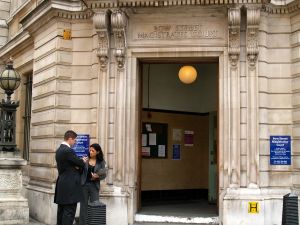
Bow Street Magistrates Court
‘I allowed them time to straighten their dress which was in some disarray and then arrested them,’ the officer said with the sort of straight face only a police officer in court can muster. The man pleaded guilty and the magistrate imposed a fine warning him that the consequences may be more severe if he was caught again and may result in him having to explain to his wife where he was and why.
The next person in the dock was the prostitute. She had a long list of previous offences for soliciting in a public place, but the Magistrate was reluctant to do anything other than fine her. When he told her how much she would have to pay, she asked for time.
‘Have you no money with you?’ the magistrate asked.
‘No.’
The court officer confirmed she had only a few coins in her possession and a return ticket to Birmingham where she lived. She was one of a number of woman who came to London and solicited on Park Lane near the hotels in order to supplement their benefit.
‘Did you not get paid last night?’ the magistrate said.
‘No, Sir.’
‘Has Mr X gone?’ said the Magistrate to the court officer.
The policeman put his head round the door to the custody area, turned back and said, ‘He’s still here, Sir.’
‘Right bring him back.’
Mr X was led back into the courtroom, somewhat bemused, and stood facing the Magistrate.
‘You didn’t pay her last night,’ the Magistrate said, nodding towards the woman in the dock.
‘No, there wasn’t time.’
‘Well there is now, you’ll pay her fine.’
And with that both were dismissed from the Courtroom.
Life at the Bar – The Unquiet American part 2
Walt was an interesting character, half American and half German. He had two older sisters. Their father was a GI serving in Germany. Walt told me the American Army were against marriages between natives and members of the armed forces. Nor were they interested in assisting immigration by families any soldiers had established in Germany. His father was sent back to the USA leaving his mother to bring up the three children alone in a war torn country.
His father kept in touch with the family but after a few years he wrote to say he had married an American woman, (shades of Pinkerton) and he wanted the children to come and live with him so they could have a better life. His mother reluctantly agreed, believing the USA to be some kind of promised land. The two girls went first and Walt joined them when he was seven. To his horror, he found himself taken to a wooden shack in the back woods of Mississippi, where he and his sisters were treated as little more than slaves. Their father’s wife instead of being a mother to them forced them to do a lot of the housework. There was no electricity, no running water and Walt’s job was to chop what seemed an endless supply of timber. They were forbidden to speak German together and were beaten when They were not given any education at all. 
One day when he was about nine years old Walt decided to run away. He was fortunate in making it to the highroad where he was picked up by the local sheriff. The equivalent of our local authority was informed. The two girls were taken from their father and all three were placed in the care of the Local Authority. However the three siblings could not be kept together and they were adopted by different families. Walt ended up in Florida living with a quite wealthy couple who had no children. They encouraged him to speak German and he went to university. When they died he inherited their wealth. He said there was not an enormous amount but enough for him to come and live in the UK, buy a modest flat in London without having to find work. He did describe himself as a writer and poet.
After he moved to the UK, he began to search for his mother and his sisters and was able to locate his mother just before she died. His father he never wanted to see again. Just before the incident he had found his sisters and they had an emotional reunion in the States with the sheriff who rescued them. He showed me newspaper cuttings about their meeting.
The trial in the Crown Court took four days. We had sought discovery and had obtained the papers about the murder investigation which illustrated how close local police officers had become to the family. The Judge, probably on the basis that it could do no harm let the evidence about that relationship be given to the Court. Similarly, I was allowed to ask the sergeant about her connection with the family and to ask her about her bias in favour of the fish shop owner.
Walt gave evidence and admitted the threatening words in the witness box, but he was acquitted of the common assault charge. He wasn’t happy about that. I advised him he had no grounds to take the matter to the Court of Appeal and I thought he had accepted that. Then I started to get letters from him asking to see the notes I had taken at the hearing and a copy of my closing speech. I declined and he reported me to the Bar Council. Something every barrister dreads. When I explained the reasons for not letting him have my notes the Bar Council dismissed his complaint. Anyway, my writing was so bad I couldn’t read the notes of my speech, so I doubt they would have given him an assistance.
Life at the Bar – The Unquiet American
In the calendar of offences, threatening behaviour comes fairly near the bottom, although it can have disastrous consequences. It is an offence for which there is no right of election to have the case tried by a jury, so most senior barristers are only rarely instructed in such cases. However, I was instructed to represent a defendant who had been convicted of threatening behaviour and a common assault in the Magistrates court and was appealing that decision to the Crown Court, where the court would comprise a Judge and two Magistrates.
The defendant was an American and was in his late forties. I can’t remember his name so I’ll call him Walt. The circumstances of the case did have an unusual twist. Walt had gone to buy fish and chips at a shop near to his home. He had gone on his bicycle intending to return with a meal for him and his girlfriend. He had gone by bicycle and when he went into the shop he propped the bike up against the plate glass window. As he joined the queue, Mike, one of the grown up sons of the owners, who was serving in the shop, asked him to move it. Walt began to argue with Mike and the language became more abusive. The abuse escalated when Walt said Mike’s brother, who had been murdered about eighteen months previously, had probably deserved it. 
Mike grabbed hold of the bike and threw it into the road, damaging the front wheel. Walt was very angry and a scuffle started. The police were called and Walt was arrested. At the police station, Walt was interviewed under caution by a woman detective sergeant. He said she was rude, refused to listen to his account of the evening’s events and told him the damage to his cycle was minimal. Furthermore, she had no intention of arresting Mike for an offence of Criminal Damage, nor for any assault on Walt. It transpired later she had been involved in the investigation of the murder of Mike’s brother and, at one stage had been the family liaison officer. Walt’s view was that she was a biased investigator in his case and, he believed, could not envisage the shop owners and their family could lie. He may have been right. Unusually the local police station had conducted the murder inquiry rather than the Murder Squad. I assumed it was because the murderer was known and had recently been released from a secure hospital in the area.
As a way of proving the police were not independent of the fish shop owners family, Walt decided to keep watch on the premises and count the number of times officers arrived and, he said, were given food. There were further incidents but none serious. No one was arrested but Walt was warned not to persist in his surveillance. He didn’t take any notice of the warning and continued often in disguise. He didn’t fool anyone and in the end, an injunction was obtained to keep him away from the shop.
When the case came to trial in the Magistrates Court, Walt was convicted. The evidence he had put together alleging police bias was disallowed. He decided to appeal and it was then I was instructed to represent him in the Crown Court.

 scribblingadvocate