The Fatal Step
This is the working title of my new novel and so far I am about half way through the first draft. Some how the summer has not been conducive to writing – who wants to be stuck in front of a computer when the sun is shining outside. I think too, I am rather daunted by the task I have set myself. I didn’t think about it with Crucial Evidence. I’d started that as part of my dissertation for my MA and I just kept going until I’d finished. Then I drafted and redrafted without thinking, each time telling myself that this time it would work and when I sent it to agents someone would love. They didn’t and I began to realize that it wasn’t my writing that was the real problem but the type of book I wanted to write. Also talking to agents at places like Winchester Writers’ Conference and at The London Book Fair I knew any publisher would want a series of novels and I didn’t want to be tied to writing a book a year. In the end I decided to publish the book myself. In the process I’ve learnt at lot about writing and publishing, but that makes the mountain I have to climb much higher and harder than the first. I know how long it takes and how difficult it can be.
But you have to begin somewhere so this is the first page of my second novel. It follows the career of barrister Cassie Hardman as she gets her first leading brief in a murder case.
‘As Cassie hurried along the driveway from Snaresbrook Crown Court towards the tube station, she turned on her mobile phone. Amongst the emails from fashion houses, department stores and restaurants, there was a message showing the subject matter as Paul Sadler. He had been the defendant in a rape trial, who she had successfully defended at the Old Bailey the week before last. She didn’t recognise the name of the sender, Malcolm Delaney. Normally she was very careful about opening emails from unknown people but it was from someone who knew about her involvement in the Sadler case. She clicked the message open and read, ‘Miss Hardman, I wanted to congratulate you on your representation of Mr Sadler. Your cross examination was very effective and your closing remarks were obviously persuasive. Clearly they carried the jury along, as you know from the verdict. I would like the opportunity of congratulating you in person, and would like to invite you to have lunch or dinner with me. We can arrange a time and place later. I look forward to hearing from you. Malcolm’
The email gave no clue as to how Malcolm Delaney, knew she had represented Paul Sadler or what Delaney’s connection to the case was. Was he a police officer, a member of the court staff or just a spectator from the public gallery? She knew there were a number who came regularly to watch the proceedings at the Bailey; the staff described them as ‘groupies’ and she had been told by one of the ushers that some of them would ask which barristers were appearing in which court and make a point of watching their favourites’ cases. The wording of the message was a little old fashioned so perhaps it was one of them. The thought that one of the men from the gallery wanted to invite her to dinner amused her, but nothing more.
Back in Chambers, the senior clerk, Jack, summoned her into his room and closed the door behind her. On his desk were four lever arch files, tied with pink tape, the front sheet bore the title R v David Winston Montgomery. Jack beamed at her. ‘I’ve managed to get you a leading brief in a murder at the Bailey. I assume you’ll want to apply for silk in a couple of years. This is a good one; you’re ready for it, even though it’s a murder. None of the silks want this. Scared they’ll get tarred with a racist brush, I dare say. A woman won’t of course. Judge Crabtree is in a bit of a panic thinking the defendant might want to represent himself. I said, to Colin in the list office, my Miss Hardman can handle it. Spoke to Tim. Didn’t take long to persuade him you could do it. So there you are a leading brief in a murder.’
Any comments to make about that so important first page.
The Magpie and Stump and Barristers’ Clerks
The photograph shows the Old Bailey from the north and the Edwardian entrance to the Central Criminal Court is the archway on the left of the picture. Facing it is a large white build which is on the site of a public house
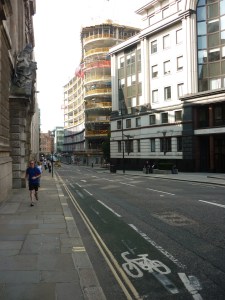
Old Bailey
called The Magpie and Stump. I think there is still a pub there tucked into the modern office building but not as I remember it.
There has been a Pub here, at the corner of Bishops Court, for over 300 years. When Newgate Prison stood opposite, where the Central Criminal Court is now, and public executions took place outside it, the upper rooms of the Pub, overlooking the street and the gallows below, were rented out to wealthy people, who wanted to watch the public executions.
While the lower classes were crammed into the street below, the rich were able to get a good view of the proceedings, while enjoying a “hanging breakfast” for a cost of 10 pounds or more. They must have been very rich-ten pounds seems a lot for breakfast even now, but I suppose they had steak, lamb chops, devilled kidneys and as much ale and porter as they could drink.
When the crowd of spectators below stampeded on one occasion, the Pub acted as a temporary hospital for many of the injured. The landlord is said to have collected several cartloads of discarded items of clothing from the street after the tragedy.
The Pub also supplied condemned prisoners with their very last pint of ale. The ale was taken across the road to the prisoners, in their condemned cells, on the morning of their executions. The last hanging took place there in 1868.
In 1718 it was described as being the hangout of ‘thieves, thieftakers and turnkeys, when I began my pupillage it was a meeting place for lawyers, police officers and journalists. Not much had changed then ! The interior was very theatrical , all red plush and brass fittings, The seats were arranged in booths so that conversations could be conducted in private and I suspect many a secret was spilled in those dark recesses.
Another group associated with the lawyers who worked in the Court were their clerks. Charles Dickens described one of a group of clerks at the Magpie and Stump as ‘a young man with a whisker, a squint, and an open shirt collar (dirty)’ putting emphasis on their shabby gentility which, he thought, was never quite overcome. Newspapers of the time supposed them ‘dapper’ and used phrases like ‘spruce young lawyer’s clerk’ or a barrister’s clerk ‘genteelly dressed’
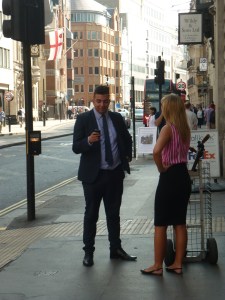
Barrister’s Clerks – Loitering with Intent
I took this photograph of two clerks I saw at the top of Middle Temple Lane, no doubt sharing gossip about their senior clerk and the barristers for whom they work. They are still very distinctive when you see them scampering about The Temple or up and down Chancery Lane. Now of course some of them are women and they have mobile phones.
Middle Temple Lane London
One of my favourite books is Bleak House by Charles Dickens. Indeed it was the first book on the reading list when I began to study law at the University of Sheffield. In it Esther Summerson describes going into Old Square Lincoln’s Inn ‘we passed into sudden quietude under an old gateway, and drove on through a silent square..’ and in The Mystery of Edwin Drood the change as one passes into the Inns of Court in this case Staple Inn is evoked in these words – ‘It is one of those nooks the turning into of which out of the clashing street imparts to the relieved pedestrian the sensation of having put cotton in his ears and velvet on the soles of his boots.’
I’m not sure it is so quiet these days but walking into Middle Temple towards Fountain Court one does leave much of the bustle of modern London at the entrance. Today the gateway under the sign of the Knights Templars is guarded by a modern barrier to prevent any entry by motor vehicles. It does look rather incongruous.
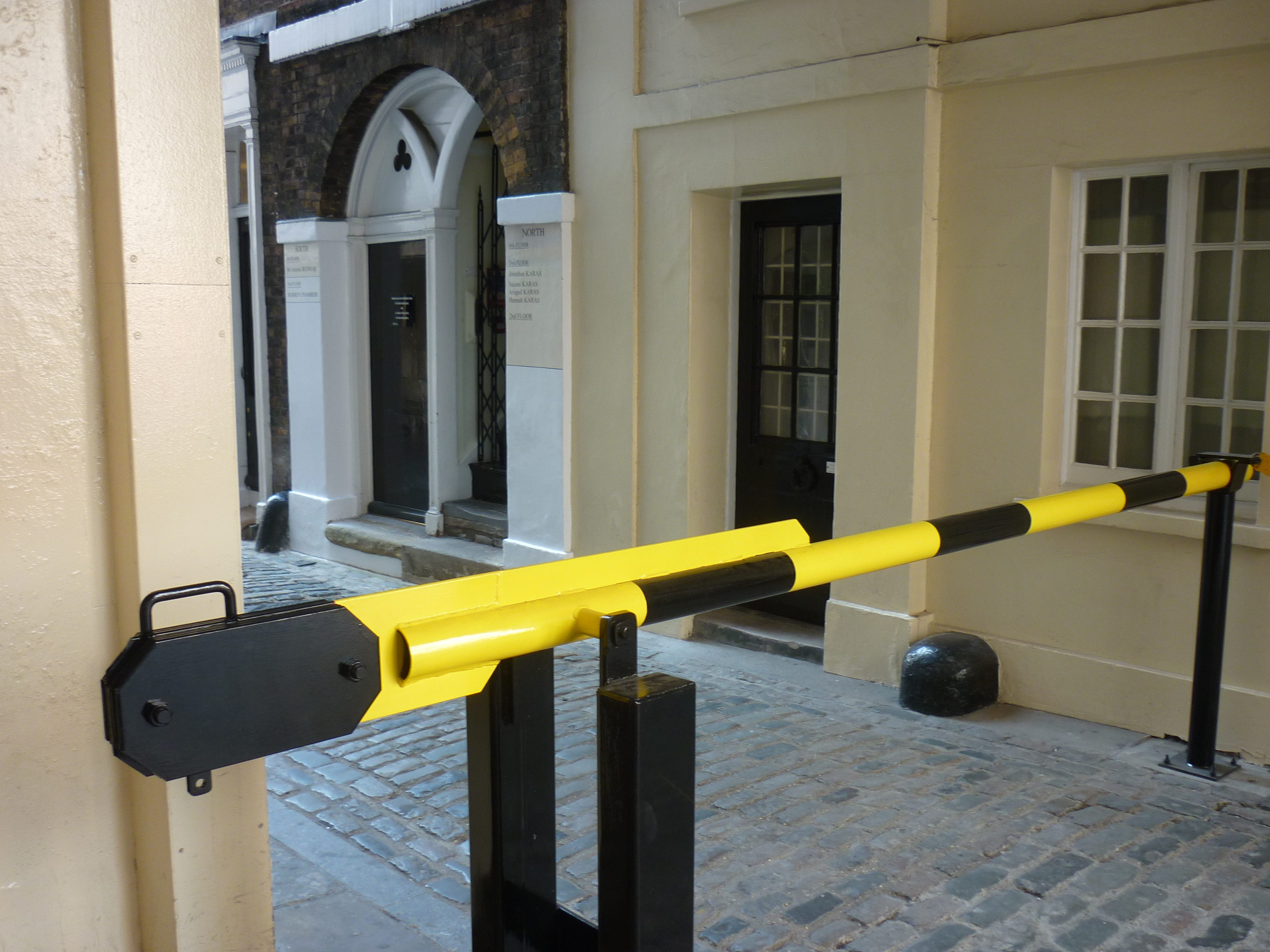
Gate to Middle Temple
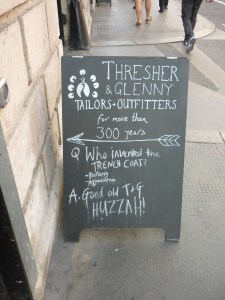
There is a small shop at the entrance that is now the premises of Thresher and Glenny Tailors and Outfitters for three hundred years, the blackboard proclaims along with the boast that they were the inventors of the Trench Coat and through the window I could see a khaki coloured coat looking rather battered as if it had lived through two world wars, as indeed it may have.
As I walked down Middle Temple Lane where my imaginary Burke Court is set squeezed in between other sets of Chambers, rather like platform 9 and 3/4 at Kings Cross nothing has changed for two centuries, although I suspect it is rather cleaner than it was. I did see a noticeboard with posters warning about terrorist threats, thefts and events in Middle Temple Gardens; similar lunches may well have been enjoyed in the Garden, indeed the Inns were known for their conviviality, but City of London Police posters would not have been evident until recently.
In Fountain Court, where John Westlock woos Ruth Pinch in Martin Chuzzlewit, the fountain splashes into the round stone basin, the mulberries stain the ground around it and a young man eats his lunchtime sandwich from a Pret A Manger carrier bag. 
I have described The Temple in the following passage taken from my novel, Crucial Evidence-
‘Cassie’s chambers were at 3 Burke Court, part of that area of London inhabited by lawyers for centuries and known as The Temple. Walking through the arch bearing the Pascal Lamb, was like time travelling; each time, she was stepping out of the tumult of the twenty-first century into the ordered calm of the eighteenth. She was reminded of her home town, where similar Georgian buildings surrounded the castle, built by John O’Gaunt, which remained a centre of law and punishment, judges and offenders at its heart. So unlike The Temple which turned its back on the bulk of the Royal Courts of Justice across the Strand, a row of the banks and sandwich shops providing a barricade to the noise of traffic and the bustle of pedestrians, and creating a sanctuary of narrow lanes and courtyards for its lawyer inhabitants.’
As I have remarked here the changes are ‘de minimis’ to quote a legal phrase.
Fleet Street London
The protagonist in my novel Crucial Evidence, Cassie Hardman walks from the Old Bailey to her chambers in Middle Temple Lane and as my novel is set in contemporary London I wanted to find out how much it had changed since the days when I took the same route. At the beginning of my career Fleet Street was the home of the newspapers. Here journalists and lawyers rubbed shoulders in the pubs and bars, although only males if El Vinos was your drinking hole of choice.
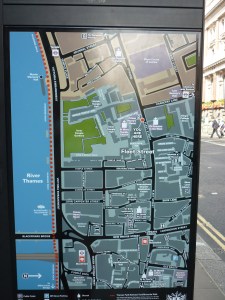
Fleet Street
As you can see from the map along the street are some fascinating places redolent with history. I have already mentioned St Brides Church but not the Institute and Printing Library, which is attached to the church. Shoe Lane runs north and there is a library on the western side of that lane. Between Shoe Lane and Fetter Lane are a number of Courts, narrow lanes and squares of a type familiar to all who read Dickens. Dr Johnson’s House.a 300 year old town house nestles among these narrow lanes at 9 Gough Square (see http://www.drjohnsonshouse.org) On Fleet Street is the public house with which the Dr is associated ‘The Cheshire Cheese.’
On the same side of the road is the building that was occupied by the Express group of newspapers. The curve of black glass a contrast to the shop fronts next to it. It is difficult to tell what the building is used for now. I noticed a number of serviced offices being advertised. One of the old Inns of Court, Sergeants Inn has become a hotel. The photograph shows it with the ground floor hidden by the red London bus.
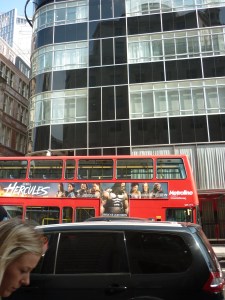
The Express Building
Some things remain the same, the signs outside the public houses, but there are now banks, coffee shops and the small stores the supermarkets have reinvented rather than the offices of newspapers. The Church on the right in the photograph of the map is St Dunstan’s in the West.
St Dunstan-in-the-West was a well-known landmark in previous centuries because of its magnificent clock. This dates from 1671, and was the first public clock in London to have a minute hand. The figures of the two giants strike the hours and quarters, and turn their heads. There are numerous literary references to the clock, including in Tom Brown’s Schooldays, the Vicar of Wakefield and a poem by William Cowper (1782):
When labour and when dullness, club in hand,
Like the two figures at St. Dunstan’s stand,
Beating alternately in measured time
The clockwork tintinnabulum of rhyme,
Exact and regular the sounds will be,
But such mere quarter-strokes are not for me.
The courtyard also contains statues of King Lud, the mythical sovereign, and his sons and Queen Elizabeth I, all of which originally stood in Ludgate. The statue of Queen Elizabeth I dates from 1586 and is the only one known to have been carved during her reign. Taken from the website http://www.stdunstansinthewest.org Here too there has been change as the church now caters to the Romanian community in the city.
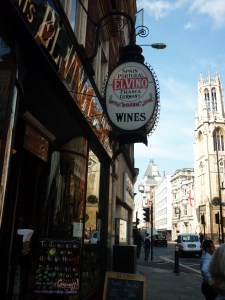
El Vinos
El Vino’s was of course the inspiration for Pomeroys Wine Bar beloved of Rumpole in John Mortimer’s books.
One of the other changes I noticed was that the vehicles using the street were mainly the buses, taxis and the little white van. Private cars pushed out by the congestion charge no doubt. Parking was always a nightmare, very expensive and difficult to find a space.
Old Bailey London
My novel Crucial Evidence is set in the London with which I was very familiar. Until a few years ago I was often working at the Central Criminal Court, more commonly known as the Bailey to the lawyers who work in there. The original Edwardian building houses the famous Number 1 Court and the hall with its painted ceiling. Next to that, opened in 1970 by the then Lord Mayor of London, is a newer building in which the courtroom 12, where much of my novel takes place, is situated. My journey to work was by Central Line Tube from Notting Hill Gate to St Paul’s. The map shows where the Old Bailey is on the edge of the City of London.

Map of area around the Central Criminal Court
I would walk along Newgate Street to the Old Bailey which is the name of the street which gives its name to the court. Quite often, when a terrorist trial was taking place the police would hold the traffic and pedestrians back at the junction with Warwick Lane to allow the prison van to sweep into the yard of the court. They would be dressed in bullet proof vests and carrying guns. I thought it was a bit stupid to hold up to twenty people where they would be in the line of fire if anyone tried to free the prisoners. The police may have prevented the escape but they risked a number of dead bystanders.

Junction of Newgate Street and Warwick Lane
I wanted to see if the area had changed since I had last been there and if, when I described the places my main character, barrister Cassie Hardman would see on her journeys around the area, they were the same as I remembered them. In the novel Cassie stands in the Bailey looking out onto a wet street scene. She describes the cobbles of Seacoal Lane glistening in the rain. If you look at the map, the lane has vanished into the middle of an office block. In another scene she looks sees the spire of St Brides Church – the journalist’s place of worship – now a new building under construction will hide it from view, if it has not already done so.

St Bride’s Spire

Artists Impression of a new office block on Old Bailey
I will have to do some editing when I come to the part in may next novel, whose working title is The Fatal Step where Cassie is looking out of the windows of the Bailey. At the moment as she gazes across the city the spire of St Brides in sparkling sunlight, but it will not be visible so instead she’ll have to look at the glass of the building opposite. But at least it was worth while going to London and walking around to see these changes for myself and, of course see how or when I can work them into my story. I’ll continue my walk along Fleet Street another time, but there have been changes there as well. Creating that sense of place in a novel really does rely on knowing the streets scenes you are writing and there is nothing like walking around with a camera and capturing it to take back to your desk.

 scribblingadvocate