London – Kensington High Street
A stroll through Holland Park, with its colourful flower displays took me onto Kensington High Street by the former Commonwealth Institute
The Commonwealth Institute was designed by Robert Matthew, Sir Robert Matthew, Johnson-Marshall and Partners, architects, and engineered by AJ & JD Harris, of Harris & Sutherland. Construction was started at the end of 1960 and completed in 1962. The project was funded by the UK government, with contributions of materials from Commonwealth countries.
Regarded by English Heritage as the second most important modern building in London, after the Royal Festival Hall, the building had a low brickwork plinth clad in blue-grey glazing. Above this swoops the most striking feature of the building, the complex hyperbolic paraboloid roof, originally made with 25 tonnes of copper donated by the Northern Rhodesia Chamber of Mines. The shape of the roof reflected the architects’ desire to create a “tent in the park”. The gardens featured a large water feature, grass lawns, and a flagpole for each member of the Commonwealth. The interior of the building consists of a dramatic open space, covered in a tent-like concrete shell, with tiered exhibition spaces linked by walkways. Despite its iconic status the building fell into disuse and began to deteriorate. As it was a listed building plans to demolish it were always resisted. Now the garden is a building site, but the ‘tent in the Park’ has retained its original shape without the copper. Still I thought it was looking good and hopefully will provide an exciting new home for the Design Museum. 
Kensington High Street is not the fashion centre it used to be – most of that has, I suspect, moved to Westfield just over a mile away. Would it be too much to hope that more independent shops will start of open up along this important thoroughfare. Certainly one has, and an unusual one at that. The shop is an old fashioned hardware store called Skillman and sons. The original Skillman and sons was opened by Alfred Daniel Skillman in 1900. What a super name for someone selling tools. The store was famous for selling everything from watering cans to musical instruments. Today at Skillmans, you will find some of the best hand tools from around the world, together with top quality hardware and ironmongery from the U.K, as well as the most functional cleaning products made from all over Europe and the rest of the world. Would it be too much to hope that more independent shops might open along this important thoroughfare. Certainly one has, and an unusual one at that. The shop is an old fashioned hardware store called Skillman and sons. The original Skillman and sons was opened by Alfred Daniel Skillman in 1900. What a super name for someone selling tools. The store was famous for selling everything from watering cans to musical instruments. Today at Skillmans, you will find some of the best hand tools from around the world, together with top quality hardware and ironmongery from the U.K, as well as the most functional cleaning products made from all over Europe and the rest of the world. See http://www.skillmanandsons.co.uk

Life at the Bar – The Man in the White Suit
I am not referring to the journalist, Martin Bell, who stood for Parliament some years ago but to a solicitor who had an office close to West London Magistrates Court. This was before it moved to being in the shadow of the Hammersmith Flyover. I had only just started working for another local solicitor’s practice as the second string advocate, when the outdoor clerk, a Welsh lady who liked a drink or two or may be three, told me I needed to meet Bob. 
‘He’s really good looking, and single,’ she said acknowledging my own status. And so he was, six feet tall, a mop of dark hair and a sonorous voice with just a trace of an accent I recognised as being like my own. He was one of the many Lancastrians who had moved to London hoping to make their fortune in the big city.
When the court doors opened in the morning, the outdoor clerk would dash across the road to see if any of our regular clients were in the cells, and to try and get our share of the unrepresented prisoners. She would then come back into the office and prepare a list of the cases we had to cover. There were two courtrooms in the building and I was meant to do the shorter list, usually with the less serious cases and the man who was the main advocate would do the more important ones. It never seemed to work out that way and I found myself covering most of the work in both courts, which brought me into contact with the ‘man in the white suit.’
Actually it wasn’t his usual choice of dress, he normally wore a grey or navy blue pinstripe, but sometimes in the summer and when he wanted to make a dramatic entrance into court, he wore white. I liked Bob, but quickly worked out that he was not the man for me; far too eccentric.
However we worked well together in the courtroom even though we were competitors for business. A long list of clients meant there was too little time to see them all before the stipendiary magistrate came into court. Bob and I learnt to work the list officer so that our cases were not listed consecutively and so allowing a little time to see a client who had not yet appeared.
Cases in the magistrates’ court can be very amusing, and West London had its quota of fun, often provided by the homeless men who lived on and around Shepherds Bush Green. They were usually brought before the court for being drunk and disorderly, and although we wouldn’t be paid both Bob and I often addressed the court on their behalf. One man, it was impossible to tell his age from his appearance, he was so unkempt in a dirty mac, torn green sweater and a once white shirt was before the court for stealing a tin of salmon. He was one of Bob’s clients and this was one of his white suit days. The contrast could not have been more striking.
The defendant pleaded guilty to the theft and Bob stood up to mitigate on his behalf. He was immediately interrupted by the Magistrate, ‘Your client has been in prison too many times. What am I going to do with him? Send him back for a tin of salmon?’
‘That’s exactly what I am asking you to do. The last time he was in custody, he got his teeth seen to. The upper jaw. He’d like to go back to get his lower ones sorted out. That’s why he stole the tin of salmon. He needs a sentence of a least three months for the prison service to sort that out,’ said Bob. 
He got his three months. Whether he got his teeth sorted out, I don’t know because that winter he died of exposure, and it was me and Bob together with the list officer who organised a whip round to pay for his funeral.
Oysters and George
I suppose George Carman was one of the more colourful members of the Bar and my first meeting with him was a little strange to say the least. I was still an articled clerk and I was sent to  Blackpool Quarter Sessions to sit behind him in a case of causing death by dangerous driving. He was a small rather busy man, always dressed in pinstripe trousers with a black jacket and the silk waistcoat worn by QC’s. The client was pleading guilty to the charge and after a rather tedious conference, with him George went off to do some work in the robing room. I was left sitting with the client until, about half an hour before the midday adjournment, I was summoned to see George.
‘Go and find out if there is any chance of our case coming on before lunch,’ he said. I did as I was told and scurried off to find the court usher. My enquiries revealed that we were unlikely to be called before the court rose. I returned with the news to the robing room. When I told George he snorted and said, ‘Damn, well I suppose we’d better make the best of it. Do you know where Robert’s Oyster Shop is on the promenade?’
It was a silly question; everyone living in Blackpool knew where to get oysters. I told him I did.
‘Good. Go and tell Robert I want a dozen oysters and a pint of Guinness and tell him I’ll pop in and pay later.’
I was to meet George on many occasions; there were a few other cases while I was still an articled clerk and then when I was living in London and had become a barrister, we frequented the same drinking holes, but I was never in the same case as him again until much later on in my career.
In early 1981 I was instructed to represent a solicitor who was charged with defrauding the Legal Aid Fund of many thousands of pounds. The case was tried in Manchester and I was being led by the leader of the Northern Circuit Mick Mcguire and George was prosecuting. As George called the various witnesses, court clerks, law society staff we began to undermine the prosecution case, which was based on a number of false premises, one of which was that a bail application would only take ten minutes of court time. That was torpedoed when a bail application was interposed in our trial; the judge said it would only take fifteen minutes at the most. It took over an hour as Mick Mcguire pointed out. George was clearly getting rattled as we scored again and again, until one lunch time we heard him on the telephone to the Director of Public Prosecutions. ‘I can take a few bullet holes below the waterline but a bombshell is too much.’
No oysters for George that day.
Holland Walk London
Holland Walk is the scene of the murder of Shelley Paulson in my novel Crucial Evidence. I describe it as a being ‘poorly lit, the overhanging trees creating areas of deep shade; just the sort of place for a murder’ I am not the only one to describe it in those sort of terms. In 1845 the Kensington Gazette was receiving letters which described the Walk as a ‘dark sink hole’ dismal and dangerous owing to the erection of high fences and the lack of lighting. One correspondent wrote of apprehension of insecurity being such that his wife and daughters had to be warned not to use it. Yet another writer said he was ‘constantly afraid of forbidding presence of a thug’ and it was a ‘rendezvous for the obscene’ 
The Walk did not follow the same route as it does now, but at that stage turned across the front of Holland House but two years after the correspondence in the press the footpath was straightened so that it was as it is now.
There has been a death there in the distant past when after a robbery occurred in the Walk during one afternoon in October 1772, Lady Mary Coke who lived in Aubrey House (which also features in my novel) heard the sound of a pistol while she was reading in her library. A highwayman had been shot on the road outside her grounds.
It certainly is a suitable place for a murder.
I want to acknowledge the publication by Barbara Denny ‘Notting Hill and Holland Park Past.’
Antiques Road Show
As the experts on the Antiques Road Show examine an item they always ask what the owner knows about the piece. I have a print I acquired some years ago whose provenance is a little risqué. It’s a lithograph by the artist John Ward and I bought it from the manageress of the club where I played squash. She was a dark haired, dark eyed woman who not only managed all the bookings at the club, but also ran the bar. It was a very social place and I often stayed on after a game to gossip with the staff and other players. It was also a favourite watering hole for police officers from the local CID.
The manageress produced the picture and asked me if I was interested in purchasing it for quite a modest sum. I recognised it as one of the Inns of Court and asked her how she had come by it. I was particularly concerned because the price she was asking was very low and I thought it might have been stolen. There were some shady characters drinking in the club. She reassured me that it was not stolen with the riposte that she wouldn’t have produced in front of a group of detectives who were drinking in the bar that night.. I could see the logic of her comment. ‘So’, I said, ‘How did you come by it?’
She told me that her then boyfriend was the manager of an ‘adult only’ club in Soho and some months before, there had been a police raid when the club was full. The clients had all made a hasty exit through the fire doors without stopping to collect any of the items they had left in the cloakroom. Over time most of the property had been collected, but the club had been left with a collection of umbrellas and this print. When the boyfriend was given the task of disposing of the picture he thought I might like it, as he knew I was a barrister.
I decided in the circumstances it was not the proceeds of a theft and I would not be charged with handling stolen property. so I purchased the print. 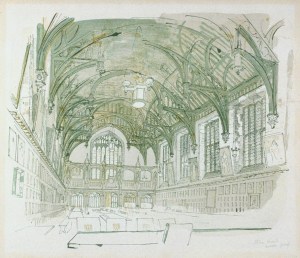
For many years it hung in my office in Chambers and now is in my home; it continues to give me great pleasure. It shows the hall of Grays Inn, the Inn of which I am a member, as incidentally is the protagonist in my novel Crucial Evidence. The lithograph also makes me smile as I think it was left in that Soho club by some eminent judge too embarrassed to reclaim his piece of art.
Middle Temple Lane London
One of my favourite books is Bleak House by Charles Dickens. Indeed it was the first book on the reading list when I began to study law at the University of Sheffield. In it Esther Summerson describes going into Old Square Lincoln’s Inn ‘we passed into sudden quietude under an old gateway, and drove on through a silent square..’ and in The Mystery of Edwin Drood the change as one passes into the Inns of Court in this case Staple Inn is evoked in these words – ‘It is one of those nooks the turning into of which out of the clashing street imparts to the relieved pedestrian the sensation of having put cotton in his ears and velvet on the soles of his boots.’
I’m not sure it is so quiet these days but walking into Middle Temple towards Fountain Court one does leave much of the bustle of modern London at the entrance. Today the gateway under the sign of the Knights Templars is guarded by a modern barrier to prevent any entry by motor vehicles. It does look rather incongruous.
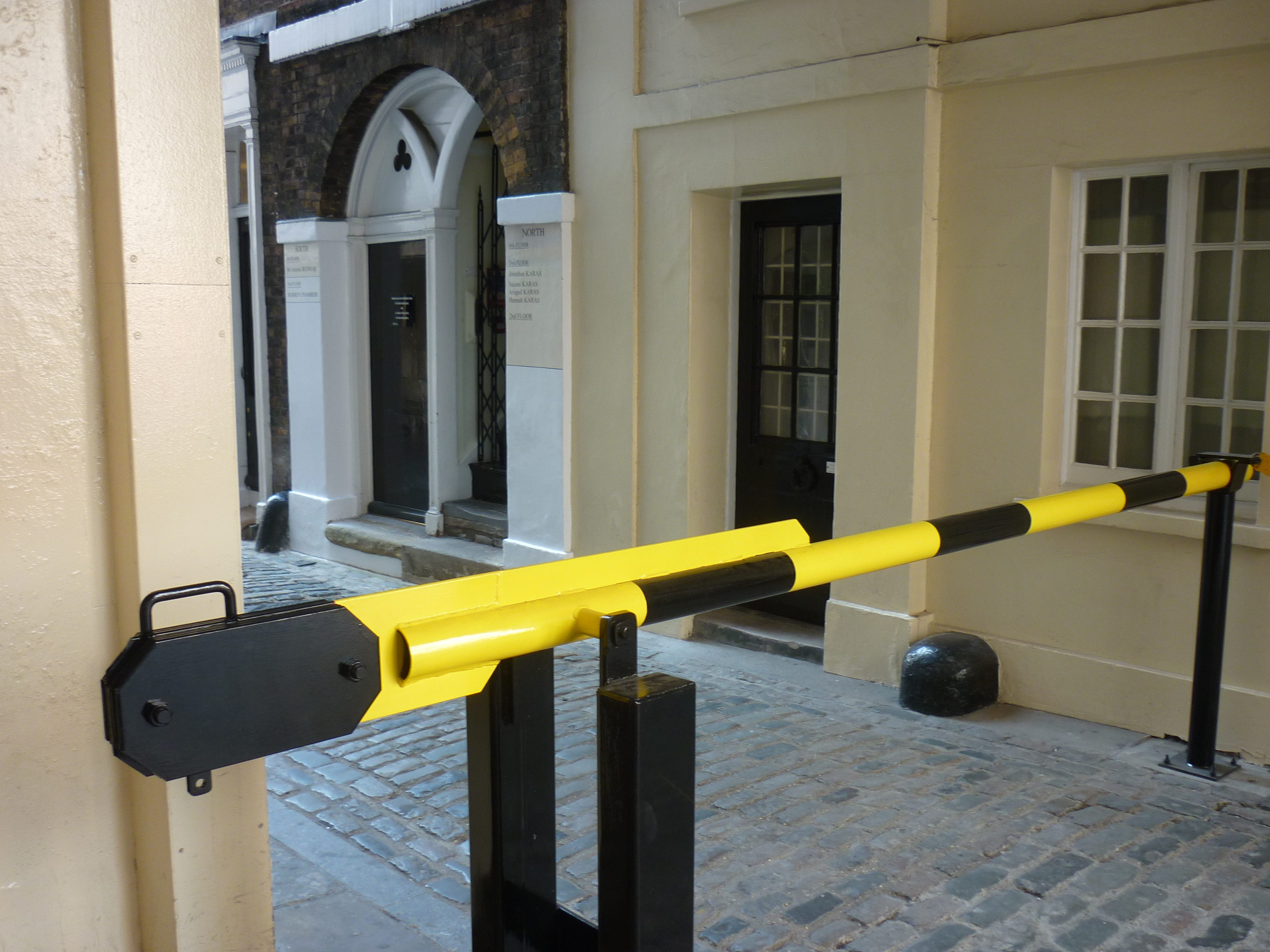
Gate to Middle Temple
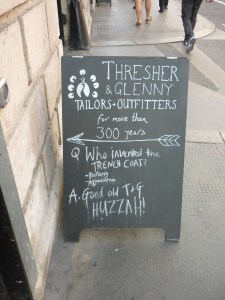
There is a small shop at the entrance that is now the premises of Thresher and Glenny Tailors and Outfitters for three hundred years, the blackboard proclaims along with the boast that they were the inventors of the Trench Coat and through the window I could see a khaki coloured coat looking rather battered as if it had lived through two world wars, as indeed it may have.
As I walked down Middle Temple Lane where my imaginary Burke Court is set squeezed in between other sets of Chambers, rather like platform 9 and 3/4 at Kings Cross nothing has changed for two centuries, although I suspect it is rather cleaner than it was. I did see a noticeboard with posters warning about terrorist threats, thefts and events in Middle Temple Gardens; similar lunches may well have been enjoyed in the Garden, indeed the Inns were known for their conviviality, but City of London Police posters would not have been evident until recently.
In Fountain Court, where John Westlock woos Ruth Pinch in Martin Chuzzlewit, the fountain splashes into the round stone basin, the mulberries stain the ground around it and a young man eats his lunchtime sandwich from a Pret A Manger carrier bag. 
I have described The Temple in the following passage taken from my novel, Crucial Evidence-
‘Cassie’s chambers were at 3 Burke Court, part of that area of London inhabited by lawyers for centuries and known as The Temple. Walking through the arch bearing the Pascal Lamb, was like time travelling; each time, she was stepping out of the tumult of the twenty-first century into the ordered calm of the eighteenth. She was reminded of her home town, where similar Georgian buildings surrounded the castle, built by John O’Gaunt, which remained a centre of law and punishment, judges and offenders at its heart. So unlike The Temple which turned its back on the bulk of the Royal Courts of Justice across the Strand, a row of the banks and sandwich shops providing a barricade to the noise of traffic and the bustle of pedestrians, and creating a sanctuary of narrow lanes and courtyards for its lawyer inhabitants.’
As I have remarked here the changes are ‘de minimis’ to quote a legal phrase.
Fleet Street London 2
Researching Fleet Street for my novel I was reminded about the advice to look above shop window level to see what the buildings really looked like. I was doing just that when I noticed the number of different type of signs that shops displayed. The American interlopers MacDonalds and Starbucks had bland fascia boards on their shop fronts – so did Sainsburys so we can’t just blame trans-Atlantic invaders. Not surprisingly the pubs and wine bars had more distinctive signs.
So I wrote the following in my second Cassie Hardman novel,
‘She noticed the sign above the Punch public house, a gold painted profile of the character holding his truncheon aloft.
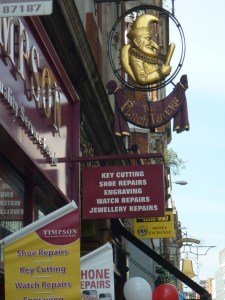
The Punch Tavern
Then she saw the three gold balls of a pawn brokers, next to a sign proclaiming they were pawnbrokers of distinction. She wondered how long there had been a need for them so close to the Temple and what the phrase ‘a pawnbrokers of distinction’ meant; did they only deal with people of distinction or only lend money against objects of distinction. Whichever it would rule her out.

Pawn Brokers of Distinction
In an optician’s window she was amused by a poster for spectacle frames by Lanvin; a hundred or so sketches of faces with little bits of colour, a green bow tie or purple earrings, but hardly any glasses.

Optiicans
They walked past what had once been the entrance to Sergeants Inn. Cassie glanced into the courtyard where there was a large green elephant. She pondered on what the animal was meant to represent or indeed why it was there at all.

Sergeants Inn
Soon they were under the oval sign of El Vino’s wine bar. The painted glass, in addition to the name, had the words Spain, Portugal, France, Germany Wines. What no Australian, New Zealand or Chilean, she thought. She remembered her pupil mistress telling her that at one time women were not allowed into the wine bar unless accompanied by a man and then they had to sit in the rear of the premises.
As they drew level with the faded sign of the three squirrels outside Gosling’s Bank, she heard James’s voice as if it was coming through water, asking her something about accounts. She shook her head as if to shake out fluid from her ear. ‘Sorry, I was miles away. You were saying?’
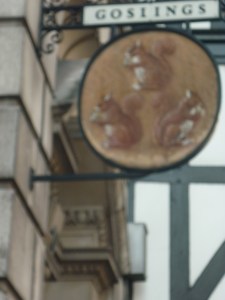
Gosling’s Bank
Old Bailey London
My novel Crucial Evidence is set in the London with which I was very familiar. Until a few years ago I was often working at the Central Criminal Court, more commonly known as the Bailey to the lawyers who work in there. The original Edwardian building houses the famous Number 1 Court and the hall with its painted ceiling. Next to that, opened in 1970 by the then Lord Mayor of London, is a newer building in which the courtroom 12, where much of my novel takes place, is situated. My journey to work was by Central Line Tube from Notting Hill Gate to St Paul’s. The map shows where the Old Bailey is on the edge of the City of London.

Map of area around the Central Criminal Court
I would walk along Newgate Street to the Old Bailey which is the name of the street which gives its name to the court. Quite often, when a terrorist trial was taking place the police would hold the traffic and pedestrians back at the junction with Warwick Lane to allow the prison van to sweep into the yard of the court. They would be dressed in bullet proof vests and carrying guns. I thought it was a bit stupid to hold up to twenty people where they would be in the line of fire if anyone tried to free the prisoners. The police may have prevented the escape but they risked a number of dead bystanders.

Junction of Newgate Street and Warwick Lane
I wanted to see if the area had changed since I had last been there and if, when I described the places my main character, barrister Cassie Hardman would see on her journeys around the area, they were the same as I remembered them. In the novel Cassie stands in the Bailey looking out onto a wet street scene. She describes the cobbles of Seacoal Lane glistening in the rain. If you look at the map, the lane has vanished into the middle of an office block. In another scene she looks sees the spire of St Brides Church – the journalist’s place of worship – now a new building under construction will hide it from view, if it has not already done so.

St Bride’s Spire

Artists Impression of a new office block on Old Bailey
I will have to do some editing when I come to the part in may next novel, whose working title is The Fatal Step where Cassie is looking out of the windows of the Bailey. At the moment as she gazes across the city the spire of St Brides in sparkling sunlight, but it will not be visible so instead she’ll have to look at the glass of the building opposite. But at least it was worth while going to London and walking around to see these changes for myself and, of course see how or when I can work them into my story. I’ll continue my walk along Fleet Street another time, but there have been changes there as well. Creating that sense of place in a novel really does rely on knowing the streets scenes you are writing and there is nothing like walking around with a camera and capturing it to take back to your desk.

Reviews 2
A librarian friend commented that he thought the plot of my novel Crucial Evidence was ‘dodgy’ because he couldn’t see why the police had arrested Barker for the murder of Shelley Paulson and why they were so convinced he was guilty just on the basis of a witness identifying him as the killer. It’s an interesting comment and I have questioned myself as to why he thinks that is a fault in the plot. Is it because when a reader opens a crime novel they expect it to begin with a murder followed by a detective following up clues which lead to the identification of the killer and his arrest? Of course that is what many crime stories do, but I wanted to write something different and my story begins after the investigation has finished and at the point where lawyers have been instructed to represent Barker and the trial is about to begin. It is written from the point of view of the barrister, Cassie Hardman and she would not be concerned with why Barker was arrested only whether there was enough evidence to support a prosecution. 
Do crime novels present an unrealistic view of policing and of their powers of arrest? Don’t police officers act on anonymous tip offs and informants whose names they don’t reveal? They would be criticised if they did not and programmes like Crime Watch would have little or no part to play in investigation. An identification of the perpetrator of an offence is good evidence and if the accused has admitted he was close to the scene of the murder it seems reasonable for the police to believe he is the killer. Again on the basis of that evidence the relatives of the deceased would expect the accused to the prosecuted and let the jury decide, wouldn’t they?
Colin Stagg the man accused wrongly of killing Rachel Nickell on Wimbledon Common was arrested because they had information he frequented the common. They arrested him and decided he was rather strange and therefore he must be guilty. There was virtually no evidence against him apart from a forensic psychologist’s assessment made on the basis of letters written to an undercover policewoman offering sex if he admitted to the crime. He did not make any admissions, but was charged with the murder because the police were convinced he was guilty. I remember well the TV shots of Rachel Nickell’s grieving parents as they were interviewed outside the Old Bailey, saying if only the jury had heard the whole story, They were clearly convinced their daughter’s murderer was walking free, and that conviction can only have come from their conversations with police officers.
Is truth stranger than Fiction?

 scribblingadvocate