By the Seaside
After I posted my haiku ‘Beach Life’ I just had to go to the seaside, so I pushed trying to write the synopsis of my novel to one side and we went to Padstow in Cornwall. After the deluge over the last few months we had a clear day. The tide was very low so we walked along the beaches of the estuary towards the sea. In the distance a line of waves breaking into surf showed where the bar held the sea back. The sand is a deep gold-beige, but as we got nearer to the sea it began to shift under our feet, and our footprints made deep impressions. Rudi, even on four paws, was unhappy, afraid of being held fast by the wet sand, so we headed back into town for lunch at a Michelen listed restaurant. Mussels in a broth, followed by mackerel with beetroot and orange salad.
 Padstow is on the west side of the river and the sun didn’t flood the scene with light until after lunch, when I took this photograph of the boats in the harbour.
I loved the bright colour of the hulls and the buoys.
And how lovely to feel the sun on my face.
PS has anyone got some good
tips on how to write a synopsis
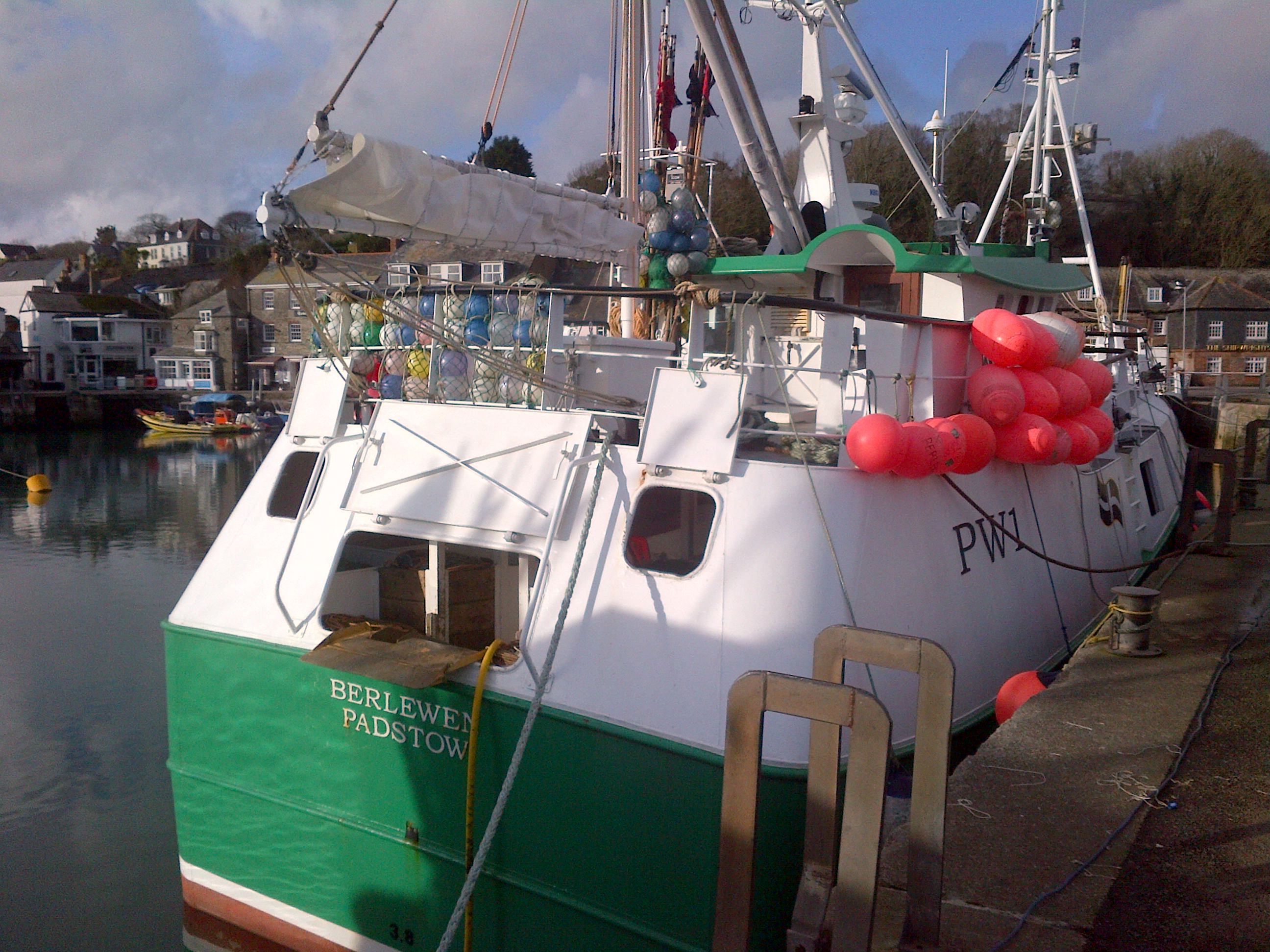
Boats in Padstow harbour
Beach Life

A large promotional deckchair on the Western Esplanade at Ryde, Isle of Wight, there to promote a business hiring out deckchairs to tourists for use on the beach at Ryde. For a comparison, a standard size deckchair can be seen next to it. (Photo credit: Wikipedia)
Beach Life
Wet suited surfer
rides the wild and rolling waves
toward the sandy beach
Children build sand castles
with painted bucket and spade
by waters edge
Large male in white shirt
knotted handkerchief on head
sleeps slumped in deckchair
Teenage girl in shorts
turquoise T shirt and flip flops
slowly eats ice cream
Baby on all fours
crawling fast along the beach
pursued by father.
Dressed in purple
elderly lady wrestles
with striped deckchair.
Young woman wrapped
in beach towel wriggles
to remove bathing suit.
This time of year it’s good to dream.
Christmas Garland
Ever year at the Tudor house, Cotehele Cornwall, a garland is made from flowers grown in the gardens over the summer. It hangs in the hall of this magical old house, to attract visitors to the property. We went on Friday and although it was thinner than it has been in the past, due to our atrocious summer, nevertheless it is still a reminder of the time when the Christmas decorations were not bought in a shop.

 Happy Christmas and wonderful New Year
Early Reading Habits
My younger brother has gone to bed; my mother is sitting by the fire sewing. My father is sat opposite her in a large armchair with me on his lap, leaning against his scratchy woollen sweater, my head tucked under his chin and my thumb in my mouth. He is holding a small buff-coloured book from which he  is about to read.
I can see the pictures on the open page; the vegetable patch with the rows of lettuces, a spade stuck in the ground and the back of Mr McGregor leaning on it. Peter is hiding under a large leaf, his inquisitive face looking towards the burly gardener. I can almost see Peter’s nose twitching. I point at the pictures, identifying the objects in it.
Then my father begins, ‘Lettuces are soporific.’
So began my interest in books. Today I picked up my battered copies of Beatrix Potter’s books with the intention of throwing them away. They are so distressed, the spines missing or torn, pages stuck in with ageing sellotape; they are not fit to pass onto another child. But I couldn’t put them with the rubbish, they are too precious, so I have put them back on the shelf.
Hollywood
Not the town in California, but the exhibition at the Victoria and Albert Museum in central

English: Victoria and Albert Museum in London Svenska: Victoria and Albert Museum i London (Photo credit: Wikipedia)
London, where there is an exhibition of clothes designed for some of the most famous characters in films.
Amongst the exhibits was the navy tailored suit, Meryl Streep wore when she played Mrs Thatcher and next to it the outrageous playsuit she wore in Mama Mia. One clearly spoke of power and control and the other of sex and outrageous behaviour; there is no way they could be interchanged.
Another exhibit explained how the clothing for Harrison Ford as Indianna Jones was designed and then aged to provide the lived in look of a 1940’s explorer. The designer had used as a blueprint, the early adventure films.
I began to think about the importance of clothing to establishing character. I do imagine them in various clothes until I find something I think is appropriate for their personalities and for different events in the story line. Obviously, a barrister will wear a wig and a gown over a dark suit, when she is in court, but what about when the character is not working.? Is she a jeans and T-short type or would she wear a skirt and blouse. What about a female detective? Would she wear trousers to work with a trench coat or something more feminine?
Do you imagine characters in different outfits and do you use the clothes to help define the character to the reader.
London
Just spent a few days in London, reminding myself why I like the city so much. Of course there are the usual tourist things, the theatre and art galleries, the major sights. We went to see The Magistrate at the National, and it was a very enjoyable evening, a bit like a panto. But it’s not that, although the cultural  life was the reason I moved to London. I think the attraction for me is the energy that so many people hurrying around seem to engender. There is always the possibility of some suprise, of changes occuring that create a new experience. The Shard glittering in rain, a new art gallery, an extension of the Serpentine Gallery, being built in Hyde Park. It’s still wrapped in its plastic sheeting so its shape is a secret but the architect is Zaha Hadid, so it should be an exciting addition to the landscape. I came across a class for nervous cyclist (or even teaching those who can’t) in Little Wormwood Scrubs Park. I watched an elderly woman on a three wheeler set off cautiosly round the park, and two girls who said they hadn’t ridden bikes for years racing round. That’s another new addition to the street scene, the blue rows of ‘Boris’ bikes. These are the sort of places and events I need to keep my novels up to date.
I’ve also discovered a pedestrian route under the Westway which would make a great setting for a crimestory. It runs between a number of sports facilities, a sand ring with two disconsolate looking ponies, empty fives courts, a climbing frame and a sculpture that looks like a set of coloured pencils bent in peculiar shapes. Next time I go I must take a camera and photograph the route.
The photograph is the set for The Magistrate from the back of the circle.
Does anyone have any other ways of keeping the locus of their novels real.
Childhood Home
In my blog Sense of Place, I suggested that homes live in the memory and we are able to describe them in detail. Whether that detail is correct is, of course, open to debate, our memories are faulty, and we probably describe home as we want it to be rather than as it really was. I thought it would be a good exercise to describe some of the places I have called home and see if I can make them real again. I’ll begin with the house I lived in as a child, from the age of one to soon after my tenth birthday. It was in a village on the western side of the Pennines, called Edenfield.
I hesitate to call my first home a house as it had originally been the village market hall, and was, at the time we lived, there a shop. It was situated in Market Place at the junction of two busy roads, one went to Bury and then Manchester and the other to Rochdale. A roundabout occupies the place now.

Edenfield Village Centre – geograph.org.uk – 399389 (Photo credit: Wikipedia)
Our home was rather burrow-like as we lived in the back part of the building and the rooms were dark and only really cosy in winter when the fire was lit. From the parlour there was a stone-flagged corridor that led into a tiny kitchen, where my mother cooked and washed. There was a smell of wet clothes emanating from the copper, as steam filled the kitchen, to be followed by the sound of rollers wringing the clothes before they were hung out on lines in the back yard.The other smell was a mixture of linseed oil and paraffin. The linseed oil came from cans of putty, which were for sale in the shop and the paraffin was spilt as it was poured from large canisters into cans brought by customers. During the day there would be the sound of the plumbers and apprentices my father employed as they worked above our heads, the bang of hammers, the hissing of soldering irons and their chatter.
After a few years we moved upstairs and lived over the shop. The picture shows the view from the large sitting room window. But I will come back to those years later.
One Lovely Blog

one-lovely-blog-award (Photo credit: Valdecor)
I need to thank kellielarsenmurphy.com for recommending me for a ‘One Lovely Blog Award. Following the rules
1. Insert the logo -took me hours to find it.
2. Thank the person nominating you.
3.Share seven things about yourself
4. Nominate seven blogs you like
5. Tell them you have nominated them
Seven things about myself.
1. I’m half Australian. My father was born in Newcastle NSW but came back to the UK when he was only seven.
2. I have an orchard of about 34 apple trees.
3. I like cheese with my apple pie, preferably creamy Lancashire.
4. I am a fellow of the Royal Zoological Society, but never get to the meetings.
5. My favourite animals are dormice and tigers.
6. I can keep a secret.
7. I dislike doing housework and I’m not very keen on gardening.
Blogs I like
The struggle to be a writer that writes.
phoenixrisesagain
Cristian Miahi
People,Places and Bling
The dog ate my novel
Sally Xerri-Brooks
CrimeThrillerGirl.
Sense of Place
‘I had a farm in Africa.’ So begins the first sentence of the memoir ‘Out of Africa,’ that compelling account of Isak Dinsen’s life in Kenya. Soon I will be saying, ‘I had a house in France,’ and that made me think about whether the past tense is correct. I think I will always have a small cottage in the edge of a village near to the town of Uzes in Southern France, because it stays in my memory. Isak Dinsen used her memories to give life to her farm as she wrote about the place and the people. In the book she charts her love affair, not just with Finch-Hatton, but with the experience of living in Africa.
Our house was only a holiday home and there is no novel or memoir to be written about it, but I began to think about the places I have lived over the years and I am suprised about how well I can recall the rooms, the furniture, the sounds and the smells of those houses. In my mind I can walk round them and think of the events that happened in each one. Is that why a sense of place is so important in writing, putting characters into a context of their homes? I wonder.
Uzes
We are going to France next week to complete the sale of our cottage there. I wrote this piece some time ago after I had seen this girl begging by the expensive chocolatiere. in the square of our nearest town, Uzes.
Chocolate Candy
It was just after four in the afternoon when James strolled into the Place aux Herbes, in the small city of Uzes. The square lay languid under the upturned blue enamelled bowl of the sky. The seventeenth century former silk merchants’ houses were built of topaz coloured stone which glowed in the sun, their olive- green shutters closed to stop it from penetrating the interiors. The same strong light shone through the canopy of the plane trees created patterns across the paving stones, and under the vaulted arcades the shadows were the colour of a raven’s wing.
James felt his shirt sticking to his back and he slid his finger along the neckband of his linen grand-dad shirt. He took a seat at one of the many cafes, whose chairs and tables formed fingers in the open space, stretched his long limbs out in front of him and threw the battered panama he had inherited from his father, onto the table. He ordered a beer in his schoolboy French. It arrived quickly. Condensation on the outside of the glass formed a pool of water on the table. He sipped the cool amber liquid slowly, the antiseptic taste bursting on his tongue.
From behind a pair of sunglasses he settled down to observe the town, as it shook itself awake from its siesta. Tourists, dressed in light loose clothes, wearing sunhats and dark glasses, strolled across the square, the heat a brake on their energy. Children played in the fountain, dabbling their hands in the translucent green water. A golden retriever leapt up into the basin to cool off, and showered them as he jumped out, making them squeal and laugh.
After he had been sat for some time, from between the arches of the arcade, emerged the most beautiful girl he had ever seen. She had the golden glow that looked like it had been perfected on the beaches of the Cote D’Azur. Her hair was spun gold, pulled back into a bun and held in place by a red ribbon. Her face was long and thin with high cheek bones and a well formed nose above bow-shaped lips. As she passed in front of him she looked directly at him, and he could see her eyes were a startling pale blue framed with long dark lashes. She was tall and slim, almost boyish. Her clothes were shabby chic, cut-off jeans and a tight white T-shirt, and she carried a grubby blue canvas bag. Over her arm hung a red and white beach towel, and by her side trotted a grey-brown shaggy dog.
James watched her amble across the square, the roll of her walk accentuating the slight curve of her hips. He thought she looked like a starlet, what was the French, une vedette, and he imagined her dressed in a clinging white gown, walking along a red carpet with an admiring crowd applauding her. Or perhaps flouncing along a catwalk in Paris, London or Milan, wearing a well cut trouser suit, under the appraising eye of the fashionistas. Then he thought of taking her to his firm’s annual dinner, introducing her to his friends, her smile dazzling them, and he being warmed by their murmurs of approval. Other thoughts, of her naked and in his bed, came as well.
By now she had reached the far side of the square and was about to disappear from view. James dropped some euros onto the table, to pay for his unfinished drink, grabbed his hat, and rushed after her. He rehearsed the words he would need to ask her if she would have a drink with him. ‘Prenez une tasse du café.’ ‘No,’ he thought, ‘une coupe de champagne.’ Surely she only drank champagne.
Back out onto the Boulevard Gambetta, James cast around and saw her to his right, some way ahead, walking purposefully, the dog loping at her side. He hurried to catch up. She stopped in front of Deschamp’s, the chocolatiere, and within a few seconds he was besides her, in front of the large glass window. They stood side by side looking at the tasteful display inside. Chocolates arranged precisely on glass salvers, in pyramids, circles and triangles, a few to each plate. The sort of chocolates his mother would buy to take to a dinner party. They came in a variety of shapes, enrobed in dark and pale brown chocolate, as well as creamy white. By each cluster was a small label written in an elegant script, describing the different flavours, cherry, violet, caramel, apricot and orange. The very sight of them made his mouth water. He looked at the girl, and saw her long dark eye-lashes quiver, as she stared at the chocolate coated candy, as if trying to decide what to buy. He thought he would pre-empt her by purchasing some, then give them to her and ask her to have a drink with him.
Inside the shop he made a small selection, and waited impatiently whilst the ‘vendeuse,’ she was far too elegant to call a sales assistant, put them into a small oblong box of gold coloured cardboard. ‘Pour offrir, Monsieur?’ James kept glancing behind him, making sure the young woman was still outside. ‘Oui,’ he replied abstractedly. The vendeuse placed the box in transparent cellophane, tied it with a long strand of thin gold tape and handed it to James together with a few coins, the change from the ten euro note he had given her. As he turned to leave, the girl moved towards the door. He opened it and held it ajar to allow her to enter and for a moment they stood face to face, looking into each others eyes. He was about to speak when she moved to one side, folded the beach towel carefully, placed it on the ground against the wall, and sat down on it. The dog, which had been stood patiently by her side, flopped down next to her and placed it’s head on her bare knees, paws outstretched. From her bag she took a battered straw sunhat, which, instead of putting on her head, she placed on the ground in front of her. She was very still, leaning slightly against the wall, her long neck bent forward and her head bowed.
James stepped out onto the pavement and stopped next to her, his shadow falling across her face. She didn’t look up, but he could see her blue eyes had lost their liveliness and the pretty lips were turned down. One hand rested in her lap and the other was motionless on the dog’s head. Then he saw, in the hat, a piece of card with the words ‘Pour manger S.V.P.’ He closed his eyes for a moment, before bending down and placing the box of chocolates and the coins he was still holding into the upturned hat, before walking away.
.

 scribblingadvocate