Something that made me laugh
Sometimes when I am out walking my dog, I see something that makes me laugh and this week a little girl called Lydia had me in stitches. She was walking along a track on Woodbury Common, a large stretch of open land that has great views of the sea. We were following the little figure, I guess she was about three, as she toddled along following her Dad, her older sister and their two dogs. Lydia, I knew her name because her Dad was shouting to her to hurry up as the rest of the family were way out in front of her. She was not to be hurried. Dressed in pink from head to toe, pink

Pink Mac
Wellington boots with yellow butterflies, pink over trousers and a pink mac she was determined to paddle through the pools of water that lay along the path. At each puddle and there were quite a lot of them, she stood arms outstretched like birds wings, waited for a second or so and then leapt into the air only to come down with both feet firmly in the water. She laughed and giggled as the water splashed up around her, her blond hair flying in the wind. It didn’t matter how many times her father called her, she repeated the action at each stretch of water she came to, until one of the dogs, a puppy called Polly vanished into the undergrowth, followed by the elder daughter, Emma. At that point, father gave up waiting for her; he ran back to Lydia and grabbed her under his arm before running off in the direction Emma and the puppy had gone. We heard him calling for the dog for quite a while but didn’t see them again. The picture of Lydia thrusting herself feet first into those puddles kept me laughing most of the day.
Lawyers in Literature
I have just finished reading The Children Act by Ian McEwan and it has made me think about how lawyers are described in fiction. The immediate names that come to mind are Tulkinghorn from Bleak House, Dickens’ masterpiece about the law, incidentally a novel that was on the reading list when I first began to study law at the University of Sheffield, Soames Forsyte from John Galsworthy’s Forsyte Saga’s and Rumpole, John Mortimer’s delicious character. Tulkinghorn and Soames Forsyte are both solicitors and are rather dry characters, brooding over wills and conveyances in dingy offices. In Bleak House the lawyers are the villains of the novel, in an interminable legal action 
In Bleak House the lawyers are the villains of the novel, in an interminable legal action Jarndyce and Jarndyce which only comes to a conclusion when all the money in the estate has been used in paying legal bills. Tulkinghorn is a manipulative lawyer who glories in the power he has over his clients as he learns their secrets.
Soames Forsyte is equally unimaginative and scheming as he tries to control his wife who he sees as his property as indeed women were until the Married Woman’s Property Act of 1882 which gave women the right to own property in their own names. The series of novels by John Galsworthy were written between 1906 and 1921 when that independence had taken root. Soames is obsessed with property and considers his wife as just another chattel. He is a cold character with little to commend him to the reader.
On the other hand John Mortimer by creating Rumpole as a caricature of the people around him at the Bar, some of whom are recognisable to me from my own career, has created a likeable rogue. Put upon by his wife, she who must be obeyed and his colleagues who he always gets the better of in the end, most readers enjoy reading about him.
In The Children Act, the main character is Fiona Maye, a High Court Judge in the Family Division who hears a case which involves the refusal of medical treatment. McEwan has written with great elegance about the reasoning HH Judge Maye uses to arrive at her decision. The character has her own private sorrows but as Tessa Hadley says in her review of the novel in The Guardian, nothing in the character’s life is as interesting as the legal arguments. In my own experience, this is true my own difficulties always seemed so petty compared with the troubles my clients face. It is perhaps the reason that writing giving a lawyer the main role in a novel is so difficult.
St Petersburgh
I haven’t posted anything for over two weeks because I have been on a cruise around the Baltic and had very limited internet connection – far too expensive on the ship and too little time to find an internet cafe on shore. We visited Copenhagen for an afternoon in the pouring rain, Rostock and Warnemunde on the German Coast with a watery sunshine, Tallin, where it rained again. The furthest destination was St Petersburgh where the temperature dropped and there was a smattering of snow. We spent two days there before returning to Tilbury calling at Helsinki where the temperature dropped to minus 5 and then Klapedia in Lithuania – never heard of it, neither had I- but it was sunny and the band played in the town square.
St Petersburgh was the highlight of the trip. Two days in not enough to see the city, its churches and palaces but we did our best.
We liked these beach chairs we saw in Warnemunde and thought we might like one for our garden.

Warnemunde
Tallin is like a film set from Walt Disney, but we found a great restaurant and sat watching other tourists scuttle around the Town Hall Square whilst we enjoyed beautifully cooked rabbit followed by a raspberry parfait.

City Wall Tallin
In St Petersburgh, I was reminded of the novel ‘The Seige’ by Helen Dunmore – chillingly graphic description of the days the city was surrounded by the Nazi’s during the WW2. Catherine’s Summer Palace was trashed by the German Army but has been restored to it’s former glory.

The Ball Room In the Summer Palace
Antiques Road Show
As the experts on the Antiques Road Show examine an item they always ask what the owner knows about the piece. I have a print I acquired some years ago whose provenance is a little risqué. It’s a lithograph by the artist John Ward and I bought it from the manageress of the club where I played squash. She was a dark haired, dark eyed woman who not only managed all the bookings at the club, but also ran the bar. It was a very social place and I often stayed on after a game to gossip with the staff and other players. It was also a favourite watering hole for police officers from the local CID.
The manageress produced the picture and asked me if I was interested in purchasing it for quite a modest sum. I recognised it as one of the Inns of Court and asked her how she had come by it. I was particularly concerned because the price she was asking was very low and I thought it might have been stolen. There were some shady characters drinking in the club. She reassured me that it was not stolen with the riposte that she wouldn’t have produced in front of a group of detectives who were drinking in the bar that night.. I could see the logic of her comment. ‘So’, I said, ‘How did you come by it?’
She told me that her then boyfriend was the manager of an ‘adult only’ club in Soho and some months before, there had been a police raid when the club was full. The clients had all made a hasty exit through the fire doors without stopping to collect any of the items they had left in the cloakroom. Over time most of the property had been collected, but the club had been left with a collection of umbrellas and this print. When the boyfriend was given the task of disposing of the picture he thought I might like it, as he knew I was a barrister.
I decided in the circumstances it was not the proceeds of a theft and I would not be charged with handling stolen property. so I purchased the print. 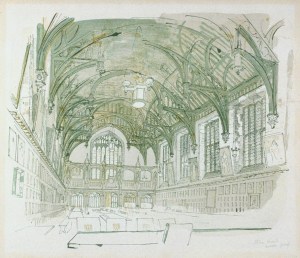
For many years it hung in my office in Chambers and now is in my home; it continues to give me great pleasure. It shows the hall of Grays Inn, the Inn of which I am a member, as incidentally is the protagonist in my novel Crucial Evidence. The lithograph also makes me smile as I think it was left in that Soho club by some eminent judge too embarrassed to reclaim his piece of art.
Elizabeth David in Uzes
In 1984 Elizabeth David added a postscript to her book ‘Eating Out in Provincial France.’ I haven’t read that particular book although I have devoured her cookery books, both metaphorically and literally, reading and following her recipes. I suspect that most of the restaurants she mentions in the book have long since disappeared and certainly eating out in France can be as disappointing as in the UK. But even now you can still buy wonderful food in the small city of Uzes.
She writes of the Casino on the Boulevard Gambetta, where one can buy the essentials and then the wonderful butchers shop; one needs to remember the cuts of meat are different, less fat but more expensive. There are some wonderful bakeries too. My favourite is the one under the arches on the Place aux Herbes, where in addition to the standard baguette they sell a variety of different breads. The shop assistant weighs the loaf one picks, a Campagne or Rustique for example and one pays by weight. There is nothing more delicious than fresh bread with a great cheese. In this part of France it has to be goats cheese. The pelardons as they are called are made locally and can be bought in various stages of maturity, fresh soft and creamy for eating immediately, or harder for grilling or toasting.
The fruit and vegetables are wonderful as well. Elizabeth David was there in February so not as much choice but as she went round the stalls of the Saturday morning market, she found creamy fleshed potatoes, crisp bronzed-flecked, frilly lettuces, bunches of chard, leaf artichokes, pumpkins and read peppers, new-laid eggs, nine or so varieties of olives and golden coloured honey. They are still available in winter. 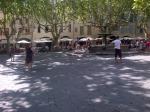
Through the summer local producers bring their products to the Market on both Saturday and Wednesday. The season begins with a small sweet strawberry called Garrigette, then the apricots in large boxes. The same grower sells green asparagus in large bunches-it’s delicious fried with a fresh egg on top. Later on as summer creeps towards autumn, the peaches, white or yellow appear on the stalls; they have an intoxicating smell and are so luscious. Finally figs become available, eaten raw with some of that lovely bread and a runny unpasturised Brie.
Just thinking about it makes my mouth water particularly now that summers over.
Poetry Day
As this is Poetry Day I want to share my favourite poem. When I was a small child I had freckles scattered across my nose and on my cheeks above the bones. I hated them, but my Dad called them sun-kisses, and tried to reassure me by reading this poem by Gerard Manley-Hopkins. It’s called Pied Beauty. 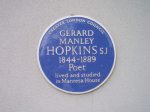
Glory be to God for dappled things—
For skies of couple-colour as a brinded cow;
For rose-moles all in stipple upon, trout that swim;
Fresh-firecoal chestnut falls; finches’ wings;
Landscape plotted and pieced-fold, fallow and plough;
And all trades, their gear and tackle and trim
All things counter, original, spare, strange;
Whatever is fickle, freckled (who knows how?)
With swift, slow; sweet. sour; adazzle, dim;
He fathers-forth whose beauty is past change;
Praise Him
The Burglar (Alleged)
 The security light on the garage came on just as I got to the front door to turn on the outside light. I wasn’t worried as any stray cat is a sufficient presence to trigger the light, then I saw the figure of a man emerge round the side of the garage furthest from the front door. He appeared to be carrying something in his hand, but I couldn’t see what it was. I hoped the back door was locked and he had not been into the house and stolen anything, while I worked on my novel. I didn’t get a proper look at his face before he had turned towards the gate, but I thought he was about fifty, pinched features and grey hair. He looked an unlikely burglar, but a recent email sent by the Chairman of one of the local ladies groups had warned of a sneak thief who had stolen a handbag from a near neighbours’ house while they had been watching television. I decided to be a responsible citizen and dialled 999.
A few minutes later my husband returned, followed almost immediately by a police car which swept into the drive, closely followed by a second who drove along the cycle track looking for my burglar.
A stocky man sprang out of the driver’s seat of the police car and asked me to describe the man I had seen.
‘He was wearing a white and grey check shirt, jeans. I didn’t really get a good look at his face but I thought he had gray hair,’ I said.
The radio on the officer’s lapel began to crackle and he said, ‘We’ve got him.’ He asked me to walk into the private lane that links our home to the bed and breakfast next door. The officer from the second car was talking to the man I had seen in our garden. The same checked shirt and the same angular build. ‘That’s him,’ I said.
We walked back to the house, followed a few minutes later by the police officer. ‘It appears the gentleman is resident at the B&B next door and lost his way in the dark. He says he’s not been drinking but I would dispute that,’ said the officer. He didn’t add those immortal words, his speech was slurred, he was unsteady on his feet and his breath smelt of alcohol, but it was clearly what he meant. Nevertheless he thanked me for calling the police and reassured me I had done the right thing. He explained they were keeping watch for the man they thought was committing the offences by keeping a presence at either end of the cycle track, but had not succeeded in catching him red-handed.
Later the Community Support Officer telephoned, repeating the thanks for calling the police and saying my burglar was a ‘drunk and disorientated tourist.’
The Legal Thriller
Anyone who writes a legal thriller must be influenced by John Grisham. I know I was and still am. Some of his books are about lawyers rather than the law, but I think he is at his best when his stories have legal principles at their heart. His first novel ‘A Time to Kill’ examined the dilemma between right and wrong, and legal or illegal. The main protagonist in the novel is lawyer Jake Brigance and he believes his client Carl Lee Hailey by killing the assailants of his daughter ( a very brutal rape ) had the moral high ground. Can Brigance ensure Hailey is acquitted on the grounds of insanity and how will the lawyer try to ensure that happens. It is a gripping tale because as Grisham says in the opening note ‘The greatest dramas occur not on screens or stages, but daily in countless courtrooms across this country’ The same can be said of courtrooms in the UK although the drama is often concealed behind the more clinical approach of barristers and solicitors in English courts. 
When I wrote my novel ‘Crucial Evidence’ I wanted to tell a story about a female barrister who believed passionately in justice and was prepared to compromise her own career in order to ensure her client received a fair trial. When the novel was first published and I searched for the book on Amazon using the title ‘Crucial Evidence’, John Grisham’s novel Sycamore Row came up on the screen side by side with mine own novel. I have finally read the book, which is described as a sequel to’ A Time to Kill.’ Jake Brigance is once again battling racial prejudice when a rich white male, Seth Hubbard, kills himself and leaves the bulk of his wealth to his cleaning lady, a younger black female, and specifically disinherited his children and grandchildren. Hubbard has instructed Jake to fight any attempt by his family to set aside the will. The trial has its ups and downs and illustrates one of the interesting things about this type of novel – the reader is encouraged to form a view of the witnesses, the judges rulings and the jury’s verdict.
Grisham understands the way lawyers work,( something that writers of police procedurals don’t often show in their descriptions of police work) and their was one passage in Sycamore Row which I thought reflected my own feelings about being an advocate. Jake’s wife asks him ‘Why do you want to be a trial lawyer?’
And he gives this answer, ‘Because I love it. It’s what being a lawyer is all about. Being in a courtroom, in front of a jury, is like being in an arena, or on the field. The competition is fierce. The stakes are high. The gamesmanship is intense. There will be a winner and a loser. There is a rush of adrenaline each time the jury is led in and seated.’
Absolutely!
The Fatal Step
This is the working title of my new novel and so far I am about half way through the first draft. Some how the summer has not been conducive to writing – who wants to be stuck in front of a computer when the sun is shining outside. I think too, I am rather daunted by the task I have set myself. I didn’t think about it with Crucial Evidence. I’d started that as part of my dissertation for my MA and I just kept going until I’d finished. Then I drafted and redrafted without thinking, each time telling myself that this time it would work and when I sent it to agents someone would love. They didn’t and I began to realize that it wasn’t my writing that was the real problem but the type of book I wanted to write. Also talking to agents at places like Winchester Writers’ Conference and at The London Book Fair I knew any publisher would want a series of novels and I didn’t want to be tied to writing a book a year. In the end I decided to publish the book myself. In the process I’ve learnt at lot about writing and publishing, but that makes the mountain I have to climb much higher and harder than the first. I know how long it takes and how difficult it can be.
But you have to begin somewhere so this is the first page of my second novel. It follows the career of barrister Cassie Hardman as she gets her first leading brief in a murder case.
‘As Cassie hurried along the driveway from Snaresbrook Crown Court towards the tube station, she turned on her mobile phone. Amongst the emails from fashion houses, department stores and restaurants, there was a message showing the subject matter as Paul Sadler. He had been the defendant in a rape trial, who she had successfully defended at the Old Bailey the week before last. She didn’t recognise the name of the sender, Malcolm Delaney. Normally she was very careful about opening emails from unknown people but it was from someone who knew about her involvement in the Sadler case. She clicked the message open and read, ‘Miss Hardman, I wanted to congratulate you on your representation of Mr Sadler. Your cross examination was very effective and your closing remarks were obviously persuasive. Clearly they carried the jury along, as you know from the verdict. I would like the opportunity of congratulating you in person, and would like to invite you to have lunch or dinner with me. We can arrange a time and place later. I look forward to hearing from you. Malcolm’
The email gave no clue as to how Malcolm Delaney, knew she had represented Paul Sadler or what Delaney’s connection to the case was. Was he a police officer, a member of the court staff or just a spectator from the public gallery? She knew there were a number who came regularly to watch the proceedings at the Bailey; the staff described them as ‘groupies’ and she had been told by one of the ushers that some of them would ask which barristers were appearing in which court and make a point of watching their favourites’ cases. The wording of the message was a little old fashioned so perhaps it was one of them. The thought that one of the men from the gallery wanted to invite her to dinner amused her, but nothing more.
Back in Chambers, the senior clerk, Jack, summoned her into his room and closed the door behind her. On his desk were four lever arch files, tied with pink tape, the front sheet bore the title R v David Winston Montgomery. Jack beamed at her. ‘I’ve managed to get you a leading brief in a murder at the Bailey. I assume you’ll want to apply for silk in a couple of years. This is a good one; you’re ready for it, even though it’s a murder. None of the silks want this. Scared they’ll get tarred with a racist brush, I dare say. A woman won’t of course. Judge Crabtree is in a bit of a panic thinking the defendant might want to represent himself. I said, to Colin in the list office, my Miss Hardman can handle it. Spoke to Tim. Didn’t take long to persuade him you could do it. So there you are a leading brief in a murder.’
Any comments to make about that so important first page.
Getting Noticed
So many books are published every month that getting your book noticed by potential readers is a problem for any author. I have just managed to prise the sales figures out of my publisher, (why are they so reluctant to give them?) because I wanted to look at how sales had been effected by the publicity I have been given. I was rather disappointed with the overall figure of 190 to mid June. It is also quite difficult to analyse the figures in relation to the individual pieces of publicity I received, however I have tried to make some sense of it.
Crucial Evidence became available as a paperback on 14th February 2014, five copies were sold before that date which I think were probably review copies, although I was a guest on the blog CMashlovestoread on 29th January. Amazon ordered ten copies on 13th February again I assume to have some in stock, although to begin with they were showing a three week wait for the book to arrive. Between 14th February and 20th February Amazon bought twenty-three books. Again I have to make the assumption that these were sales to friends and family who bought the book as a result of my emailing them about its availability. 
The Western Morning News, a regional newspaper in SW England with a distribution of over 20,000, did a two page spread in their Magazine section on 22nd February and on 28th February an on line magazine AfterNyne broadcast an interview with me. Sales during the last week of February were quite low; one through the distribution company Bertram Books, two through Amazon in the UK and two Amazon US. My ex sister-in-law I think.
I had a book launch at The White Hart in Moretonhampstead on 8th March for my friends in Devon- a fantastic cream tea – and sold 20 copies to the those who attended.
At the beginning of March the novel became available in the ebook formats and by March14th thirteen books had been sold by Amazon Kindle. During that period I did a Giveaway of two books on Goodreads, which finished on March10th. Over 100 people put it on their ‘ to read lists’ but it is my impression this has not resulted in many sales.
I had been asked to do an interview for TalkRadioEurope and that was recorded in February but not broadcast until 27th March and on 3rd April the Exeter Express and Echo which has a distribution of 20,000 had a two page spread about me and my novel. Between 14th March and 14th April two copies were sold through Bertram Books, sixteen were ordered by Books on Demand and eleven sold for Kindle.
Books on Demand are a German company who my publisher New Generation use for printing copies in Europe. I don’t know that many people living in Europe so I assume these sales were a direct result of the radio interview. TalkRadioEurope broadcasts to English speakers in Spain and Portugal. I guess sitting out in the sun by your pool means you read a lot- so quite a good market. Indeed sales in Europe continued with another sixteen being sold by Books on Demand on 16th April.
The novel is set in London and I wanted to have a launch party for people we knew who lived in the city and that was held on 10th April at the Slightly Foxed Bookshop on Gloucester Road. It was a lovely evening, there are some photographs on this blog at Celebration Party and Publication Party, and the shop sold twenty three copies. 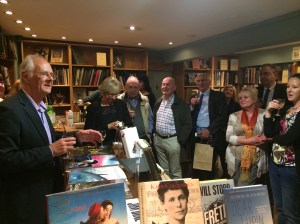
I did a talk to a local Ladies Group and sold a further sixteen copies of the book.
So what conclusions can I draw from this. I think I can say the following
1. Doing talks is the best way of selling books.
2.Two books for a ‘giveaway’ on Goodreads is not enough.
3. Some publicity is better than no publicity but only just.
4.Your own email list is a good source of readers.
5. Launch parties are good fun but can be expensive – I did feel like a writer when I was reading excerpts from my book in a bookshop.
I reduced the price for the Kindle version as I felt having looked at the top 100 books the price was too high but as yet the sales figures since are not available. t may be that it’s too late but it was worth trying.
My next publicity stunt is booksontheundergound.tumblre.com who are placing ten books on tube lines. These are books I have bought and I think having some books available as giveaways should be part of any sales campaign. I would be interested in any ones opinions on marketing, giveaways and pricing.

 scribblingadvocate